

![Redeye Bass complex. Clockwise from top left: Chattahoochie Bass, Tallapoosa Bass, Cahaba Bass, and Warrior Bass (photo credits: J. Vincent, R. Guevarra [East Alabama Fly Fishing], J. Vincent, and J. Waters).](/files/bass-fishing-img/bass-fishing-is-getting-complicated-1-400.jpg)
I grew up fishing for Smallmouth Bass in rivers and Largemouth Bass in local ponds and reservoirs. I am not sure at what age I learned that there were also Spotted Bass, but by high school, I was confident there were three species of bass.
Then I went off to college to study fish. I quickly learned that the black bass genus, Micropterus, which includes the aforementioned Largemouth, Smallmouth, and Spotted Bass, is not a true bass at all. Black bass are part of the sunfish family (Centrarchidae), along with Bluegill, Redear Sunfish, Crappie, and many others.
I also learned there were a few more black bass species I didn't know about. There was one called a Redeye Bass, which was different than the Rock Bass (also a sunfish) that I grew up calling "redeye". And then there was something called a Suwannee Bass, which could have the most unnatural turquoise coloration. Finally, I knew everything there was to know about the black bass.
That, of course, was before the advent and proliferation of sophisticated genetic techniques capable of telling similar-looking fish apart (yes, I am that old). Genetic testing moved slowly at first, but a recent 2022 paper turned the bass world on its head. All of us fish biologists have a lot of relearning to do.
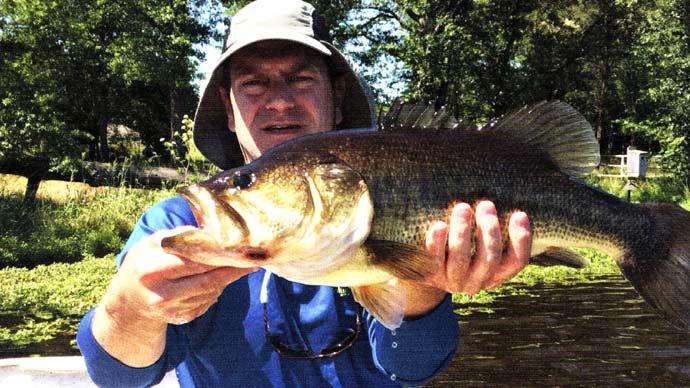
Let's start with the ubiquitous Largemouth Bass. You probably know Largemouth Bass as Micropterus salmoides. You may also know that there is a subspecies from Florida that grows bigger but may be harder to catch. You may have even stocked one of these or their hybrids in your pond paradise.
Well, recent research has concluded they are indeed separate species.
And it gets more complicated. It appears that the initial type specimen, or the fish that was first described and named M. salmoides, was, in fact, a Florida Bass. Thus, Florida Bass are now officially M. salmoides. Because of this change, Largemouth Bass needed a new scientific name. They are now M. nigricans, which was the oldest previous name for this species, originally applied to a type species from Lake Huron.
Aside from the other implications of this name change, this means I have 27 years of publications with the wrong scientific name!
Luckily, Smallmouth Bass are still Smallmouth Bass, right?
Right?
Well...
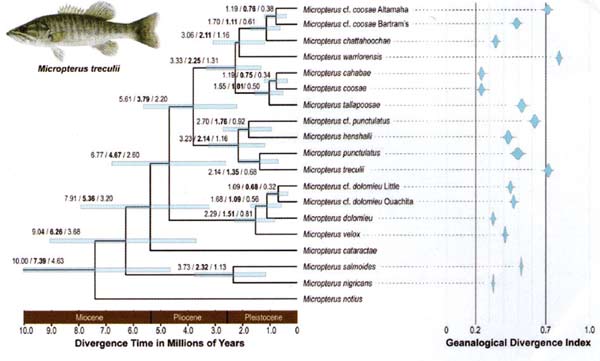
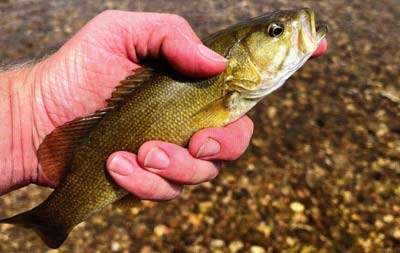
Smallmouth Bass from most of their native range are still M. dolomieu as you know them, unless you live in the Ozark or Ouachita Mountains. In those areas, it depends. There is at least one new species, with two more potentially new species that have not yet been officially recognized.
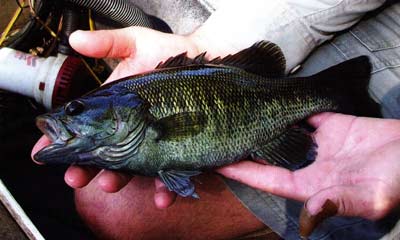
There is the Neosho Bass M. velox, which is strictly a small river species. It looks like a Smallmouth Bass, but is typically smaller and genetically distinct, and does not tolerate slow-moving water like Smallmouth Bass can. This characteristic led to an absence of this fish when reservoirs were built. Unfortunately, managers assumed the local "Smallmouth Bass" just didn't take to the lake, and, not realizing they had a unique species, stocked Smallmouth Bass from the Tennessee River Basin. These invaders quickly moved upriver and are competing with and hybridizing with Neosho Bass.
And there may be two more species that get split from Smallmouth Bass in the coming years. They are currently considered to be the Little River Bass M. cf. dolomieu Little and the Ouachita Bass M. cf. dolomieu Ouachita. These scientific names are placeholder names until they are formally described. These potential species are even more isolated in headwaters and have few populations remaining; they have also been impacted by Smallmouth Bass introductions, which compete with and hybridize with them.
The Spotted Bass complex is equally diverse. Fish from the Tennessee and Ohio River systems are still mostly Spotted Bass M. punctulatus, and these fish are rather small-bodied, with fish rarely exceeding four pounds. But there's also the Alabama Bass M. henshalli, which are naturally found in eastern Mississippi and much of Alabama. This is an aggressive species that gets substantially larger than Spotted Bass, with fish over eight pounds reported. This has led to them being moved around with extremely negative consequences for receiving fish communities.
Then, far away from similar species and isolated in the Edwards Plateau, is the Texas State fish, the Guadalupe Bass M. treculii. Although it can reach a maximum of about 3.5 pounds, most fish are about a pound or two. This relative of the Spotted Bass is found in clear headwater streams and was nearly wiped out by the introduction of Smallmouth Bass. However, an extended drought allowed biologists to remove Smallmouth Bass, and now Guadalupe Bass are doing much better.
There is one more currently undescribed species related to Spotted Bass. For the time being, it is called the Choctaw Bass M. cf. punctulatus. It is found in the upper panhandle of Florida. It is hard to distinguish from other related species, but its genetic profile is clearly distinct. Official species recognition should come soon.
Next is the Redeye Bass complex. There is still the Redeye Bass M. coosae, which was originally thought to inhabit the Mobile River basin east to the upper portions of the Apalachicola, Altamaha, Savannah, and Saluda River systems. But recent genetic research has identified many potential new species in these isolated river basins. Some people get upset and say they look the same, so they are the same. But genetics does not lie.
The Cahaba Bass M. cahabae is found only in the Cahaba River, a tributary of the Mobile River in central Alabama. They are small and prefer the flowing waters of small and medium rivers. The Chattahoochee Bass M. chattahoochae is a newly recognized species that was originally found throughout the upper Chattahoochee River basin from Columbus, Georgia, upstream. However, river impoundment, land-use changes, and the introduction of other Micropterus species have greatly impacted this species. They often have bright orange margins on their soft dorsal, anal, and caudal fins.
The Tallapoosa Bass M. tallapoosae is found only in, you guessed it, the Tallapoosa River in Alabama and Georgia. This is a beautiful fish with larger scales, dark coloration, and hues of blue that set it apart from other close relatives. And there is the Warrior Bass M. ivarriorertsis. Found only in the Black Warrior River in Alabama, this species prefers headwaters with cover.
Two additional potential species related to Redeye Bass are still being described. These are the Altamaha Bass M. cf. coosae from the Altamaha River, and the Bartram's Bass M. cf. coosae, found only in the upper Savannah River basin. Official designation of these two species should occur soon. None of the aforementioned species in the Redeye Bass complex commonly exceeds two pounds.
The final two species are not as closely related to other species. The Shoal Bass M. cataractae is native to Florida, Georgia, and far eastern Alabama. Unlike the other uncommon species of black bass, Shoal Bass like larger rivers and get much larger. Fish over 4 pounds are common, and fish exceeding 8 pounds have been caught.
Finally, we have the Suwannee Bass M. nodus. This species can be found in the Ichetucknee, Santa Fe, St. Marks, Suwannee, Wacissa, and Wakulla Rivers in Florida and the Alapaha, Ochlockonee, and Withlacoochee Rivers in Florida/Georgia. Although Suwannee Bass are relatively small, they make up for it with their coloration. Mature males sport dark black diamonds on the sides and a deep, subtle turquoise color on the cheeks and abdomen. A fish exceeding 1.5 pounds is considered a big fish.
If you haven't been counting, that's 14 confirmed species and another 5 potential species likely to be confirmed in the next few years. So, black bass diversity is a bit more complex than the three species I knew as a young angler. If you are on a mission to catch them all, you had better get busy.
Dr. Wes Neal, Extension Professor at Mississippi State, serves as the State Extension Fisheries Specialist and is passionate about educating the public on small-lake and pond management. He is an avid researcher on topics from farm pond management to sport fish genetics. Wes is the lead editor of Small Impoundment Management in North America, the only textbook on the subject. He loves to hunt and fish, wes.neal@msstate.edu.
Reprinted with permission from Pond Boss Magazine