

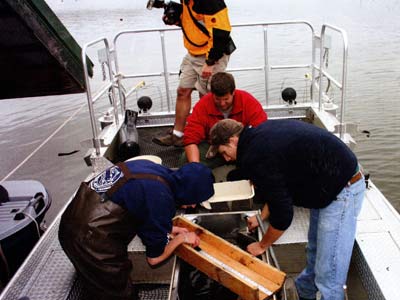
I'll always remember a project way back in 2004. I was hired to help develop a fishing program at a private preserve in upstate New York between Rochester and Syracuse. This Texan had never dived into the finer aspects of northern waters.
Being a bit apprehensive, not truly knowing about northern species such as walleye, Smallmouth bass, yellow perch, and northern pike, I might have been a little bit intimidated...at first. But a few times around a lake in an electrofishing boat quickly proved that fisheries management is still based on a handful of principles: water, habitat, food chain, genetics, and a harvest plan.
Yes, there were nuances, pretty much based on latitude.
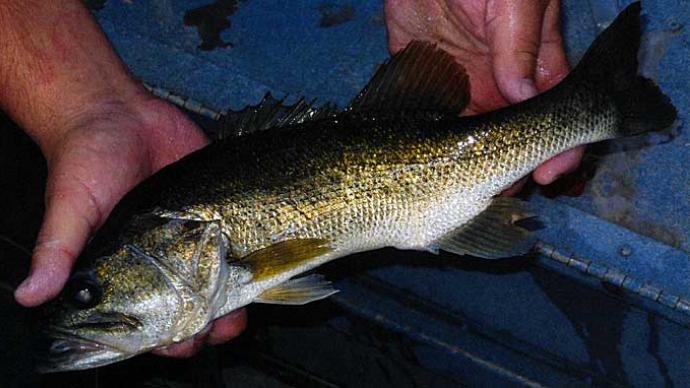
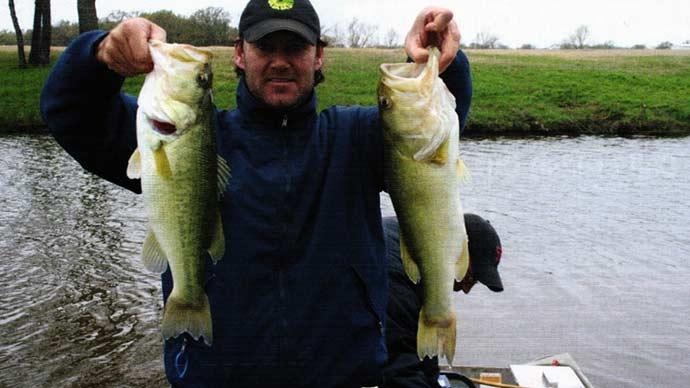
I'll never forget the first round of electrofishing in the main 90-acre lake. Most of the Largemouth bass were cookie-cutter, carbon copies of each other, with a handful of exceptions. Most of those bass were 10-14 inches long, with a very few bigger ones. The biggest? Six pounds, seven ounces. The mission? Get Largemouth bass beyond eight pounds. Sounded easy, but it was certainly a challenge.
One of those early trips in that wildlife preserve's brand-new Smith-Root electrofishing boat was confirming what I'd seen over two dozen years of fisheries management in the south.
Overcrowded bass, with not much to eat. Typical.
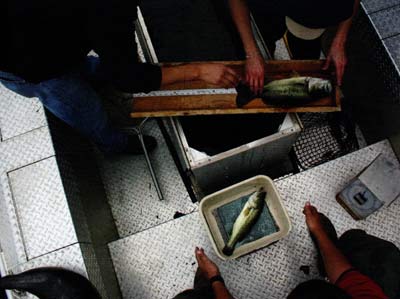
Here's a funny twist. Dave Beasley, a student biologist at the time and now a nationally known fisheries expert, was in training. I was piloting the boat, watching the guys at the bow net fish and flip them into the spacious live well. One bass caught my attention. It actually had a gut. The others didn't. When we stopped to weigh and measure those fish, and that bass was ready to be processed, I asked the guys to pass it to me.
I'd seen the little fat belly. Beasley handed the fish over, and I looked down its gullet. I saw feathers. Two little black feathers were sticking out of that bass's throat. I reached down, grabbed those feathers between my forefinger and thumb, and pulled. Out slid a little barn swallow, who met its demise with perfect timing as that bass did what bass do.
I raised that bass in my right hand, slimy bird in my left, and showed it to the young guys manning the measuring board and scales. Beasley had a puzzled look. He said, "I didn't know bass could fly!" I busted out laughing and, to this day, still pick on him about that comment.
We all got a good chuckle out of that.
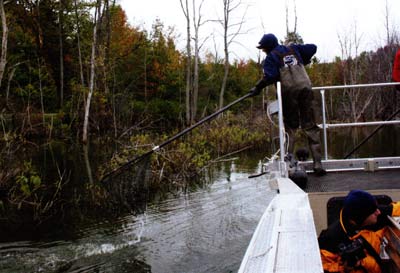
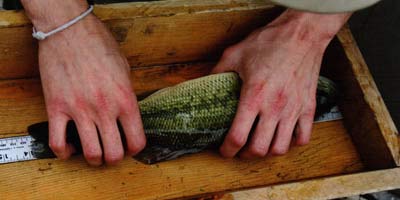
Those bass were seriously overcrowded. We figured out that most of those 10-14-inch bass were at least six years old. Their growth potential was limited, to say the least. But keep in mind, bass at that latitude can live to be close to twenty years old.
Overcrowding of largemouth bass is one of the most common fisheries problems in northern ponds, leading to stunted growth, skinny fish, and unbalanced ecosystems.
In northern ponds, as in this case, Largemouth bass often become too abundant relative to the available food supply. Studies show that up to 90% of ponds surveyed by fisheries biologists suffer from bass overpopulation. When bass numbers are high, they consume most of the small forage fish—especially bluegill—leaving little prey for the population as a whole. As a result, bass grow slowly, remain lean, and few reach trophy size.
Overcrowding is especially common in ponds with minimal fishing pressure. Many pond owners worry about overharvesting, but in reality, the opposite occurs: too few bass are removed, and the population balloons.
Biologists use electrofishing surveys to measure bass density and health. Over-crowded ponds often show:
- High catch rates (100-300 bass per hour of electrofishing) indicate excessive density.
- Poor relative weights—bass appear long and thin rather than plump and healthy.
- Unbalanced prey populations, with too few small bluegills to support bass growth.
As we think about it, bluegills have earned a bad reputation in northern ponds. While this species is the backbone of the food chain in the south, they are at a distinct disadvantage in the north. Think of it this way...in northern ponds, bluegills don't typically spawn until June or July. That means they've got a fundamental growing season of 70-80 days. When you process that information, it's easy to understand that they hatch and grow really fast, or they'll be eradicated. In northern ponds, bluegill spawn once, and if they are fed well, they may spawn a second time. In southern waters, it's common for bluegills to spawn up to five times a year, providing abundant food for bass.
Therein lies the rub. See the consequences? Overcrowded Largemouth bass populations disrupt the natural balance of pond ecosystems. Without enough forage fish, bass expend more energy chasing prey, leading to malnourishment. Meanwhile, bluegill populations skew toward larger individuals, since young fish are heavily preyed upon. This imbalance reduces biodiversity and limits the quality of recreational fishing.
What are the management practices in northern waters?
To restore balance, pond managers recommend:
- Selective harvest: Actively removing smaller bass to reduce competition, based on relative weight.
- Stocking forage fish: Adding bluegill or other prey species to rebuild or supplement the food base.
- Habitat improvements: Installing artificial structures to provide cover for forage fish and ambush points for bass.
- Regular monitoring: Using electrofishing or angler catch records to track population health.
For northern pond owners, bass overcrowding is not a sign of success but of imbalance. Healthy fisheries require active management—removing excess bass, supporting forage populations, and maintaining habitat diversity. With these steps, ponds can sustain robust bass growth, balanced ecosystems, and rewarding fishing experiences.
Reprinted with permission from Pond Boss Magazine