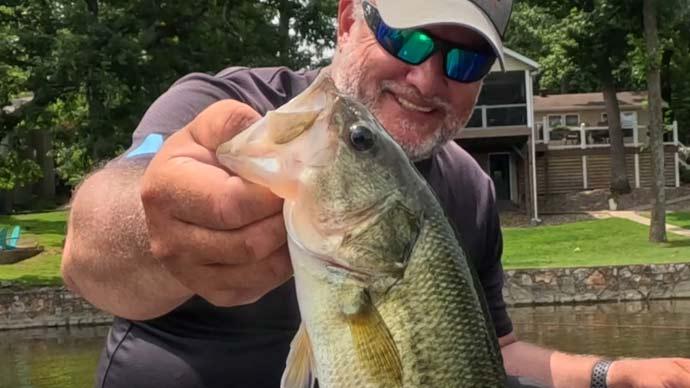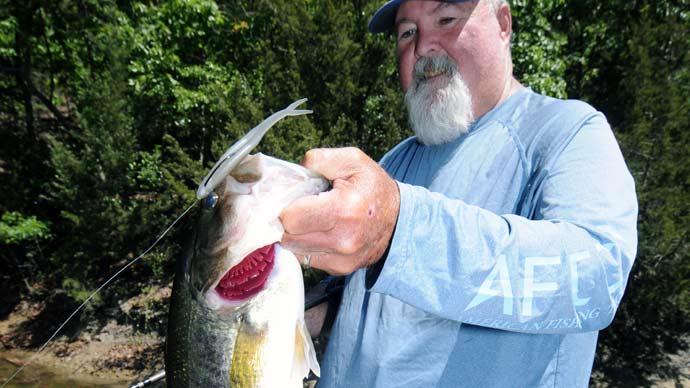


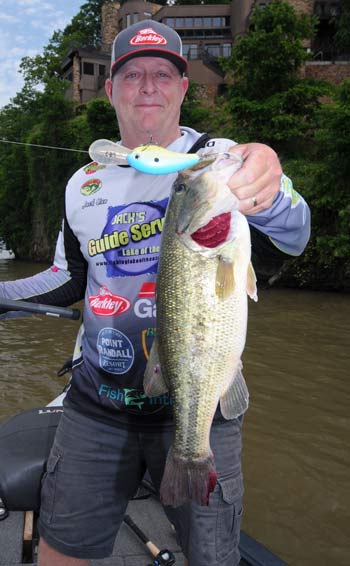
Postspawn bass famished by the rigors of spawning will eat just about any lure thrown in front of them.
Spawning bass will also attack most any lure thrown close to their nests, but the most productive lures for the two stages of the spawn seem to change. “The lure categories are changing (from spawn to postspawn), says Missouri guide and regional tournament angler Jack Uxa. “I can’t really say I am narrowing down (his lure options); I am just changing what players I’ve got on the deck.”
Uxa notices that the postspawn for bass on his home waters, Lake of the Ozarks, occurs in three stages: early, middle, and late. During the early stage, bass either guard fry around the spawning banks or transition to a secondary point or the first ledge of a bluff in the 4- to 8-foot range. Bass in the middle stage move out to the drop-offs of points and deeper ledges, while late stage postspawn bass start setting up near their deep summertime haunts.
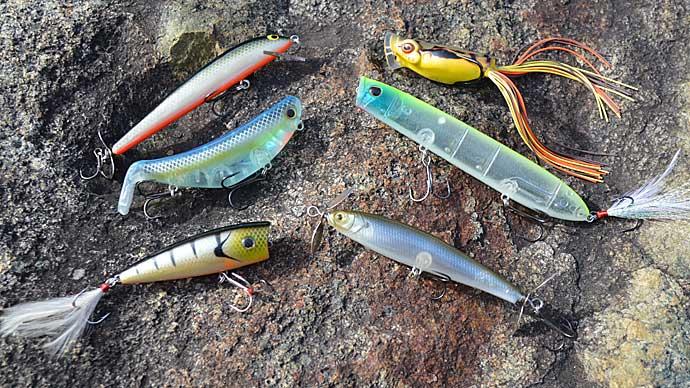
Here are the five lures Uxa selects for catching bass on the lakes in the Ozarks region during the three postspawn stages.
Topwater Walker
Early in the morning, Uxa tempts aggressive bass guarding fry with a walking topwater lure. Quality bass looking for an easy meal attack the topwater lure because it looks like a wounded baitfish. “It will catch big fish for sure,” Uxa says.
Postspawn stage: Early.
Lure: Berkley Cane Walker. Uxa prefers the Cane Walker because it walks better and creates more splash while staying in the strike zone longer than other walking topwater lures.
Colors: Silver and bone.
Structure and cover: Shallow brush and rocks on steep banks slightly inside coves or on the main channel.
Depth: Less than 10 feet.
Best weather conditions: Cloudy, misty, and enough wind to create a small chop on the water.
Best water conditions: Stained.
Presentation: Standard walk-the-dog retrieve steadily walking the lure out to a depth of 10 feet.
Tackle: 7-foot medium-heavy casting rod and 7.0:1 gear ratio baitcast reel filled with 20-pound Berkley Big Game monofilament line.
Shaky Head Worms
If bass ignore his topwater offering, Uxa switches to finesse fishing with a shaky head worm, but opts for a larger, thicker worm than the usual 4- or 6-inch finesse worm. The shaky head triggers bites from postspawn bass of all sizes.
Postspawn stage: Early.
Lures: 7-inch Berkley PowerBait MaxScent worm on 1/8-ounce shaky jighead or 7- or 8-inch straight tail worm on a 3/8-ounce E-Factor shaky jighead.
Colors: Purple and green pumpkin.
Structure and cover: Rock piles and brush piles on secondary points or main channel ledges on a bluff.
Depth: 4 to 8 feet deep.
Best weather: Sunny and calm
Water conditions: Clear or stained with current from power generation.
Presentation: "I will stroke it a fair amount," Uxa says. "I will shake the line a lot, and occasionally I will stroke it, which means to pull it up 3 or 4 feet off the bottom and let it fall back down, and then just shake it on the bottom for a while.”
Tackle: 7-foot medium-heavy spinning rod with a 30-size spinning reel filled with a main line of 15-pound braid and 12-pound fluorocarbon leader for the lighter shaky head, and a 7’3” medium-heavy casting rod and 7.0:1 baitcast reel with 17-pound test fluorocarbon.
Deep-Diving Crankbaits
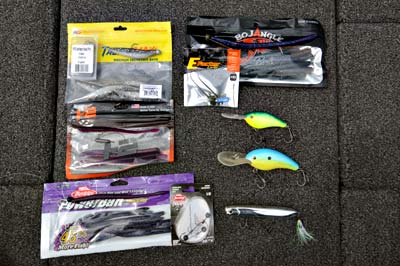
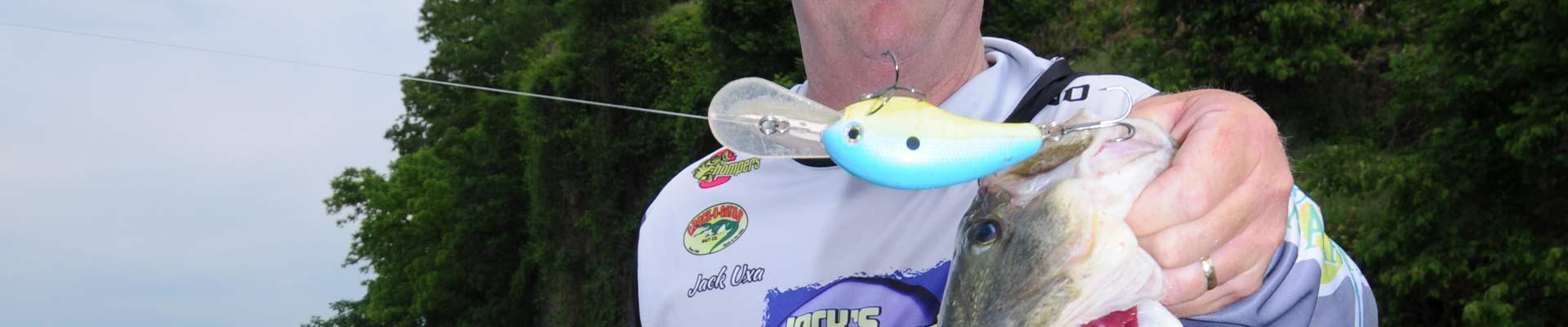
When bass move to main-lake points and other main-channel drop-offs, Uxa uses his electronics to find small schools of bass. He opts for a deep-diving crankbait that he can race through the school to trigger reaction strikes. The magnum-sized bait usually draws strikes from the largest bass (4- and 5-pounders) in the congregation.
Postspawn stage: Middle.
Lures: Strike King 6XD, 8XD, and 10XD crankbaits.
Colors: Blue-and-chartreuse and black-and-chartreuse
Structure and cover: Main channel drop-offs.
Depths: 15 to 25 feet deep.
Best weather: Sunny, with a slight north wind creating a chop on the water.
Water conditions: Slightly stained with current from power generation.
Presentation: He makes a long cast and reels the lure as fast as he can to crash it through the schooling bass.
Tackle: 7-11 medium-heavy Lew’s Super Duty Speed Stick casting rod and Lew’s Super Duty 7.2:1 baitcast reel with 12-pound Berkley GinClear fluorocarbon.
Jighead Minnow
“The jighead minnow is a bait I will have on my deck quite a bit of the time for just picking off bass that didn’t bite my crankbait or fish that I am seeing floating around,” Uxa says. The lure produces best for postspawn bass suspended over deep water. Uxa claims the jighead minnow is more of a numbers lure than a big bass bait.
Postspawn stage: Late.
Lures: 4- and 5 1/2-inch plastic minnows on 3/16-ounce TackleMax tungsten jigheads.
Colors: Grays and silvers.
Structure and cover: Brush or rocks along main channel drop-offs.
Depths: 15 to 20 feet.
Weather: Sunny, cloudy, calm, or breezy.
Water: Lightly stained or clear.
Presentation: Uxa keeps his boat a safe distance from the bass he sees on his forward-facing sonar (FFS) and pitches the lure to the fish. He frequently shakes the lure as it falls through the suspending bass.
Tackle: 7-foot medium spinning rod and 30-size spinning reel with a main line of 15-pound braid and a 12-pound fluorocarbon leader.
Drop Shot Finesse Worm
When Uxa has thrown other lures for deep postspawn bass without success, or when he encounters pressured bass, he resorts to his "mop-up bait": the drop-shot rig with a straight-tail finesse worm. “You can catch an occasional 3-pounder with it, but you are going to catch a lot of limit fillers mostly," Uxa says.
Postspawn stage: Late.
Lures: 6-inch straight tail finesse worm on a 1/0 Berkley Fusion hook with a 1/4-ounce cylinder weight
Colors: Missile morning.
Structure and cover: Main lake points with current.
Depths: 15 to 25 feet deep
Presentation: Uxa relies on FFS to make a short pitch to bass he sees on the bottom. After letting the rig hit the bottom, Uxa makes a vertical presentation to the bottom-hugging bass with subtle shakes of the worm. "I will shake it for a little bit, and then I will just hold it with a fairly tight line,” he says.
Weather: Light wind and sunny.
Water conditions: Fairly clear.
Tackle: 7-foot medium spinning rod and 30-size spinning reel with a main line of 15-pound braid and a 10-pound fluorocarbon leader.