


Bass start moving to their summertime homes after a brief respite from the rigors of spawning.
Whether he fishes rocky highland reservoirs with clear water or mud bottom lowland reservoirs with off-colored water, Missouri guide, and tournament competitor, Jeff Hoots has a good hunch as to where bass start moving to after the spawn. “The bass always tend to spawn on flatter banks towards the back (of coves and creeks), and when they get done, they kind of hang out somewhat close back there a little bit and kind of rest up,” Hoots says. “Then they start to migrate out to maybe that first channel swing where they get a little deeper water (10 to 12 feet deep), and then they will hang out there under docks or around some brush. As the postspawn continues, they will work their way out to deeper water.”
Hoots notices some postspawn bass move all the way out to the main channel while others spend their summers halfway out of the cove or creek about 20 to 25 feet deep. There are also bass that remain around cover 1 to 2 feet deep in the backs of creeks all summer long provided the baitfish are in the area and the resident bass have enough shade and oxygen-enriched water.
The guide believes the key to targeting postspawn bass in transition is to find their forage. “Bass are hungry after spawning and expending all that energy, so they are going to want to feed on shad, crawfish, and stuff like that,” Hoots says. “So wherever there is an abundance of bait for them, that is where the bass are going to spend their summer."
Transition Hideouts
On rocky highland reservoirs with plenty of docks, such as his home waters of Lake of the Ozarks, Hoots keys on the floating boathouses for transitioning bass. “The bass have good ambush points there for the shad that come by the docks, “ he says. On undeveloped lowland lakes such as Missouri’s Truman and Mark Twain reservoirs, Hoots finds transitioning bass around standing timber or laydowns in the coves and creeks.

Checking a good topo map showing tight contour lines reveals to Hoots the location of the first channel swing near a spawning bank. “There could be a little jetty point that you can’t see with the naked eye along the bank, but you can see it with the topo map and your electronics," Hoots says. "The little point that extends out into an area right by that deep water channel swing with some timber or big rocks on it will be a key spot to fish.”
The next move for transitioning bass is to long stretches of bank in the middle of the creeks or coves. When bass are in that transition period, Hoots has to look for a sweet spot along the banks where there are rows of docks or standing timber. “That seems to be the toughest time of the year sometimes,” Hoots says. “When they get in that in-between zone, those bass are tougher to catch because they are way up underneath a dock or timber row where they are 15 to 20 feet deep along the long stretch of bank. It is hard to cover that much water and get on them.”
During this time, Hoots relies heavily on his Garmin LiveScope forward-facing sonar. “It helps you eliminate a lot of dead water,” he says. “You can look with the LiveScope under docks or into the standing timber or on rock piles, but just because you see bass doesn’t mean you are going to catch them.”
The final destination for some postspawn bass is the main lake structure. Hoots favors fishing long, shallow points that eventually drop off into the old river channel.
Transition Lures
Postspawn bass on the move often requires the use of a moving bait to track down the fish.
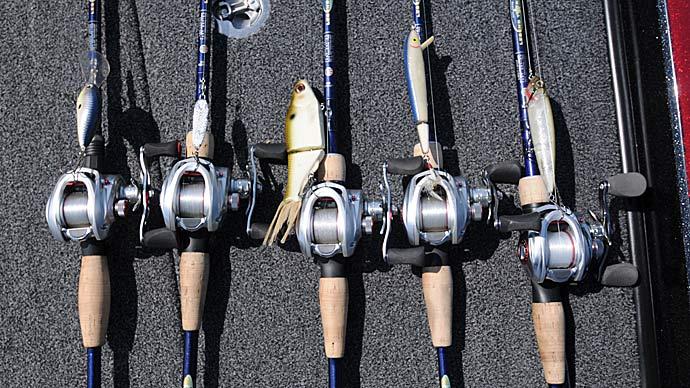
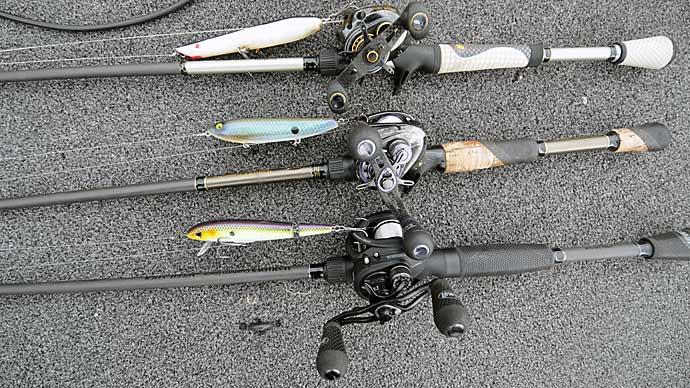
“I love to start with a searching bait in the morning like a (Berkley) Choppo or some sort of topwater bait and keep moving,” Hoots says. “I will start on the main lake point, and most of the time, the bass will be up shallow within a few feet of the bank. If I don't catch them on the point, I will move 50 to 100 yards down off the point and see if I can get hit in the timber or along dock corners. Once I locate them and get some good bites like that, I might slow down and throw a 10-inch worm or a shaky head." A crankbait or football jig are also good options for Hoots when he wants to find postspawn bass on the long, shallow main lake points.
Hoots favors jigs, shaky head worms, or Texas-rigged 10-inch plastic worms for postspawn bass that have stopped along the first channel swing in the back of a creek. He works the lures in depths ranging from less than 1 foot to 20 feet deep.
Transitioning bass on lowland reservoirs with standing timber and dirty water tend to hold in shallower water than bass on the clear highland lakes. Hoots tracks down these transitioning bass with square-bill crankbaits, spinnerbaits, and buzzbaits that he retrieves at high speed through the standing timber or along laydowns.
When postspawn bass start moving to their hot-weather haunts on your home waters, applying Hoots’ tips will help you catch more bass transitioning from spring to summer spots.