

After enduring the rigors of spawning, bass are ready to chow down to regain energy.
Former Bassmaster Elite Series pro Brian Snowden knows when postspawn bass are on the feed, he needs to imitate the bass' forage. Favorite meals for bass on Snowden’s home waters of Table Rock Lake are gizzard and threadfin shad.
"After the bass spawn, the shad are going to spawn, so a good technique is to try and find the shad spawn, and some of the things I like to use then are moving baits,” Snowden says.
Here is a look at the five shad imitators Snowden selects to catch postspawn bass.
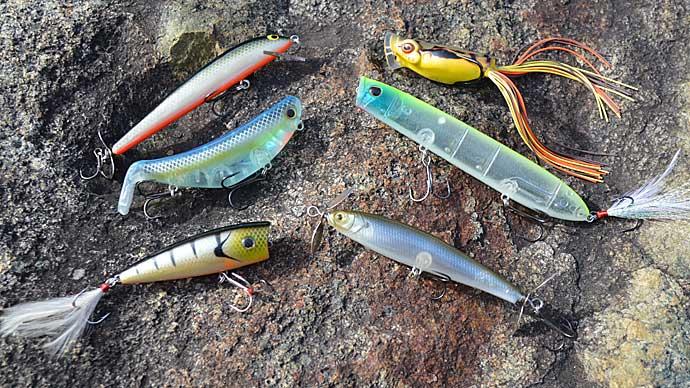
Topwater Walkers
The seven-time Bassmaster Classic qualifier notes the topwater walkers shine whenever postspawn bass suspend around docks or standing timber.
“The good thing about the walking-style bait is that it has a lot of motion on the surface, and a lot of them have rattles as well, so when you are fishing the ends of deeper docks, it really draws the bass' attention, and moves them, up towards you,” Snowden says.
Favorite sizes: 4 1/4 or 4 1/2 inches.
Colors: Bone for off-colored water or flitter shad or transparent hues for clear water.
Best Conditions: Stained to clear water with some wind. Cloudy skies extend the shad span and keep bass hitting topwaters throughout the day.
Retrieve: The standard steady walk-the-dog retrieve.
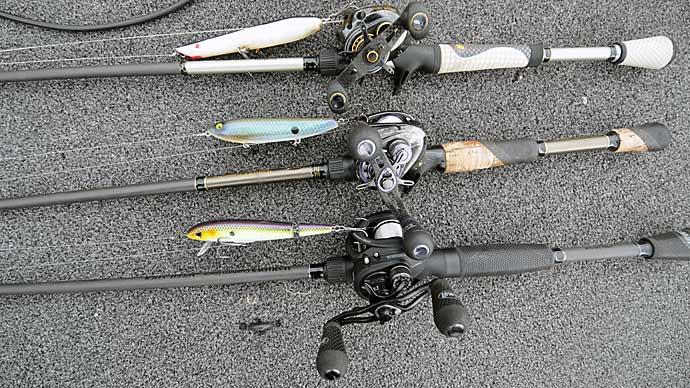
Tackle: 7-foot or 7-02 medium heavy action casting rod and 6.8:1 gear ratio baitcast reel with 30-pound braid or 14- to 17-pound monofilament.
Topwater Wake Bait
Snowden suggests the wake bait is a more subtle shad imitator than the topwater walker for presenting to suspended bass when the water surface is slick.
Sizes: 4 1/2 inches.
Colors: Bone.
Conditions: Clear water on calm days with sunshine or clouds.
Retrieve: Keeping his rod at the 1 or 2 o’clock position, Snowden reels steadily with a bit of slack in his line so the lure maintains a "v" as it wobbles across the surface. He cautions that reeling the lure too fast will cause it to dive too much.
Tackle: The rod and reel are the same as the topwater walker and 14-pound test monofilament.
Glide Bait
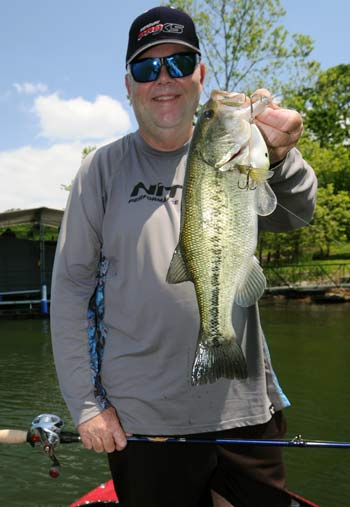
“The glide bait is effective for postspawn fish because it is a larger profile bait that draws a lot of attention from the bass and also draws a lot of larger bass than the average size fish that you are going to catch on the topwater lures or spoons,” Snowden says.
"The good thing about the glide bait is that it allows you to cover a relatively large amount of water quickly." The Missouri Pro usually uses the glide bait for bass suspending along points with ledges or standing timber, bluff ends, or sheer bluff walls.
Sizes: 6 and 7 inches for most waters, but he opts for a 9-inch lure for lakes that traditionally produce bigger bass.
Colors: “You just want something that really resembles a shad," Snowden says. “You don’t need to have a ton of colors because you are basically mimicking a shad. He suggests that a combination of white and black hues works best, but the guide will also select chrome and black for added flash in off-colored water.
Conditions: Stained to clear water with sunshine and a bit of wind. "I think bass need to be able to see the bait a little bit, and the sun really helps that," Snowden says.
Retrieve: Snowden either steadily winds in the lure to make it move from side to side, or he makes it glide 8 to 12 inches. He makes the lure glide with a half turn of the reel, then pausing a second to let it glide to one side. Making another half turn of the reel and pausing it causes the lure to glide to the other side. “So, each time you pause it, it switches directions,” Snowden says.
Tackle: 7-04 heavy action casting rod for 6- and 7-inch baits or 7-06 or 8-foot rod for larger baits with 6.8:1 baitcast reel and 20-pound fluorocarbon line.
Spoon
Snowden opts for either a flutter or slab spoon to throw around docks or into dock wells to probe deeper water. "It allows you to get that bait down 12 to 25 feet, and it just kind of flutters down like a dying baitfish," he says. The flutter spoon falls slower, so Snowden uses it for bass hanging less than 20 feet deep and switches to the faster-falling slab spoon for bass deeper than 20 feet.
Sizes: 1/2 and 3/4 ounces for both spoons.
Colors: White or nickel.
Conditions: Clear water (2 to 4 feet of visibility) with calm, sunny weather.
Retrieve: "Basically, you want both spoons to fall to the desired depth,” Snowden says. “Usually, you can count it down because it falls about a foot and a half per second. Then you will start a pumping motion (lifting the rod about 1 to 2 feet), letting it fall in between pumps, so it goes back down just a little bit.” He lets the lure fall on a semi-taut line and avoids having the line lie slack on the surface.
Tackle: 7-04 medium heavy casting rod and 6.8:1 baitcast rod with 14- to 17-pound fluorocarbon.
Deep-Diving Crankbait
“When postspawn bass first start moving out, they move out in stages and sit in about 12 to 18 feet,” Snowden says. “When they are in that range, it is a perfect depth for a deep-diving crankbait.” He suggests the crankbait is good for covering water along points or other structures with sunken brush piles or standing timber.
Sizes: 3 inches.
Colors: White with black back for clear water and white with blue back and a tint of chartreuse for stained to clear water. Blue and chartreuse or black and chartreuse for stained water (less than 2 feet of visibility}.
Conditions: Partly cloudy with some wind. “As long as you have a 10 to 12 mile per hour wind where it is rippling the surface seems to work really well for the crankbait," Snowden says—stained water with less than 2 feet of visibility.
Retrieves: “I will retrieve it really fast and steady, or I will use a stop-and-go with a fairly quick retrieve,” Snowden says. “Many times, if the crankbait hits something or bounces off the bottom, I will pause it for just a second, and then I will reel it really quick again. That off-and-on, start-and-stop seems to help trigger some bites, like when I hit a brush pile limb or a big rock. "
Tackle: St. Croix 7-10 moderate crankbait rod and Bass Pro Shops Johnny Morris Signature Series 6.8:1 gear ratio baitcast reel with 12- or 14-pound fluorocarbon.