

A question posed by long-time Pond Boss subscriber and "Ask the Boss" forum member, Tim Kennedy from Georgetown, Texas, prompted a lively discussion on the forum. He simply asked, "Should I harvest some of my biggest bluegills?"
The flurry of answers was not only noteworthy from a fisheries management perspective, but some of them carried a hint of passion. "Never harvest the biggest ones! They defend the nests and are the best of the best," one member wrote. "It's okay to harvest a few big ones. They are probably at the end of their lives," wrote another.
Both of those are good pieces of advice.
Another one quoted the man most of us consider the father of pond management, Dr. H.S. Swingle, from Auburn University in Alabama. Dr. Swingle pioneered research on farm pond management to learn and then teach people how to use small ponds to sustainably raise fish for protein for families during the Depression, as well as following its end and through World War II.
Dr. Swingle founded the now world-famous fisheries department at Auburn and served as a professor there from the 1930s until the 1960s.
The fisheries building on campus is named after him.
His work from the past influences today's professional pond managers. The most significant difference between now and then is that pond owners are not as interested in feeding their families as much as they are in having a fun fishing hole. Most of them want to catch a fish or a lot of fish, admire them, and then toss them back into the water — not necessarily into the grease.
As that forum thread wound its way, it occurred to me that we all need to revisit the four primary scenarios that Dr. Swingle figured out all those years ago. As fisheries evolve, each develops in its own way, with those four main concepts unfolding as the pond presents its opportunities.
Those fundamentals are relevant today. A tip to start: The fishery is mainly a consequence of what the pond offers.
Here are Dr. Swingle's conclusions after decades of working on ponds, raising fish, draining ponds, collecting data, evaluating, and coming up with replicable conclusions of what he found.
• Bass/bluegill ponds evolve either into:
• Bass-crowded situations,
• Bluegill-crowded populations,
• Some transition into one of those three main ones.
By far, what we see today are bass-crowded lakes. That makes complete sense because bass are top-end predators, especially in warmwater ponds and lakes. With a big mouth and aggressive attitude, Largemouth bass are kings of southern waterways. Bluegills are the backbone of their food chain, and with minimal harvest of bass by all our catch-and-release aficionados, it makes total sense that bass will overeat their food chain.
And...drum roll, please...they do.
That second one? Rarely do we see overcrowded bluegills in southern ponds. But it's a thing north of the Mason-Dixon Line. With good reason, too. In southern waters, bluegill have a range from 200-300 "perfect" growing days to do what they do. But in most northern waters, bluegill have 75-100 days to spawn and grow to survivorhood. In that world, bluegills only spawn once per year, maybe twice if well-fed. In southern ponds, bluegill reproduce 4-5 times yearly.
When they only spawn once, that singular-year class has to grow fast...faster than bass can consume them. They quickly outgrow the dominant size class of bass's mouths, leading to crowding.
What about "balance"?
In class, in seminars, and theory, balance is what we seek. We need just enough rabbits to satiate the coyotes. Likewise, we need just enough bluegills to fill the tummies of hungry bass or other predators. In reality, it doesn't work that way.
When we have enough rabbits, the survival rate of coyote pups increases. When that happens, we need more bunnies. But rabbits, being the reproductive wizards they are, can't keep up with the demand. Rabbit numbers plummet, and coyotes have to forage for grasshoppers and whatever else they can scrounge; as a result, their numbers begin to drop.
The same thing happens in your pond with bass and bluegills.
Picture your grandkids on a teeter-totter. As long as that one on the end jumps, the other gets to touch the ground. Rarely does that see-saw stay in the middle.
Balance is the see-saw sitting squarely in the middle.
Same with your pond.
The predators are doing all they can to lead to the extinction of their entire food chain. It's up to you, your pond, its "happy water," its habitat, and all those key pieces of your pond management puzzle to keep that inevitability at bay for some period of time.
Balance is what, just for reference? It has all size classes of all species of fish, and they are all in good shape, healthy, and even chunky.
What about that fourth scenario?
That is a "transition" state.
It's what happens to a fishery that dramatically takes it out of any of the other three. A drought, a flood, a fish kill...a number of opportunities can arise to put a fishery into its transition.
Another way to look at all four of these things is to remember an axiom that holds true in nature. Nature abhors a void and doesn't appreciate a bounty. What that means to us is when we have a fish kill, if it's not a total kill, the remaining fish do what they do to fill the void left behind by the death of their brethren...after the water calms down to allow it. If your pond can support X-number of pounds of bluegills, for example, and after the fish kill you have X-100 lbs., then the remaining bluegills put on their spawning caps and get to work to fill the space.
That's what nature does.
Conversely, nature doesn't allow a bounty for very long. Just try to grow a whole lot more fish than your pond can support and see what happens. If your water chemistry doesn't balk, then predators make their way to your place to help themselves. Or, the fish top out at some maximum carrying capacity and stop growing until whatever link in their world-chain breaks and the fishery collapses.

Remember this: each one of those scenarios is manageable. If bass are crowded, harvest some and make sure you have enough adult bluegills to reproduce and rebuild the food chain.
Diversify the food chain where it makes sense.
If bluegills are overcrowded, figure out
the size class that makes up the majority and either harvest or stock enough predator fish to assist with harvest. If your pond is somewhere in the realm of "balance," harvest the key size classes to maintain...or try to maintain...that harvest.
Seeing a keyword in this article? Harvest, maybe?
A significant part of the fun of fisheries management is studying your fishery and then determining which fish to harvest and when.
If I've said or written this once, I've said or written it 4.2 gazillion times...your pond is like a garden. When it gets ripe, harvest it.
You get to define "ripe".
Should Tim Kennedy harvest some of his bluegills?
It depends.
Are you laughing or rolling your eyes at that comment?
It depends on his goals and the status of his fishery at this point.
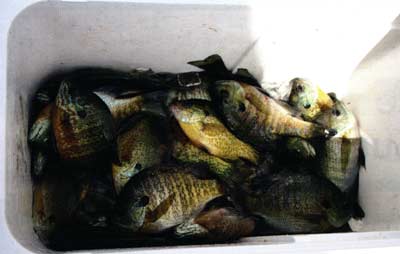
If he wants to harvest 40 or 50 big bluegills from his mature fishery and he's not leaning toward bass crowded, by all means, harvest some bluegills.
Should he release those bluegills? After he heads, guts, and scrapes the scales off with a spoon and dips them in cornmeal.
Release them to the peanut oil.
Or, heck, put them back in the pond to reproduce and feed his big bass one more time.
Reprinted with permission from Pond Boss Magazine