

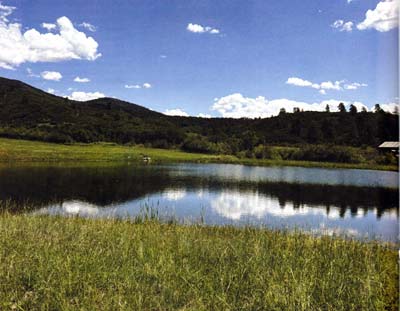
Pond management in the high mountain regions of Colorado isn't anything like the rest of the country. Fish are typically an afterthought. Beauty rarely has anything to do with building a pond, since most are surrounded by awe-inspiring views.
Water is a commodity in the Rocky Mountain state, and some landowners go to great lengths and expense to capture and hold onto their fair share.
Heavy on the term "fair share." Water rights in Colorado are appropriated and tightly regulated for use. Landowners who own water rights are strictly governed by water courts and agents who come onto the property using a staff gauge on what's called a Parshall Flume to measure flow rate accurately and, therefore, project the volume the landowner can retain in ponds or for direct irrigation.
Water rights are dictated by "senior" water rights holders on that particular stream or tributary. What that means is someone downstream of you may hold senior water rights, meaning you must allow water to flow through your property toward theirs, until their rights are filled.
Last August, Mike Otto and I took a fairly spontaneous road trip and decided to go where it's much cooler than Texas in summer. We picked Colorado, starting in Pagosa Springs. We have a mutual friend there. We rented a VRBO for a couple of days and got in touch with a long-time earthmover, Mike McDonald.
McDonald took a whole day off to show us around the area and tour projects he's accomplished over the years. His projects are quite different than the ponds and lakes Otto and I see across the rest of the nation.
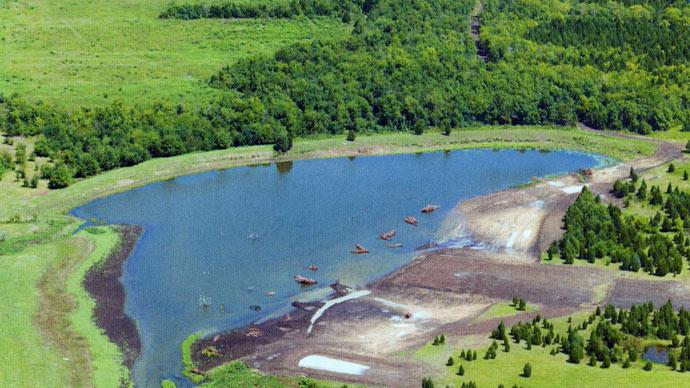
We toured one ranch where McDonald had built several ponds. Each one was for water storage, except for a small one in a valley designed as an elk wallow. This landowner views his ranch as a preserve, and providing elk with a refuge as they travel is part of his wildlife management strategy.
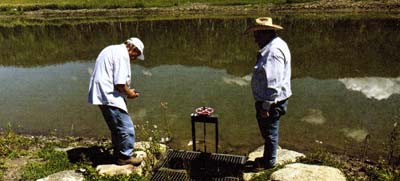
Judging by the tracks and muddiness of the water, it works quite well.
McDonald explained the nature of water flow, water rights, impoundments, and ponds around his area of the state. "Almost all of our stream water comes from snow melt. Over the last decades, snow is melting faster and faster each year, so some ranchers are building ponds to capture their allotment." He told us the pond design has been a little tricky. Most of the soils there are porous, so he builds many ponds with rubber liners. Landowners want those ponds to look natural, which means plenty of dirt on top of those liners, which are heavily anchored around the edges to keep them from moving. Plus, no one wants to fix a hole in a liner from a giant elk's hoof.
Not only are these ponds lined, they have water movement structures, typically valves or devices like an Agri-Drain. Underground piping allows water to flow to downstream ponds or to be managed for irrigating hay pastures or wildlife food plots.
It isn't cheap, either. Landowners tolerate that because of the value of their water. Rain is scarce, and since snowmelt is the deal, landowners have to be creative to deal with what they've been dealt.
In fairness, there are recreational ponds and lakes all over Colorado. Most of those take advantage of ample water flow in their locale. Building new ponds and lakes isn't easy for a variety of reasons, not the least of which is permitting. Colorado is picky about where ponds can be built, and recreation as a primary use isn't on their radar.
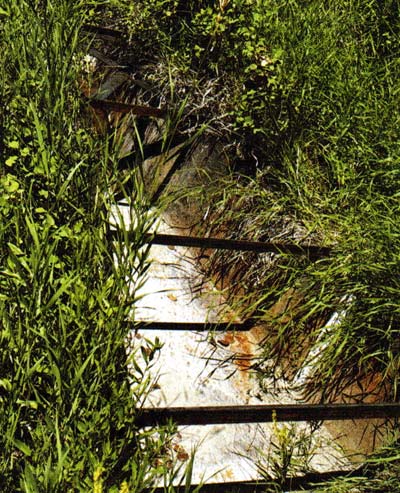
Ponds are often built in the spirit of conservation, and if they can be used recreationally, that's value-added.
Permits are hard to get and restrictive, and usage is heavily enforced.
Around Pagosa Springs, Mike McDonald cited several cases in which landowners with water rights must yield their water to senior rights holders downstream. Even though this landowner collected water within his rights, he has to open the valve and send some of his water downstream to fill the rights of that senior holder and hope for more from junior right holders upstream.
While it seems complicated and not easy to enforce, McDonald assured us that each county has enough water staff to monitor and guide landowners with a strategy to stay within their rights.
While Otto and I rode around with Mike McDonald most of that day, we ended our tour still scratching our heads to figure out how sophisticated water management in the Colorado Rockies is, especially knowing their governmental forefathers pretty much gave away the state's water to Arizona, Nevada, and Colorado many generations ago... which stands today.
Water in Colorado ain't quite the same as it is in states east of the Rockies.
Reprinted with permission from Pond Boss Magazine