

Physical factors operating at and below the water surface influence fish and other aquatic life. A small discussion about how pond fish respond to pressure and gravity might be interesting to Pond Boss readers.
The total pressure exerted on an object at any depth beneath the surface of a water body is the sum of the atmospheric pressure acting down on the surface plus the hydrostatic pressure. The atmospheric (or barometric) pressure is the weight of the atmosphere pressing down on the Earth's and water's surfaces. The atmosphere consists of nitrogen, oxygen, and lesser amounts of several other gases in a layer that completely envelopes the Earth. The gravitational attraction between the Earth and the gas molecules holds the gases over the Earth. The closer to the sea level location, the greater this attraction because the thickness of the atmosphere decreases quickly with greater altitude.
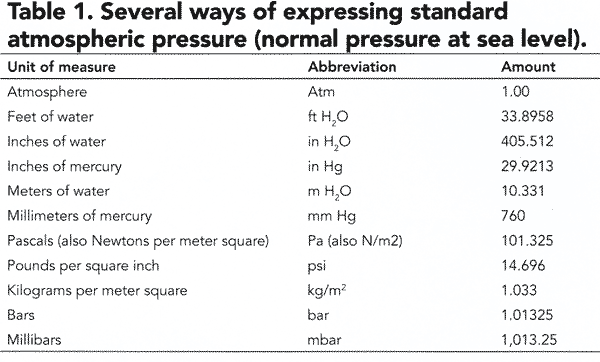
The atmosphere extends outward from the Earth for about 62 miles above sea level. The atmospheric pressure declines to one-half of its sea-level value at an altitude of about 20,000 feet (3.8 miles). Atmospheric pressure can be measured with a barometer, whose simplest form is a small diameter, calibrated glass tube sealed at one end and open at the other. The air is removed from the tube, and its open end is inserted with the tube upright into a vessel of mercury exposed to the atmosphere. The distance the mercury rises in the tube is measured as the atmospheric pressure. There are many units of measure for atmospheric pressure (Table 1), and they typically refer to pressure at mean sea level or standard pressure.
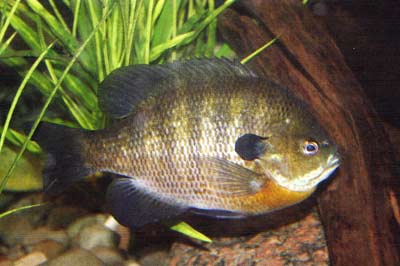
The water column in a pond is pressed on at its surface by the weight of the atmosphere that decreases as a function of greater altitude. Weather conditions only cause slight changes in atmospheric pressure at any given location.
The weight of the water column in freshwater ponds, or the hydrostatic pressure, is roughly equal to 73.42 mm Hg/m (0.434 psi/ ft) of depth. This results in an increase in the pressure exerted on an object or point underneath the water surface. For example, if atmospheric pressure on a day is 14.50 psi, the weight of the water column pressing down on an object at a depth of 10 ft would add an additional 4.34 psi above atmospheric pressure. In the example above, the total pressure would be 18.84 psi at 10 ft depth.
Fish are acted on by the total pressure that varies mainly because of water depth at any given altitude. At locations of greater altitude, the atmospheric pressure will be considerably less than at places near sea level. Nevertheless, the deeper the water, the greater the total pressure within any given water body.
In everyday use, we may consider mass and weight the same because gravity is the same from one place to another on the Earth's surface. Density can be estimated by dividing the weight of a substance or object's weight by volume. The density of freshwater is around 1 kg/L, or water is commonly said to have a specific gravity of 1.0.
Two opposing forces act on a fish. The gravitation force pulls it down through the water column, while the buoyance force buoys it up. If the volume of water displaced by a fish's body is equal to the fish's weight, the fish has a specific gravity the same as that of water and will float at its particular depth.
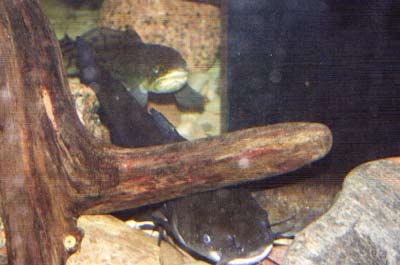
Freshwater fish have a specific gravity of about 1.05, and this would, if not countered, cause them to sink to the bottom of water bodies where pressure is greatest. This would not be problematic in ponds because the bodies of pond fish can tolerate the pressure at depths even greater than those typically encountered in the deepest parts of sportfish ponds. Sunfish, bass, and other pond species move around in ponds for feeding, nesting, and other purposes and spend time at various depths. This could be accomplished by a fish naturally sinking to the bottom by swimming, but swimming requires considerable metabolic energy.
Most freshwater fish species have a hydrostatic organ known as a swim bladder that allows them to maintain their positions in the water column without constantly swimming. The swim bladder is basically like a balloon that can be inflated or deflated with gas (mainly oxygen from the bloodstream of the fish).
Gases are highly compressible and change volume quickly in response to pressure changes. As the fish sinks to greater depth, hydrostatic pressure increases. Increased pressure compresses the swim bladder, which would increase a fish's body density to favor sinking. However, the increase in pressure triggers an expansion of the swim bladder by the introduction of gas into it to reduce the specific gravity of the fish. The reduction in the specific gravity of the fish's body by the expansion of the swim bladder allows a fish to be neutral to gravity and buoyancy and remain at a particular depth without expending energy for swimming.
If a fish moves to a lesser depth where hydrostatic pressure is less, the swim bladder will expand. A fish will expel gas from the bladder to lessen the volume of the swim bladder until its specific gravity equals that of the shallower water.
Changes in the total pressure acting on a fish trigger the increase or decrease in volume of the swim bladder to regulate the buoyancy of a fish's body so that it is neutral to both gravity and buoyancy and can remain at a given depth without effort. Of course, if the fish moves by swimming a greater or a lesser depth, the swim bladder will respond as necessary to maintain neutrality with gravity and buoyancy at the new depth. Hydrostatic pressure changes trigger the actions of the swim bladder, but the mechanism by which this is accomplished varies among species. The lateral line is involved in sensing pressure, but its influence on the swim bladder does not seem well agreed upon.
Some fisher people believe that fishing success is greatly influenced by atmospheric pressure. Typical ranges in atmospheric pressure do not exceed increases or decreases of about 0.6 psi. This would be equal to about 1.4 ft of water depth. Atmospheric pressure changes have much less effect on total pressure than does depth.
I liked to fish very much as a youngster, a fact that influenced my career choice to a minor extent. Nevertheless, I am busy with other pursuits today and seldom take time to fish. But, back in my fishing days, I never noted any remarkable correlation between my fishing success and the daily atmospheric pressure. I can say this in good conscience about atmospheric pressure and fishing success. As I see the situation, follow your conviction. Still, I venture that you will have good and bad fishing trips randomly intermingled among low- and high-pressure days. True fisher people must defend their convictions, but I am no longer obligated to enter into that argument. I wish you good luck.
Dr. Claude Boyd is a professor emeritus in the School of Fisheries, Aquaculture and Aquatic Sciences, Auburn University, Auburn, Alabama 36849. His work with water quality is internationally renowned. His most recent book, Handbook for Aquaculture Water Quality, is a must for anyone interested in learning about water chemistry and how it relates to your pond. It's technical and thorough but easy to read and understand. Buy it at www.pond-boss.com in the online store.
Reprinted with permission from Pond Boss Magazine