

A few years back, we examined factors affecting natural feeding in predator fish. Today's article examines two additional elements in the growth paradigm: fish condition and gape (mouth) size. Some common factors affecting feeding, and thus growth, that we previously examined were turbidity (water clarity), cover (plants and wood, etc.), temperature, weather, and water quality.
Specifically, we examine smallmouth bass feeding as published; Effects of Turbidity and Cover on Prey Selectivity of Adult Smallmouth Bass by Mark W. Carter, Daniel E. Shoup, John M. Dettmers and David H. Wahl in Transactions of the American Fisheries Society 139:353-361,2010, where individual adult smallmouth bass were given a choice of northern crawfish, golden shiners, or Round Goby. Smallmouth bass chose Round Goby in clear water and golden shiners in turbid water in trials without cover. With cover present, Smallmouth bass increasingly picked golden shiners, particularly as water clarity decreased. Unexpectedly, crawfish (Northern) were selected last in all trials with turbidity and cover.
However, multiple studies demonstrate that crawfish dominate the diets of Smallmouth bass. Seasonal shifts and ontogenetic shifts between crawfish and other prey have been described, and the use of optimal-sized prey accounted for energetic differences. Compared to other prey, the presumed low energetic gain from consuming crawfish is a factor. Round Goby, which are lower in energy relative to other fishes, were preferred by young gape-limited Smallmouth bass.
Thus, fish mouth size (gape) and energetic condition affect food choices.
In a report by the Michigan Department of Natural Resources Fisheries Research Report 2087,2008Aspects of Fish Growth and Predator-Prey Interactions: Modeling Relative Weight Predicting Maximum Prey Size, and Evaluating Predator Growth and Prey Survival in Experimental Ponds bv James E. Breck, noted that gape size and fish condition also affect growth. In this study, laboratory experiments and pond tests assessed how Largemouth bass allocate new tissue to growth in weight (condition) and growth in length. Results show that when fish condition is good, weight increases are primarily allocated to increasing in length while maintaining condition. In contrast, when condition is poor, increases in weight are primarily allocated to improving condition.
A model was developed to help summarize the information from these experiments regarding changes in relative weight relative to the recent growth rate. For juvenile Largemouth bass, relative weight was a helpful index of average growth rate and food consumption over the previous few weeks.
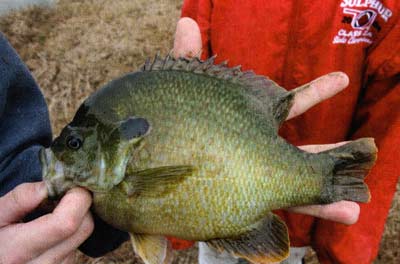
It was noted that because larger bluegills can be predators of smaller bluegills, measurements were made on the gape and maximum body depth of a wide size range of bluegills; then experiments evaluated the predicted gape limitation. New equations were developed to relate gape of bluegills as predators and maximum body depth of bluegills as prey. The results show that the effective gape of bluegills is larger than predicted by the equations. Further investigation confirmed that the previous equations underestimated gape size, especially for large bluegills. Pond experiments over winter indicated that adult bluegills are not likely to cause appreciable predatory mortality when young/small bluegills are potential prey. This is likely to change in warmer weather when bluegill metabolism is high. Pond experiments were conducted to assess juvenile walleye and adult bluegill predator growth and predation rates in the presence of different densities of juvenile bluegills as prey.
Average growth of individually marked walleyes generally increased with the density of bluegill prey. In the study where juvenile walleyes were predators and juvenile bluegills as prey, the average change in weight of walleyes increased with bluegill stocking density. The average walleye lost weight at the two lowest bluegill stocking densities, but gained weight at the three highest bluegill stocking densities. The change in Walleye weight corresponded roughly with the reduction in bluegill biomass, suggesting that the difference in consumption of bluegills produced the weight change.
Largemouth bass have also been shown to have difficulty feeding in turbid water. Generally, tolerance for turbid water and gape size is higher in largemouth bass than in smallmouth bass, and largemouth bass are more likely to successfully forage in turbid water and on larger prey than smallmouth bass. The reduced consumption by smallmouth bass with increased turbidity is similar for walleyes and several other fish-eating species, as well as many invertebrate and plankton-eating species.
Yellow perch, as a generalist predator, selected prey based on encounter rates and foraging efficiency (gape and condition) and consumed small bluegill during winter, in comparison with the walleye. This specialist fish eater actively selected fish prey to maximize growth.
Similar turbidity and gape-induced changes in diet have been observed for fish-eating Largemouth bass preying on herrings. These two studies add gape size and condition to the list of growth factors and indicate that continued good predator condition is paramount over further growth in length.
Reprinted with permission from Pond Boss Magazine