


I would like to share some basic, informative points about one of America's best pond fish. For many good reasons, most ponds and lakes have some variety of the angler-friendly and ever-popular Largemouth bass.
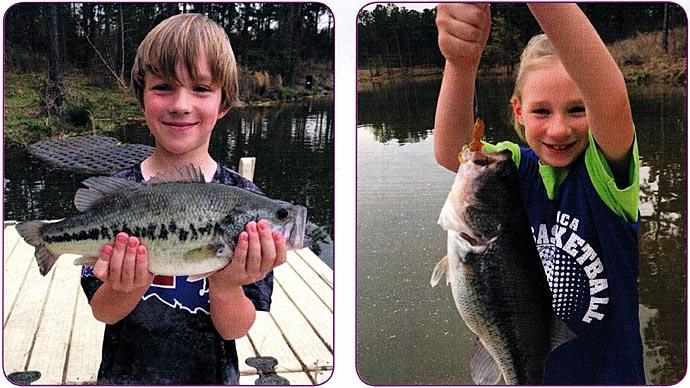
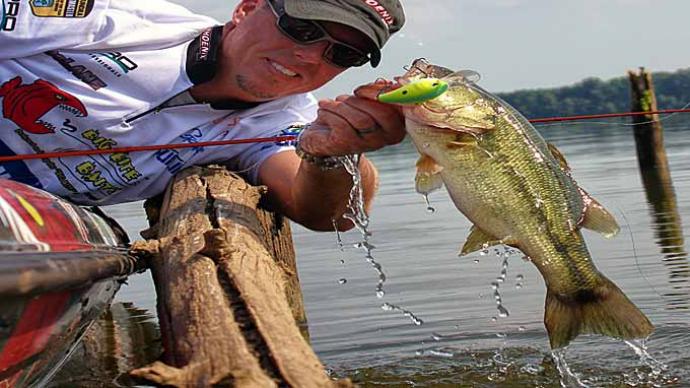
Big-time, prize-awarding fishing tournaments focus on catching Largemouth bass. These fish are pure fun. Anglers of all sizes, shapes, and ages love catching this pretty big-mouthed fish. They are a surface-jumping, water-splashing favorite fish. Younger, smaller bass are usually very eager and willing to bite on just about any type of lure tossed near them.
Here are some main points about them, why they are a favorite, and why many anglers' tackle boxes are full of all sorts of pretty lures.
1. Ol'Bucketmouthiseasytogrowin all types of waters. Emphasis on easy. They thrive in almost any form of fishy water. Largemouth bass typically spawn successfully, and their babies survive sufficiently to recruit new adults. The best long-term growth potential for these popular fish targeting larger individuals occurs when their numbers are limited, a situation that provides better growth rates and top-end sizes for the remaining bass. Too many bass can spoil the pond soup. Overcrowded bass don't grow faster. However, when the density is high, they can create better fishing for bigger panfish. Goals, goals, goals, they are important for the way you manage Largemouth bass.
2. Largemouth thrive in the warmest and coldest ponds from Canada to Central America. All but six states have records of largemouth exceeding 10 lbs. Further north, with ice cover and cooler year-round water, growth is slower, and top-end sizes are smaller. Even so, largemouth in the northern areas live longer than their southern cousins. The largest ones tend to be found further south, where warmer water allows these aggressive predators to feed and grow year- round. They rarely need to be restocked because they are good at raising lots of babies. More often, too many babies are recruited.
3. It's darn hard to keep these frisky fish from making a neat, homey nest for their young. They will spawn on just about any type of substrate. Largemouth prefer sand or gravel with some cobble. However, even muddy, silty bottoms will be diligently swept clean to form a firm, clean circle by daddy bass for attracting momma bass. After rounding up one or two willing females, the eggs are laid and promptly fertilized. Daddy bass does his best to carefully guard them from all hungry intruders for several days to a week until the eggs hatch and the fry are actively swimming. Then the interesting recruitment of another group of new predators begins.
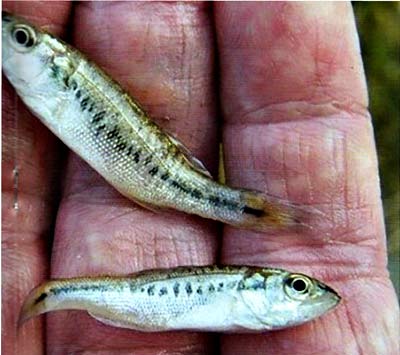
4. Very early in life, largemouth learn quickly to eat their siblings and the fry of other species. One-inch long largemouth, now called fingerlings, travel in large groups eagerly seeking food as they grow up to 1 millimeter per day. These fish terrorize everything that wiggles and fits in their mouth. They are eating machines and resourceful top predators. As they grow larger, they eat larger food items. When available, fish of consumable sizes are the most common and best type of food. Sunfish often fill that bill. However, this past summer, I caught a 14" largemouth with bird legs in its throat. Look for one or several bass hanging around any type of underwater structure. When fish such as shad and golden shiners are common in open water, largemouth also become an effective mid-water predator. They leave no habitat vacant where prey can be found.
5. Largemouth in smaller waters do not behave well with their relatives, the smallmouth bass. When these two bass are together, smallmouth very rarely have successful nests to produce more babies. Numerous studies have shown that, within a few years, largemouth bass soon crowd out the pond's smallies.
6. In large lake-type waters with diverse habitat types and unique niche areas, both species of largemouth and smallmouth can co-exist and recruit new youngsters. For example, in larger reservoirs, largemouth bass are more common in the reservoir's upper creeks and bays, which have more weedy, shallow zones and woody structures. Smallmouths will then be more commonly found thriving in the lower parts of the reservoir, where clearer water and rocky habitats are more common.
7. If you would like to have smallmouth living long-term with largemouth, experiences have demonstrated that you will need to restock some sub-adult smallies periodically. The author's opinion is that smallmouth typically prepare the nest for spawning slightly earlier in the spring than largemouth. As the water warms, the largemouth also gets its urge to build a nest. Instinct tells him that the easiest nest to use will be one that Mr. Smallmouth tends. Then ol' Mr. Largemouth bullies his weaker cousin off his freshly constructed nest: final result - no new smallies.
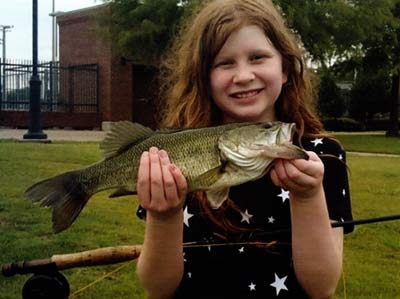
8. Over thousands of years, evolution has brilliantly paired bluegill and largemouth. Largemouth are effective and aggressive predators of wide-bodied sunfish. Their wide mouths allow them to eat all types of saucer-shaped fish. With abundant prey, bass can grow quickly. For best growth, largemouth need a conveyor belt of suitable-sized food. Prey fish should spawn frequently and grow quickly to sizes larger than minnows. Bluegills fit the bill for the largemouth's feeding behavior and growth needs. This is why bluegill are most often stocked with largemouth; to form the best backbone of the typical pond food web. These two fish species even seem to need each other to reach their full growth potential and total mass. This is especially true for bluegill, because they usually stunt over time in the absence of a large, aggressive predator like a largemouth bass, which can effectively control their prolific reproduction.
9. Adding more forage species into the food web helps produce more food of different types for your always-hungry largemouth. Bluegill fill a broad niche. However, niche habitats underutilized by bluegill will support greater standing weights of prey and bass. Redear sunfish are a perfect example. They specialize in bottom habitat and also help control snails and small mollusks. While redear and bluegill niches overlap, the combination has been shown to produce more prey than bluegill alone. Golden shiners are relished by largemouth.
Although they may need to be restocked periodically, shiners can exploit open-water habitat and thrive on veggies if they have to. This more basic utilization of the food web helps shiners produce more food for your largemouth. Where not prohibited, tilapia take veggies and detritus to the next level of forage items by utilizing underexploited food sources (sunfish and minnows). When using multiple prey species, there are more combinations of available prey at different times of year for the pond to support a population of bigger, better-growing largemouths. Gizzard shad exploit phytoplankton and detritus, as do tilapia. Gizzard shad in their first year grow to sizes that are optimal for your largest largemouth. However, their growth to the ultimate large size of 16" and long life can lead to excessive gizzard shad populations. This is why fast-growing gizzard shad need a good population of largemouth bass exceeding 18" to control prolific gizzard shad.
10. For special goals, largemouth are sometimes stocked as a single species. The bass can subsist on invertebrate prey and their own offspring. In more fertile ponds with robust invertebrate food chains, this standing weight could reach 120 lbs/acre. In low fertility ponds, expect 50-601bs per acre. This contrasts with smallmouth, which can achieve standing weights of up to 180 lbs/acre standing alone. The difference? The smallmouth's superior exploitation of invertebrate prey. Single-species ponds with just largemouth are most common in colder climates, where slower growth makes balancing largemouth and bluegill combinations more difficult. A single-species stocking of bass is an option when nipping bluegill is unwanted for a primarily swimming pond. ll. In combination with hybrid sunfish, the largemouth effectively consume most or all of the hybrid offspring. The amount and quality of habitat usually determine how many hybrid sunfish offspring survive. Fewer offspring result in faster growth of remaining hybrids. This can be considered a variation of the single-species pond, where the largemouth gets a little extra food, and the sunfish population is effectively controlled and managed to maximize growth. In combination with hybrid sunfish, the challenges of growing large panfish are overcome. As with single-species stocking, expectations of largemouth top-end growth are subdued to achieve more easily managed fish populations, with most individuals catchable.
Reprinted with permission from Pond Boss Magazine