

We haven't caught a bass over five pounds in years. Why do our bass have such big heads and skinny bodies? 'We're tired of catching one-pound bass, what do we need to do?"
Ah, that last one.
The final "We're ready to do hard things". Keeping bass populations in check is work enough in your average pond. When you have nearly 200 acres of water, the effort is monumental.
Or, is it?
Background: This community lake was constructed in 2007 and stocked right with bluegill, shellcrackers, golden shiners, threadfin shad, and Tiger bass. Lime, structure, spawning areas, deep water, feeders, you name it. Two years in—six pounders were caught. Year four—81b., 12oz lake record. All was dandy and exciting. In year five, all active fish management was ceased due to economics and budget constraints.
By year twelve, well, you guessed it. The fishery had morphed into its carrying capacity and, more importantly to anglers, its fish growth capability. Catch rates were high, but the quality of catch left a lot to be desired for most of the owners. One vital component that costs just time and effort was missing during this boom-and-bust evolution—harvest.
The originally stocked bass had pretty much lived out their lives, and it was up to the younger generations of fish to fill the slack. All they did was fill a slot of unharvested fish.
A community fishing club was organized during this period, and two fishing tournaments were established annually. The club grew and represents anglers and new anglers from across the country. Christmas trees and other fish structures are now installed annually by the club.
They're serious. Clinics are held for fishing 'how-to's', the latest lures and techniques.
Yet the bass still did not grow.
"What do we need to do?" With blessings from the community leadership, the fishing club was ready to pull on their boots and do the work to improve the fishery. But where to start? "Can we stock our way out of this? With no budget?" The community was on board as the lake was limed again in 2018. Good water quality benefits all.
Now for the fish part.
We've preached bass harvest for years and promoted the use of relative weight (Wr) as the metric to use for harvest. However, calculating relative weight and recording all the data was a stumbling block for most, including this group with around 50 members. Development of the SmartFish App in 2019 seemed like the perfect fit.
Actually, I developed this app, especially for people who want to become more serious about managing their fishery, and this club was a perfect candidate to prove its worth.
The club adopted the SmartFish App and began bass harvest in the fall of 2019. Bass harvest criteria (total lbs. of bass to harvest @ specific Wr) was prescribed based on electrofishing data and their catch records.
Off to the races they went. Well, sort of. Harvesting bass is a culture change, which, as we all know, takes time. We did hands-on workshops on measuring, weighing, and app use. Many of the club members bought the same brand and model electronic scales. What do we do with all the bass we harvest? Non-fishing owners were concerned about that as well. The fishing club bought a freezer where bass not destined for hot grease are deposited whole in plastic bags.
When the freezer's full, club members drive nearly three hours one way to donate the fish to a raptor rehabilitation center. How cool is that?
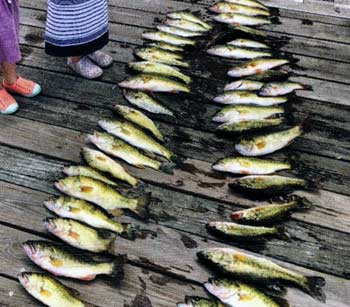
Cull tournaments were scheduled annually. We conducted spring electrofishing surveys to corroborate angler catch and bass size distribution. It is easy to do when you have actual length and weight data collected by anglers courtesy of the SmartFish App. Can you say large sample sizes? Oh, and we aged some bass via otolith removal. More about this later.
The harvest criteria changed from year one to year three. This was another culture change. The first year the prescription was harvest bass <16 inches below Wr=80. Too conservative? For die-hard pondmeisters yes. It qualified as a major paradigm shift for anglers conditioned to release every bass they catch.
By year three, the threshold was anglers' choice: all bass below Wr=90, or all bass below 16 inches with Wr below 90. Some members choose to stick with the original criteria, while others hammer the most aggressive harvest threshold. Ultimately, they have a choice. Their SmartFish data reflects the choices anglers make, which gives the club talking points to discuss as a group when evaluating their progress.
Three years later...pay dirt progress. The mean relative weights of all bass collected during spring electrofishing surveys increased from 81 to 85. It's not a huge jump, but it's a good indicator.
Let's dig deeper though. Bass 15 inches+ mean Wr increased from 78 to 86. Bass 15 inches+ with 90+ Wr increased from 1% of the sample in 2019 to 13% in 2022. This included two bass over 5 pounds, one of which was 5.9 pounds, the largest bass collected since 2013.
Now, to the club data. One of the anglers constructed a Proportional Stock Density (PSD) chart from their SmartFish data which paints a picture of results anglers can relate to: a 12% increase in preferred-size bass (15 inches-20 inches) and a 2.5% increase in memorable-size bass caught (20 inches-25 inches). Not much, you say? In real numbers, 14 memorable-size bass were caught in 2020...17 in 2021, and 52 were caught through November 2022! Most anglers can dig that.
Six bass over six pounds were caught in 2022, including a 6.69 lb. bass, which is the largest bass caught since starting their harvest program!
So, did all the lake variables remain static during the three years? Of course not. While the lake had low grass carp numbers, pondweed announced its presence in the late summer of 2019. By summer 2020, it was raging despite aggressive herbicide applications. Boy, did the bluegill and shellcrackers love the pondweed! But... the impacts of recreational use outweighed the biological benefits of having natural structure. Nutrients previously utilized by the aquatic food chain were now bound up in plant growth beyond the 10-20% coverage considered by many to be the sweet spot.
In 2021, grass carp were restocked, and by fall 2021, pondweed was nearly 100% controlled. However, the sunfish population had two growing seasons to rebound, with fewer predators and more hiding places. So, improved bass size structure was augmented by more food production. Since active bass harvest was in motion, threadfin shad were restocked in 2022. To date, the improved food situation has been going well. No plants, more available nutrients, and a dry 2022 spawned a productive food chain that supported two threadfin spawns. All the pieces came together in 2022. Yes, bass catch rates declined (we warned them) and this was hard for a lot of anglers. What was tougher to swallow were the age results from otoliths. Most of the larger bass being released were older fish, whether they met the harvest threshold or not. By year two, one-year-old bass (mean weight 0.68 lbs.) had reached 72% of the weights exhibited by 3.5-year-old bass (mean weight 0.88 lbs.)! Where the rubber meets the road is when you decide to harvest that 20" bass that scores a Wr=85 in February. Some are harvested, some aren't but as we preach, generally that fish is consuming prey that younger, faster-growing rock stars could consume.
The primary factor that spurs the club to stay the course is the catch of larger, healthier bass. But from year one to the present, the gas that feeds the flames is seeing first-hand the data they collect, which paints the picture of progress toward success. Did they meet their harvest goal every year? Nope. But by using the SmartFish App and working together, they have watched the small steps forward. Now, they are reaping the rewards. Hats off to this group for choosing to 'do hard things'! ^
Wade Bales, a nationally known fisheries biologist in Bluffton, South Carolina, owns Quality Lakes Inc., and created the SmartFish App and can be reached at: wadeb@qualitylakes.com
Reprinted with permission from Pond Boss Magazine