

People keep asking me about this nanobubble technology stuff. Should I buy one? Install it now; grow trout in southern or Midwest waters all summer? Not so fast, please.
It's like the marketplace is at the starting gate, waiting for the race to begin.
This technology is gaining traction in the industry, one trial at a time. In the last issue, we wrote about some of the obstacles that still require further investigation. Since then, I've learned that several companies are trying to carve their own niches, and each one revolves around injecting adequate amounts of nanoscopic-sized dissolved oxygen nanobubbles below the thermocline, with a focus on how to expedite the breakdown of organic matter at the bottom of our ponds and lakes. Speaking with Todd Olson and Christian Ference from Moleaer, Todd from the sales side, and Christian from the research side, my learning curve was steep.
Their primary focus in our discussion was muck reduction. As we learn, ponds begin to age as soon as they're constructed. Organic matter accumulates, silt migrates, and ponds become more eutrophic with age. Nature does what nature does; the water accumulates stuff and becomes a liaison for productivity. Plants utilize nutrients. Insects and fish utilize plants. Other fish utilize insects and small fish as their prey. It's the lifecycle.
Nature simply won't allow nutrients to go unused or unattended.
But what about all that gunk on the pond bottom that accumulates? Those leaves from your trees each fall, dead aquatic plants decaying and falling into that dead area at the bottom? Digested food from fish, insect husks from recent hatches...all kinds of organic junk sinks. You detect the rotten egg smell when you dare wade into the shallows and kick up all that nasty blackness.
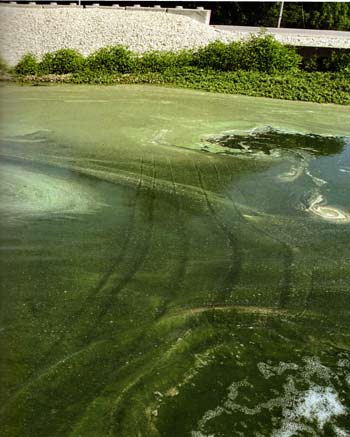
Olson said, "Part of our mission in the pond space is to reduce the amount of muck in ponds. As we do that, the life of the pond is extended." He continued, "It's like a pond gets a new life." Christian added, "Muck reduction is the pulse of the lake."
This has been a big mystery to people. Most of us don't think about it.
Our ponds experience both internal loading and external loading. As our ponds cycle and then recycle their nutrient load, organic matter is produced and flows through their ecosystems. Plant-based material dies, sinks, and, for lack of a better term, tries to rot. If it contains oxygen, it can undergo the composting process. But as we think about this process, there's only as much oxygen available on the pond bottom as can migrate there naturally...or be injected by nanobubble machines or some of the traditional aeration equipment that's been available for years.
External loading originates from surrounding parts of the watershed, such as fertilizer washing in from lawns or agricultural fields. That's why we discuss forebays, greenbelts, and buffer zones surrounding a pond. The mission is to capture as much organic matter as possible before it washes into our ponds.
Think about it like this. Here at our house, the trash truck comes by every Tuesday around noon. If he misses, our two or three bags of trash double, maybe more, by the following Tuesday. Your pond is collecting its own baggage of trash.
If the trash truck had a way to incinerate our trash immediately, it would convert to basic forms of matter and not occupy as much space at the landfill. In our ponds, oxygen fuels the incinerator. Nanobubble technology, at least at Moleaer, is focused on that reduction.
The way they explained it to me is that nanobubbles take that hard stuff, such as decaying aquatic plants, and provide the oxygen needed for bacteria to more efficiently do their work, thereby expediting the process and releasing gases as the natural microbes consume the organic matter at the simplest level.
Here's the main gist.
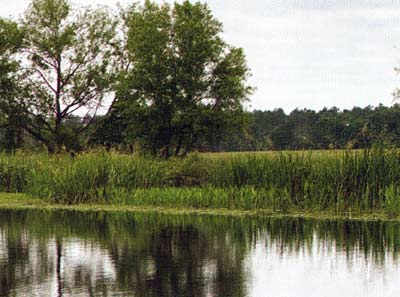
Nanobubbles facilitate microbial life at the interface between pond water and the pond bottom. This technology makes the job easier for nature's workers.
Todd explained it another way. "Nanobubbles can make the work easier for the microbes. And, with natural mixing plus other aeration sources, our ponds can speed up the breakdown of organic matter."
And that's the key. Organic matter is what typically fuels the eutrophication of ponds and lakes.
There's also watershed management. That's Part of Todd's forte and experience. "Study the watershed to address external loading. When external loading isn't properly managed, it becomes internal, shortening your pond's lifespan."
Look at your watershed as a funnel. If you don't manage parts of that funnel, the lake pays for it by receiving unnecessary nutrient loading.
In the country, it may be dirt, fertilizer, corn stubble, or other crop debris. Around the forest, it could be pine straw, oak leaves, twigs, and whatever else falls on the forest floor. In urban areas, it may be street sweeping, junk collected in storm drains, pulverized tire rubber, and oil sheen.
These are more reasons for forebays and places for stuff to collect before reaching the pond.
This nanobubble technology is about to become a race...mark these words.
When someone figures out how to get enough nanobubbles into the dead zones of ponds as fast or faster than the microbes use them, we'll all begin to see the benefits more clearly.
Currently, the technology must rely on its most recent merits. Those are dealing with small areas of heavy eutrophication, processing organic muck as quickly as possible to influence the rest of the body of water. Promise has been demonstrated through the reduction of muck, which has a positive influence on minimizing algae growth.
That's the biggest credit so far.
Reducing algae growth.
What about the price? It's still expensive, more than an average pondmeister may want to spend. However, as these pioneers continue to conduct their research and due diligence, we'll all benefit from the greater good over the next few years of pond management.
Reprinted with permission from Pond Boss Magazine