

South Florida is famous for warm weather, amusement parks, retirement communities, and relentless sun. Its semi-tropical to tropical climate, low elevation, and extensive development have led to an abundance of man-made freshwater lakes and ponds. One of these lakes is nestled in the southwestern part of the state, offering residents the opportunity to live in a premier community that also boasts an incredible lake with outstanding fishing.
Measuring 550 acres, the former quarry has a maximum depth of 35 feet and an average depth of 20 feet. Construction of the quarry began in the late 90s, providing fill material to support development throughout southwest Florida. In 2008, the mining operations ended, and the massive pit was filled with water. The lake bottom is mostly hard and rocky, with soft silt found in a few areas. The lake has a great deal of hard structure, including rocky shorelines, steep drop-offs, ridges, and humps, giving it a unique character.
The fishery also has a history of producing quality bass.
Catching big bass in its early days was common, but over the years, bass fishing deteriorated significantly.
About 10 years after the mining operation ended, developers broke ground on a large gated community. Hundreds of homes were built within a few years, attracting people from all over. Among those were some passionate fishermen, including David White, who made it his mission to ensure the lake received proper attention to help ensure the ecosystem was both aesthetically pleasing and thriving with great bass fishing.
In time, it became clear to White that the fishery needed professional attention. Working closely with the decision-makers, White received approval to hire SOLitude to electrofish the lake. In late November 2021, that work was performed. Teaming the electrofishing data with pre-existing bathymetric maps that White developed, water quality data, and angler catch data, the lake's strengths and weaknesses were identified, and SOLitude developed a management strategy.
It was determined that the bass population was overcrowded, underweight, and stunted. 88% of the bass collected were between 10 and 13 inches long. Occasional large bass were found, but overall their size-class structure was poor. These findings matched the angler catch data, strengthening confidence levels in our electrofishing results.
Tilapia, bluegill, and redear sunfish were the most common forage species, and their size-class structure was skewed towards large individuals. Given the lack of small forage and bass greater than 13 inches, it became apparent that the fishery was not thriving.
The lake's water clarity was greater than 5 feet, suggesting productivity was low, yet down-scanning sonar imaging showed a significant number of adult fish suspended in open water, indicating the fish biomass was robust.
An extensive water-quality dataset spanning 2014 to 2021 showed intermittent years with low dissolved oxygen at the surface during spring, summer, and fall months at the southern end of the lake, while the north end maintained sufficient oxygen. This was concerning and slightly confusing, since waterbodies with low nutrient levels and water clarity greater than 4 feet typically have plenty of dissolved oxygen at the surface. Rather than speculate, additional water quality data was collected moving forward to better understand the situation, enabling informed decision-making.
Going into 2022, the bass population had momentum moving in the wrong direction. Shifting that momentum takes time and requires dedication. The lake is capable of becoming a great fishery, but with a small budget of $15,000 the first year and then $20,000 moving forward, it presents challenges difficult to overcome for a lake of that size.
Similar to most low-budget fishery restoration projects, passionate anglers must do most of the heavy lifting in the process of shifting the fishery's momentum. Once the shift occurs, the community often takes notice and begins supporting the efforts of the dedicated few. In this case, David White shouldered the burden and played a key role in securing funding from the developer to improve the lake, as well as leading all initial volunteer efforts.
One of the first management recommendations following electrofishing was to harvest 3,000 bass measuring less than 15 inches within 1 year. Faced with this daunting task, White decided to start a Facebook Community Fishing Page, knowing he would need help. It started with only one person helping him pull fish. The two of them pulled out over 1,700 bass. Despite their intense efforts, the community fell short of the initial goal, removing only 2,300 bass from the lake by the end of 2022.
In May 2022,400 pounds of threadfin shad were stocked to establish a sustainable population. This open-water schooling forage species would help capitalize on the vast expanse of open water. Stocking shad exhausted the majority of the 2022 management budget. All remaining dollars that year were used to enhance the fish cover.
Establishing aquatic vegetation was the third-highest priority, behind harvesting bass and establishing a population of threadfin shad. Water lily tubers were introduced in areas, and lake management goals were aligned with fisheries goals, resulting in tolerance for Chara and Illinois pondweed to begin growing in parts of the lake. Unfortunately, the lake started with basically zero submerged aquatic plant growth. Only a couple of small patches of Chara were present in early 2022. Much of the vegetation struggles relate to the rocky substrate, low nutrient levels, and a thriving population of tilapia and other wildlife that continually suppress any attempts by vegetation and macroalgae to establish. They eat it. The intense predation pressure, coupled with a severe hurricane in September 2022, negated efforts to establish aquatic growth.
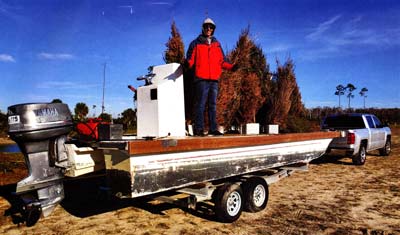
Increasing the amount of cover in deep water was another high priority. Hardwood trees, as well as most other forms of sufficient woody cover, are quite difficult to source in South Florida. As a result, White decided to make use of discarded Christmas trees. Two years in a row, he used the Facebook page to recruit assistance from community residents, collecting and sinking 200 trees in various parts of the lake. Within days of sinking the trees, bass and baitfish gravitated to them. These trees proved instrumental in the process of two guys harvesting such a large number of bass. Without the trees, they would never have been able to harvest that number, since the lake previously had literally no cover for the fish to congregate.
This Christmas tree-sinking tradition will carry on over the years. Additionally, a couple of non-native tree species have been identified nearby and will be used.
For safety reasons, the woody cover is being placed in 20 feet of water. Don't want jet skis tangling with fish structure.
By fall of 2022, bass catch rates were slowing, and some anglers had grown concerned that too many bass were being harvested. This trend is common and often adds uncertainty and doubt amongst some anglers. Around the same time, anglers observed bass beginning to gain weight and length, and it became common for bass to cough up small sunfish and shad in live wells. By winter, it became clear that bass size and body condition had improved. Anglers began releasing bass as they outgrew the 15-inch harvest limit. This was a noticeable improvement from the first eight months of 2022, when anglers would rarely catch a bass over 15 inches.
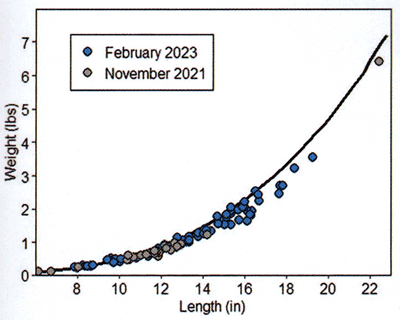
In February of 2023, the lake was electrofished again. As the anglers indicated, the fishery improved significantly. Shad were common and could be observed throughout the entire waterbody. Small bluegill, redear sunfish, and intermediate-sized tilapia were observed, which was not the case when electrofishing in 2021. Largemouth bass grew several inches, with the size-class distribution starting to look much better. As a result, the harvest size limit was increased to all bass less than 16 inches. As seen in the attached graph, the bass collected in 2023 were in poor condition relative to the goal (black line), but this is somewhat misleading, as the bass had spawned a week or two before sampling.
This positive momentum has caught the attention of many community members. The Facebook page now has 182 members, and a fishing club has formed. Additionally, community fishing tournaments have been scheduled to aid in the bass harvest, and White and others are currently seeking an organization where they can donate the harvested bass.
2023 shaped up to be incredibly impactful. The goal was to harvest 3,000 bass, with most by July 1st if possible. The 2023 budget was spent improving habitat, as the fishery still lacks key habitat elements. The focus was on soft cover in the form of vegetation, as well as hard structure in the form of woody material and man-made artificial fish habitat.
In the process of improving stands of aquatic vegetation, anglers need to work hard to raise community awareness of the benefits vegetation provides to the health and aesthetics of their uniquely deep lake. The benefits of native aquatic growth greatly outweigh the negatives, given that less than 5% of the lake is shallow enough to support vegetation growth. In summary, vegetation will help the lake maintain balanced water quality and a healthy ecosystem, all without threatening water use and aesthetics for the majority of stakeholders, as most docks are floating above 10-20 feet of water.
The opportunity for this South Florida lake to mature into an exceptional bass fishery is truly special and realistic. The bass population has exceeded expectations in the first 15 months of management. Momentum has shifted, and the forage base is on track for significant growth. The 2023 management objectives were clear, and if completed on time, momentum should continue.
David Beasley is a Fisheries Biologist and the Director of Fisheries at SOLitutuded Lake Management, an environmental firm providing sustainable lake, pond, wetland, and fisheries management services. Learn more about this topic at www. solitudelakemanagements.com/knowledge
Reprinted with permission from Pond Boss Magazine