

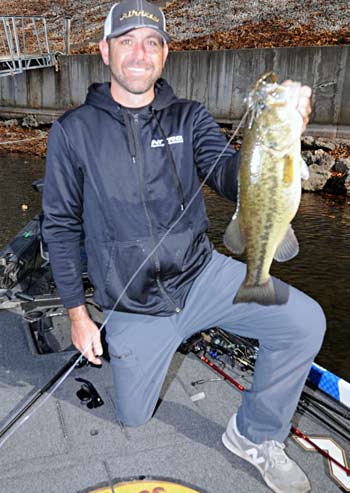
When it’s beginning to look a lot like Christmas, touring pro Casey Scanlon has a merry old time catching bass throughout the holiday season.
Scanlon considers the holiday season, running from about a week before Thanksgiving through Christmas, one of his favorite times to fish for bass because fishing pressure diminishes as many anglers focus on hunting or Christmas shopping for their loved ones. Fishing can be phenomenal during the Yuletide season, whether it's in the Deep South, where fall patterns are still producing, or in the Midwest, where early winter patterns come into play.
“The patterns change daily throughout the fall based on wind, weather, and all sorts of other conditions, so that is kind of the name of the game, being able to change and switch it up,” Scanlon says. “Most of the time, it’s because the bass are moving around chasing baitfish, no matter what part of the country you are in. They are feeding up in the fall and winter, just trying to prepare themselves for those frigid days."
As a result of changing conditions, Scanlon relies on the following five patterns to catch holiday-season bass.
Banking On Topwaters
Around Thanksgiving, Scanlon’s favorite pattern is throwing topwater lures, whether it is a Bass Pro Shops XPS Buzzer Beater Buzzbait, Bass Pro Shops XPS Smooth Walker, or a plopper-style surface bait along the bank.
The two-time Bassmaster Classic qualifier prefers running the buzz bait and plopper around big rocks, riprap, and along 45-degree banks. He throws the Smooth Walker along shallow flats, backs of creeks, and the shallow bars of Tennessee River impoundments. Other targets he will throw his topwaters around include grass edges, docks, brush piles, stumps, and laydown logs.
The key to the topwater pattern is finding active baitfish such as gizzard or threadfin shad. Scanlon either looks for bass-busting baitfish on the surface or scans his Garmin LiveScope Forward Facing sonar for pods of shad under the surface.
The Missouri angler considers cloudy days with a slight breeze as ideal conditions for his topwater pattern. He will also throw his topwaters in shady areas on sunny breezy days. The Smooth Walker is most effective in water with 2 to 3 feet of visibility, while the buzz bait and plopper are more effective in dirtier water.
Jigs For Bottom Huggers
As the days get colder and water temperatures continue to drop, Scanlon relies on a 1/2- or 3/4-ounce jig for fishing cover, such as brush and rock piles, from the bank out to 20 feet deep. “I like to keep a jig handy for bass relating to the bottom and getting a little bit more lethargic,” Scanlon says.
Around Thanksgiving, Scanlon pairs his jig with a flappy trailer, such as the Bass Pro Shops XPS Crawdigy Craw, that generates lots of action as it falls. When the water gets colder around Christmastime, Scanlon switches to a beaver-style or chunk trailer for a more subtle presentation. He will also scale down to a lighter finesse jig when the water drops into the 40s and bass become finicky eaters.
Scanlon suggests the key to the jig pattern is fishing it thoroughly at a variety of depths. “It is a great way to be efficient and stay in the strike zone no matter what depth range bass are in,” he says.
Cloudy, nasty days that push bass to the bottom are Scanlon’s favorite conditions for crawling a jig along the lake’s floor. He opts for a brown jig for clear water and a black-and-blue bait for dirty water.
Spinnerbait In The Wind
Switching sizes of his spinnerbait gives Scanlon the versatility to run the lure at different depths throughout the holiday season. He can either use a lighter-weight model to wake the surface or switch to a heavier model to slow-roll along the bottom. Most of the time, Scanlon works a lighter blade bait less than 5 feet deep, but he switches to a 3/4- or 1-ounce spinnerbait if bass have moved out to the 8- to 10-foot range.
"I really like it around wood cover, behind boat docks, and all the rocky vertical banks like a bluff," Scanlon says.
The spinnerbait produces on cloudy or sunny days as long as the wind blows. “Chasing the wind is really big with a spinnerbait,” Scanlon says.
The two-time Bassmaster Open winner tosses his spinnerbait around any windy banks on the main lake or in the backs of creeks where shad are present. The water is usually clearer during the holiday season, so Scanlon prefers a double-willowleaf spinnerbait rather than the round-bladed models he throws in the springtime when the water is usually murky.
While all of his other holiday patterns produce both numbers and quality bass, Scanlon suggests the spinnerbait pattern triggers fewer bites but more quality bass. He sticks with the spinnerbait throughout the holidays as long as the water temperature stays above 49 degrees.
Cranking Structure
During the holiday season, Scanlon runs a shad- or crawfish-colored Bass Pro Shops XPS Flatsider, Storm Lures Wiggle Wart, or Spro Rkcrawler along the same main and secondary points and channel banks where he throws the lures in the spring. He fishes the crankbait 3 to 8 feet deep most of the time, and occasionally out to 12 feet.
Stained water and a little wind are ideal conditions for Scanlon's holiday crankbait pattern. "The great part about a crankbait is that, unlike some of those other techniques that excel under a certain water or weather condition, you can get away on bright bluebird days covering some water with a crankbait and get some bites,” Scanlon says.
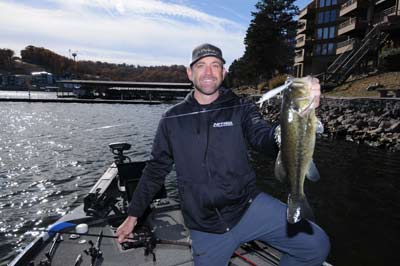
The holiday crankbait pattern remains strong for Scanlon until the water temperature drops into the lower 40s.
Jerkbaits For Suspended Bass
A suspending jerkbait produces bass for Scanlon before Thanksgiving, all the way into springtime.
During the holidays, several bass suspend over secondary points or flats littered with underwater cover, such as standing timber, brush piles, or grass edges. Scanlon tempts these bass with a Bass Pro Shops XPS Staredown Suspending Jerkbait that has a maximum diving depth of 5 feet.
“I will use that jerkbait as kind of a tool to call the bass up and get it in the middle of those suspended bass,” Scanlon says. Watching his LiveScope allows Scanlon to pause his jerkbait and keep it suspended in the bass’ strike zone longer than his other holiday baits.
The jerkbait pattern triggers the most strikes for Scanlon in weather with mixed clouds and sun with a slight breeze. Water clarity of 2 to 5 feet is best for suspended bass to find and slowly approach the jerkbait.
Determining the correct retrieve is the key to triggering strikes on the jerkbait. Scanlon employs a faster stop-and-go retrieve in warmer water around Thanksgiving but slows down the lure’s pace when the water gets colder around Christmas.


