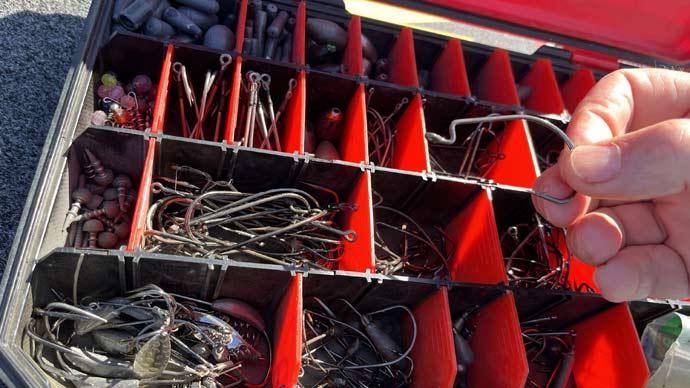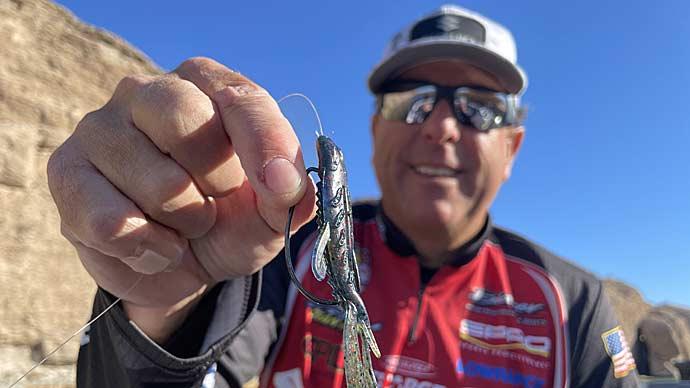


A common question on our forums is, "How do I choose the right hook for the bait I'm using?" That could be hard to do sometimes, especially when you're first starting, but even if you've been fishing for quite a few years, it can be a challenge with all the hook choices today. Which one should you use? Let me help you with the method I use, and perhaps you can apply that, too.
What I do is break it into three different parts. The first part is the wire thickness of the hook. The second part is the style of the hook, and the third part is sizing the hook for the size of the bait. Let me explain that a little bit more.
Hook Thickness
You want to match the thickness of the hook to the line and the rod you're using. For example, when you use a thin wire hook, you want to use a lightweight line and a medium light-action rod using, say, four to ten-pound test line. And the reason why to do that is that if you pair a thin-wire hook with a heavy power rod, say with 65-pound braid, when you set the hook, the only thing you're going to accomplish is straightening out that hook, and you're just going to pull it right out of the fish's mouth. The hook is too thin to withstand the pressure from a stout rod and non-stretch line like that. So if you use a medium, medium light-action rod, or real light test pound line, the rod and the line will give instead of the hook. And that's especially important during the fight.
You want to increase hook thickness as you increase rod and line strength. So a regular hook is good for about ten to twenty-pound test line, and that's the most common. You'll see that a lot for bass fishing. And then there are the thicker ones, typically called flipping or super line hooks. Those are for braided lines from 25 up to 80-pound test. You're using a medium-heavy to heavy-power, heavy-action rod, a stout flippin' stick over seven feet long. So, match hook thickness with your equipment, and you'll have fewer break-offs and catch more fish.
Hook Style
There are a ton of styles out there. I can write an entire article on all the different hooks styles, but I'll keep it simple. I use four main hooks. You want to get four different types and then get them in different sizes and wire thicknesses. That's what I'm getting at.
Extra-Wide Gap (EWG)
Image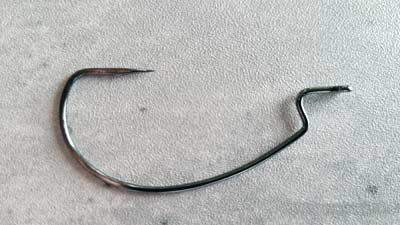
Extra Wide Gap (EWG) There's only one I use the most: the extra-wide gap hook. That is my bread and butter. EWG hooks offer several benefits, mainly when fishing with bulkier soft plastic baits, as their wider gap allows more room for the bait to collapse during a hookset, leading to a higher hook-up ratio, making them ideal for baits like creature baits, craws, and beaver style lures; additionally, the design keeps the hook point inline with the eye, creating a streamlined presentation and often making the bait more weedless. I'll use a standard thickness for most Texas-rigged plastics and a thin-wire hook for finesse setups such as mojo rigs, split shot rigs, etc.
Tube Hooks
Image
Tube Hook Another style is for tube fishing, such as a Trokar Tube Hook. I use it for tubes because of the gap. It's got an enormous gap. Because a tube has a thicker body, you want that plastic to get out of the way during the hook set. In addition, it makes the bait weedless, allowing me to fish in and around cover where bass lurk. The thick wire is perfect for flipping and pitching.
Dropshot Hooks
Image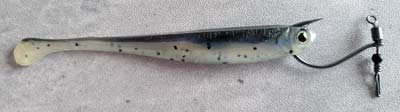
Gamakatsu Swivel G-Finesse Drop Shot I use a Gamakatsu Swivel G-Finesse Drop Shot for dropshotting. It has a swivel on it. I like it for two reasons:
- I can change the leader easily without having to retie the whole rig like you would with a Palomar knot.
- It allows the bait to swing freely and naturally. It looks more natural in the water and prevents line twists,
There are other hooks designed for the drop shot rig, but you must use a Palomar knot with them, and they are more prone to line twist. Plus, the bait doesn't move as naturally.
Keel-weighted hooks
Image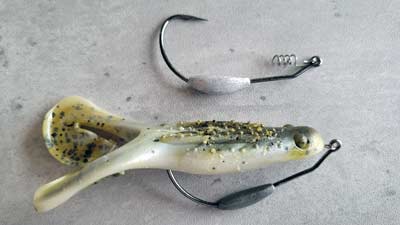
Keel weighted hook I like the ones with a spring lock. You screw the bait right onto it to hold it in place. I use it for frog and swimbait fishing. Sometimes, I'll use this instead of a traditional Texas rig with a bullet sinker up front, which gives the bait a bit of a different fall and makes it glide more. Sometimes, that's what the fish want on a given day: something to experiment with.
So, I use four different hook types and keep it at that. Combine styles with different sizes and thicknesses of wires. You'll be surprised how versatile that is. That covers 100% of all your fishing.
Choosing Hook Size
There are two things to consider when figuring out what size you want. Some guys say, "I pick the biggest size hook I can get away with," and others will say, "I pick the smallest size I can get away with." Well, they're both right. Let me explain.
On baits with a solid body and appendages that move around a lot, such as a Space Monkey or Hawg from Rage Tail, it's not the body that moves; it's the appendages. Lizards and Brush Hogs fall in the same camp. I'm going to use the biggest hook I can get away with. I want the hook point as far back in the body as I possibly can.

It does two things. Number one, a hook point near the back will catch short-striking fish. I have a better chance of hooking them when they're nipping at the bait. But the hook also acts as a spine and holds it in place. You want the bait's body rigid so the appendages can do their job. It helps the bait perform better. So, use a 3/0 or 4/0 hook in those instances.
However, suppose you're using a hand-poured or ultra-soft bait whose body's movement makes it look much more natural in the water, such as a Senko or a YUM Dinger-type bait. In that case, you don't want to use a big hook because, again, it'll work like a spine and kill that action, so that's when you'll get a 2/0 hook.
It's all about the action of the bait. Keep that in mind when you're matching the hook size to the bait.
So those are the three things to consider. Match the wire diameter with the gear you're using, pick the right hook style, and then size the hook for the body according to your desired action. I hope that helps.