

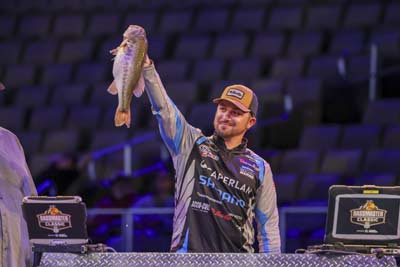
Lake Champlain runs nearly 125 miles from Quebec, Canada, down the line between New York and Vermont. And every inch of it attracts bass anglers. That makes it a frequent stop for tournaments, from local clubs to national tours.
Smallmouth bass are a major draw on Champlain. But its largemouth are on equal footing, especially if you enjoy fishing jigs. You can flip the reeds that stand in Missisquoi Bay at the lake's northern end, cast at milfoil beds submerged in the Inland Sea, or poke matted vegetation in South Bay. So, these bass see more than their fair share of this classic big-bass lure. Just ask Bassmaster Elite Series angler Alex Wetherell.
Wetherell often picks up a jig when fishing Lake Champlain, which is up the road from his Middletown, Connecticut, home. And it was no different on one particular day. He could see bass swimming around his spot. When he presented a traditionally sized jig and trailer, these largemouth ignored it. “But when you threw a small jig, they immediately swam over,” he said. “That jig catches just as big of fish.”
Wetherell doesn’t hesitate to tie on a small offering when he wants to catch big bass. And it's about a 50-50 split on why he makes that move. The first is fishing pressure. "It gives them something different that they haven't seen before," he said. He also does it to match the available forage. Some waterways are home to smaller baitfish and crawfish. If he finds the latter in his livewell, then a small jig is a strong option, he said. And while downsizing his bait can be a daily task when targeting smallmouth, it’s usually angling pressure that forces his hand when targeting largemouth.
While Wetherell has his reasons for fishing small lures, forward-facing sonar has underscored their importance. It allows anglers to watch bass react to their presentations. “The biggest thing is that we’re more aware of when fish don’t want our baits,” he said. So, anglers must rig plenty of rods, cycling through options — including small lures — until bites are triggered.
There are plenty of reasons to fish small lures for bass. Catching more and bigger bass only comes when you choose the best ones and present them correctly. Here's how Wetherell gets it done.
Choose Your Weapons

Small is in the eyes of the beholder. Wetherell considers any lure 3 inches or shorter a small one. And while they come in a variety of shapes and actions, they usually represent baitfish. Popular ones include:
- Jerkaits: Their erratic action and long profile draw strikes from all three major species of bass — largemouth, smallmouth, and spotted. Caperlan's MNW DD 76 measures 3 inches long, perfect for early spring bass, whose activity is increasing with the water temperature.
- Crankbaits: These floater-divers can be fished fast, allowing you to cover water quickly. Couple their small profile with an erratic action and you have a combination that even the wariest bass can't refuse. Caperlan's CRK 53 is slightly more than 2 inches long, has a loud rattle, and weighs 3/8 ounce. Its square bill causes it to ricochet off cover and dive to almost 6 feet, and its slightly larger belly hook — a No. 6 BKK — helps you land more bass. It's perfect for mimicking threadfin shad, especially those reservoir bass that chase into pockets and creeks during the fall.
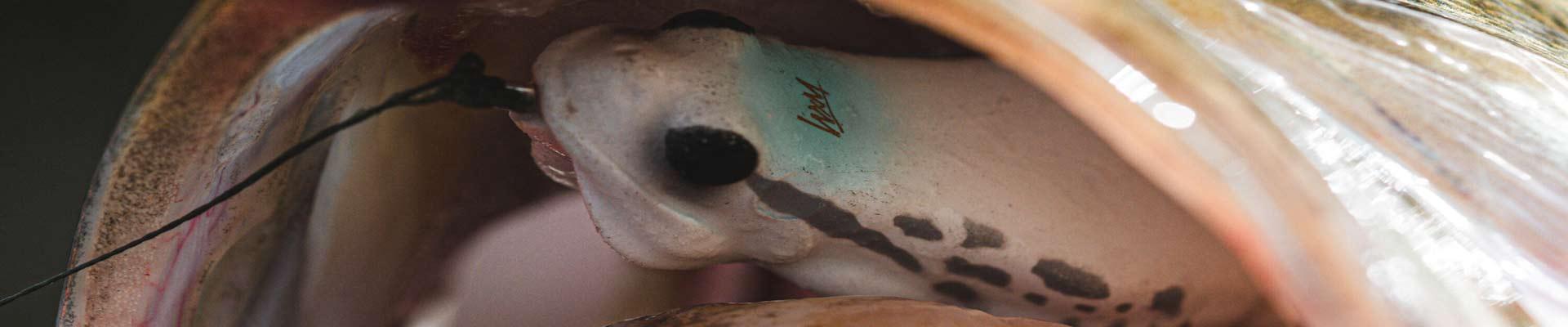
- Swimbait: Wetherell recalls many days when fishing a small lure meant catching more bass, including when fishing these soft-plastic lures. On one in particular, he watched bass follow his 3.8-inch swimbait. So, he switched to a 3-inch model. “They immediately ate it,” he said. Caperlan’s Yubari SHD is poured in four sizes, down to 2.4 inches long. It has a naturally shaped head and a relatively large tail, which creates plenty of kick for its size.
Wetherell said Caperlan’s lures still have some weight to them, despite their small size. That ensures they cast well, even on windy days. And they have all the action of the larger versions. That’s not the case with all small lures. Sometimes the original’s magic is lost when it’s scaled down.
Other Small Options
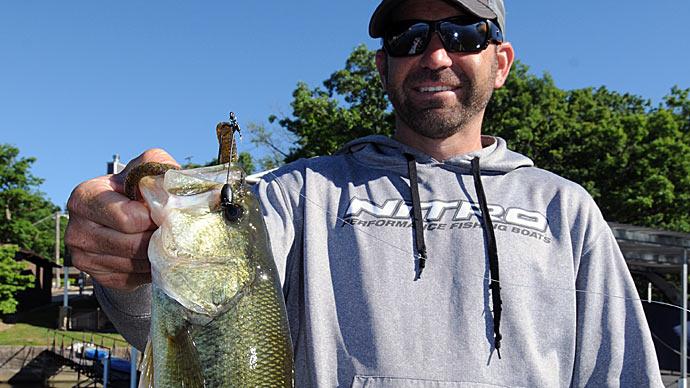
Most small lures are baitfish imitators. But there are other options, including Caperlan’s Micro RB Tungsten jig. It weighs 1/8-ounce size, and its skirt is tied to flare, creating action.
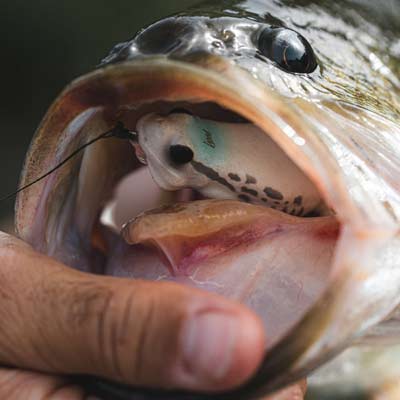
Other popular micro jigs have wimpy weed guards. Wetherell said Caperlan’s version has a beefier multistrand one, which helps it navigate cover, such as rocks and wood, with fewer snags. “I throw it in the same places that I fish a traditional jig,” he said. “It’s just a smaller package.”
Completing that smaller package is a strong BKK hook, which resists bending under a load. “I have no problem catching a 4-pounder,” Wetherell said. And its head is made from tungsten, which is denser than lead, packing more weight in less space. He completes his jig with a 2-inch Yubari Craw.
Even hollow-bodied frogs can be small. At the 2025 Elite Series stop on the Mississippi River in Wisconsin, most anglers targeted expansive mats of aquatic vegetation. Wetherell was in that group, and he used a large frog. Its profile and weight created a large disturbance, making it easy for bass swimming under the mat to find and eat, even though they couldn’t see it.
Small frogs have their own role. Wetherell chooses Caperlan’s FRG 60, which measures 2.4 inches and weighs 7/16 ounce, when the water is cool and bass want a small meal. Its lighter weight and small profile mean less of a disturbance. So, he fishes it around sparse cover such as laydowns, boat docks, or along the edges of emergent aquatic vegetation such as reeds.
Wetherell said a small frog still needs good components, especially its hook. It should be strong enough to resist bending while under load, because he’s fishing it on 50- or 60-pound braided line, as he does with big frogs. He said the FRG 60, which sports a chin keel like the larger model that exaggerates its walking action, has a BKK hook.
Rig Them Up
Many small lures are short on weight. That makes them difficult to cast and fish on the gear most bass anglers use day in and day out. It has become easier, thanks to the introduction of the Bait Finesse System and its specially designed rods and reels.
Wetherell leans on Shimano’s Zodias BFS rod. Measuring 7-feet long, it handles line between 5- and 10-pound test and lures weighing 3/32 to 5/16 ounce. But its strength is its perfect blend of light power and extra-fast action. He said even the smallest lures easily load the rod, leading to longer casts. And there’s still plenty of backbone to work your lure or battle a big bass. Investing in a quality rod is always a good move. “That’s where you’ll see the most benefit,” he said.
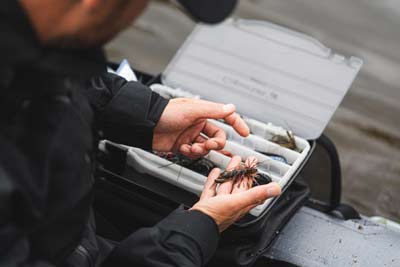
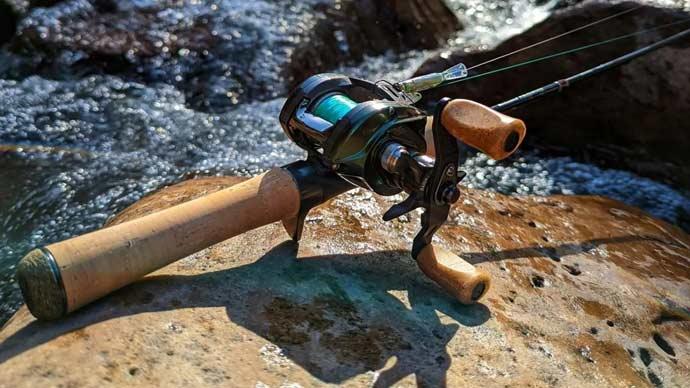
Wetherell matches his Zodias rod to a Shimano Curado BFS baitcasting reel. Available in left and right-hand retrieves, its 8.2:1 gear ratio keeps up with any presentation or bass. Its spool is surprisingly shallow at first glance, holding just 50 yards of 8-pound test. But that reduces the force needed to spin it during a cast, allowing lightweight lures to take as much line as they want, he said. “That’s what allows you to cast those lightweight baits really well,” he said.
Wetherell adds capacity by filling his reel with braided line whose rating is less than 8-pound test. Its smaller diameter means he can fit more yards in the same space. He uses 5-pound test Power Pro braided line. He adds a fluorocarbon leader. Braid helps you stay in touch with your lightweight lures. “If you’re fishing pure fluorocarbon, you’re not going to have the same feel,” he said.
Protecting light line, especially when tangling with a hard-fighting smallmouth, is vital to success. Wetherell relies on his reel’s drag, adjusting it to slip just before his line’s breaking point. The Curado BFS has a unique feature, at least as far as bass reels. Its drag has a clicker. “It’s kind of nice,” he said. “ You can audibly know how much that fish is pulling and how much to let up.”
Even with the proper gear, current conditions can make fishing with small lures difficult. Boat positioning and casting angle can come to the rescue. "I always try to keep my line out of the wind," Wetherell said. "It gives you a better feel." That means pointing his rod's tip down. "And I keep the wind at my back," he said. That helps launch his lure farther.