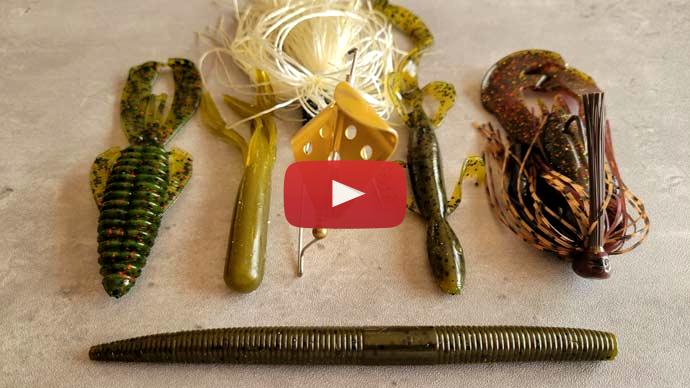


Then he shows you how to work a bed methodically, read a bass’s “personality,” choose the right baits and colors, and trigger bites without brooming the nest or destroying the eggs. You’ll learn when to move on from spooky fish, how to shorten baits for nippers, and why releasing bedding bass quickly is critical for a healthy fishery.
Hey springtime's here, and you know what that means. That's right, spawning bass. Yeah. It's the thing that a lot of us look forward to because catching bass off beds and sight fishing can be really, really exciting to be a heck of a lot of fun. So let's talk about that a little bit.
First of all, the majority of the spawn happens when the water temperatures in the upper 50s, say 58° to 62° in that range. That's generally when it the majority of the bass spawn. And I emphasize majority because, you know, nature has a way of taking care of itself. And so not all bats spawn at the same time. There's a good chunk of them that actually spawn earlier than that. When the water temps in the low to mid 50s, they're typically deeper in like 10 feet of water or so. We'll get to depth in a minute and then there's another flight that tends to spawn later. When the temps in the upper 60s and low 70s, you'll get another wave of that.
And yes, sometimes bass do spawn more than once in a year. There's sometimes bass that do spawn in the fall. Some of you have noticed this and like it looks like he's spawning, but that's really weird. It's like, you know, September. Yeah, they do do that. It's not all of them. It's a much smaller percentage. But yes, sometimes they do that. But we're talking about spring, we're talking about upper 50s, low 60s. Here we go. The most amount of bass are spawning right now.
So what do we do? First of all, you want to break out your. 7 foot 1 medium heavy fast action bait casting rod rigged with 15 LB fluorocarbon line. Why that? Well the Bay casting rod that one is the most versatile all it's super versatile The the beds are going to be anywhere on like against breakwater or bridge pilings are going to be on dock pilings, boat docks that can be next to a log stump or a boulder, I mean. Buried in weeds so you're 7 foot 1 medium heavy rods going to be. Your most versatile Jack of all trade rods to come up against all that stuff, plus that fluorocarbon line. You want clear line. This is a definitely a slow-moving process. The baits are moving slow. The bats are going to have time to examine your offering and you certainly don't want them to see your line. So fluorocarbon line is what you want to have.
The other piece of equipment you need to have is polarized glasses. You have to be able to see underwater and polarized glasses enable you to do that. So make sure you got a good pair of polarized glasses.
These bass typically in this 58 to 62° weather, a water temperature. They spawn in less than 5 feet of water. But if they spawn earlier when the water temperature is cooler, they're typically in 10 feet or so, sometimes 15 feet of water. So you guys that are fishing for those pre spawn bass and you're out there, you know, casting away to the banks, you could be going right over the tops of of beds. And typically it's the bigger fish that spawn first. So you might want to check every once in a while, pull out a little bit and look a little bit deeper. You might see some big bass there spawning earlier than you would expect. But generally speaking, from then on out there, there are shallower
And what you're looking for. If you haven't seen embedded, you know a bass bed before, it's kind of a round dish plate size, usually a foot to up to a three foot. Sometimes it can be really big. Smallies especially like to make really big beds. For some reason the size of the bed is not relevant or relative to the size of the bass. I've seen some really big beds with a little buck bass on it. Very ambitious. So, you know, don't just go around looking for the biggest bed you can find thinking you're going to find the biggest bass. That's not true.
But it will typically be a lighter or darker color than the surrounding areas, depending on the composition of the bottom of the lake or river that you're fishing in. So just look for that kind of a, you know, a dinner plate size that's average size of a of a bass bed. And they're going to be butted up against something. Usually it will be up like against a dock piling or seawall or usually a lot of man made stuff, you know, breakwater they're going to be up against maybe a rip rap. Against a log or stump, something like that.
One of the things I've noticed with largemouth is largemouth, I guess they're private, I don't know, but they don't like to be insight of another largemouth that's spawning. So maybe they're just really modest. I don't know but they if you if you found a bed for a large amount, there's not going to be one within visual distance of it. They keep themselves separated. Now that doesn't mean they won't be close because sometimes you can have like a lay down. It's a big log. And you can have one bass bed on one side of the log and another bass on the other side of the log, or a big rock giant boulder the size of a Volkswagen, for example, and you'll have a bass on one side and another one on the other. If they can't see each other, they're they're happy. They're fine.
Small mouth and more communal. I've seen small mouth just they find a good area and they just all attack and they're all having a hard fun time and they can all see each other no big deal. I've noticed small mouth prefer a gravel and real hard bottom. Yeah, they will skip over areas if they can. If you're lake or river has an area, it's got a lot of good gravelly bottom to it or rock bottom, scattered rocks, something like that. They gravitate to that first. That's an area they prefer. Largemouth are not as picky and just a solid bottom is what they need. So even if it's kind of a soft bottom, if they can fan away the silt and you get to a harder bottom, they're good to go.
One way to tell is to take a look at what kind of vegetation is growing in the in the lake bottom, you know? Lily pads tend to grow in a little bit softer bottom. That's not to say you won't find large mouth spawning around Lily pads, you will, but as a percentage you'll find more that are spawning around a harder bottom. That's like pencil reeds will grow in and cattails. They tend to grow in harder bottom, harder soil. So if you got a lake that's got a lot of Lily pads and it's got a lot of. Reeds and stuff. I would go to the reeds because you're going to probably have a larger population there that are spawning than in the Lily pads, just as an example. But those are the things you want to look for when you're efficient for these spawning bass.
Now, before I get into how to fish for them, I want to make something perfectly clear, guys, when you catch these guys. Photograph him, way him if you want to, and then let him go right away. Just let them get bright back to you and let them do their thing because you know you want them to replenish and keep the fishery healthy. So don't take them. I mean, come on man, because if you take them then that they're to guard and defend the nest, nest traders will come decimate that entire nest and you know you've destroyed. A lot of bass with one by keeping one so just let them loose.
Now how to catch them? Several different ways, but first of all, I mentioned that baitcaster. So this is where pitching really comes in handy. I've done a lot of videos on how to pitch and how to get better at pitching. And now we put it to the test. Because what you're going to do is you're going to be about 7 to 10 foot away from the bed. Don't get right up on it. If you do, the bass may not spook. And if he doesn't spook, he still sees you, and he's going to be a lot less apt to bite if you're right up on top of him. So back away as much as you can where you can still kind of see him.
Now you make your pitch. The lures. Going to be like a tube. Or a small plastic lizard that works really well. I can have a small jig, but I really shy away from that. I'll tell you why in a minute, but I like to use tubes. I like to use a little 3 inch grubs I like to use. You know little lizards, those work really good. 4 inch small ones in a bright color. The color doesn't really matter, but you need to see it. So a white color or a pumpkin seed or sorry white white color or a bubble gum works really well.
Pitch it. Past the bed, real lightweight on these, maybe an 8 oz weight. Super lightweight. It's not because you want a slow fall. But it's because what you're going to do next is you're going to drag or kind of hop that bait up to the edge of the bed and let it sit. The bass will probably notice that something moved in their area. And they might be a little frazzled by it. They'll move around, look at it, let them settle a little bit, kind of not move as much and get settled back to where he was sitting. Know where he was sitting, by the way, before he made the cast. Because that's important because that's his, that's his happy spot.
So wait till he kind of settles back into that. And now what you're going to do is kind of move your rod tip lightly and just kind of wiggle it, just kind of jiggle a little bit as you kind of crawl it up into the bed. You don't want to drag it into the bed. So This is why you don't want that heavyweight. You're not going to dredge a trench through the bed. You're just going to lightly let it kind of come across. Skip across the top of the bed and a little bit of vibration and let it stop. Basso come up, he's gonna go. What the heck is that? He's gonna go look at it. Let it sit.
Now this is where things get fun. If you've ever had. OK, let's say you really like German Shepherds or Labradors or Quarter horses, right? And you've had several through your lifetime. Even though they look very much the same, they all have their own individual personalities and their own quirks. Definitely they are different from one another and I've I firmly believe bass are that way too. And So what happens next when you when you work a bed really depends on the personality of the bass. And I call it the personality. Come on, let's not get in a biological debate in here. Yeah, okay. I'm saying personality to help you understand that they react differently to the same presentation from best to best to best.
So what you want to do here? Typically what I do is to start off with is I do that little jiggle, move it, the bass sees it, cool, then I'll give it a little bit of move. And see what he does, if he reacts to it or not. Sometimes they immediately bite it, a lot of times they don't. And you jiggle a bit more. And sometimes they come out to it and they're checking it out and then you just jiggle it in place. Give it a little bit of movement, let it sit. Sometimes a long, long pauses is what you need to do. Let it sit and play with that. A little bit of jiggling, a little bit of maybe a hop or two, pausing and you're going to work it past the bed and out at some point and the bass is not going to be interested anymore. He's going to go back to his bed. That's when you reel back up, cast again and try again.
You need to experiment with length of pauses, how much you hop it, how much you jiggle it. Play around with that. Several things to think about when it comes to this. First of all. A lot of times what happens is a bass will watch it and come up to it and look at it and won't bite it. And you've got to get a cue here as to whether or not they're going to bite or not. And what I've learned is a few characteristics.
First of all, if you make a cast and you it's past the bed and it plops down as soon as that bait hits the water, even though it's not on top of his head, the best takes off, he's gone. He is out of there, Jack. And if he comes right around, he spins right back around, comes back on the bed. Then that's OK, But if he takes off and you know, like you're sitting here going, where'd you go, buddy? And you wait and you wait and you wait and it's to me, it's like if it's more than 30 seconds, more than 45 seconds before he finally comes back to the bed, it's going to take a lot of work to catch him.
It's not that he's not catchable, but he's real skittish. And he may have been caught before or several times before, but I don't know what the deal is. But at this point, by the time I approach him, he is really wary and not as. To bite, I've been able to get them to bite, but it takes like an hour sometimes, sometimes longer than that, which feels like a small victory when you finally do get them to bite. And you learn an awful lot by coaxing those bass to bite. It takes a lot of work and effort to do that, but I've come to the realization that if I see one that's real spooky like that, I just pass and move on to the next one. This is also the reason why you don't want to drop your bait right on top of the bed, because almost always they scatter and now they're spooked and there's jittery and you've really reduced your. Chances of them biting.
All right, so. Thrown back out there, bring it on back. Playing around with it. This is what happens sometimes. A bass well. He's not showing interest in it, but he's not biting it. Watch if they're sitting there and they're and they start doing this a lot. If this starts to twiddle move around an awful lot, that's showing that they may bite. They get a little more excited, a little more interested and that's an indication they may bite. Another one is what I call barking is literally what they'll do. They almost like they blow on it. They open their mouth and they and they kind of. It looks like they're barking underwater. And if they bark at it, then that's a surefire sign that they are going to bite. They are getting close to biting sometimes 5th, 6th, 7th cast, you'll see them bark at it and like, OK, I almost got you now buddy. You know, maybe the next cast or two and you'll bite.
What happens though sometimes is when they bite, Small mouth are really notorious for this, but large mouth do it too. Sometimes, you know, they are not interested in eating. I want to make this really clear. So they're not, they're not going to bite because they're hungry. So they want, they want to, they want that thing out of their nest. They want it gone. And so a lot of times they're trying to spook it. They're trying to scare it. They're trying to make, you know, threaten it so it goes away. If that doesn't work, then they might nip at it or maybe even pick it up and carry it off the nest. And drop it.
And what I mean by that is a lot of times I pick it up by the tail where the hook isn't. And they'll carry off and drop it and you see the bait, they got it. Whoa, set the hook and all you're doing is just pulling the bait out of his mouth. The hook is already out. So you never hook them. I've had some sometimes pick it up by the Shank of the hook. Those little devils, they'll do that, you know, set the hook and just pull the hook right out. It's it's, it's frustrating, it's madding. And sometimes a bass will do that over and over and over and over again. You just never hook them.
So with those, what I'll do is I'll take a tube bait and I cut off the skirt into it or a grub and cut off the tail end or maybe even use like a Ned rig and have the hook that goes all the way to the back. It's almost hanging off rather than even in it. But I have to Texas rig it because if you Texas rigging it, you got to do that with these plastic baits because you're going to get hung up doing this because it usually around some kind of cover or something where you can get hung up. So you have to text us real good. But you can at least shorten that bait up so that hook is as far. As you can get it and that could increase your chance of hooking that fish that's just nipping at it and picking it up and dropping it off. Increases your odds.
One little other thing that I've noticed is sometimes you can cast and cast and cast and never get ready to react to it. And with those bass, I try to threaten them with the bait. I literally chase them with the bait. I come up and I knock them on the head with it. I reel it. I just cast out. I don't even hit the bottom. I just cast out and reel up and bam and hit them and reel it back in, cast back out and reel it back in and hit him. And sometimes you have that line goes over the back of their back and they feel that and they swear around and move and so I'm trying to dodge. This way or this way and trying to get it to hit him and try to threaten him with it.
And sometimes that happens. What will happen is on the, you know, 6th, 7th, 8th cast of doing that, they'll spin on it and just grab it and you got them. Just I don't know if it's out of aggravation or what, but sometimes a bass will do it. Other bass going back to that personality thing, other bass, you do that and they they're gone. They run away like, well, I'm out of here, Jack, this thing's trying to kill me. I'm gone. Other bass, sometimes they don't want that to, they want that grub. Are they only hit a lizard? So when you go to the next. Bad you got to learn that bass all over again. What is it that's going to trigger him right?
So you might This is why you got to have a couple of different baits, a couple different ways of fishing among the ways I'm telling you there's a lot of different ways you can get them to trigger and you got to figure out what that trigger is going to be for that particular bass. And sometimes there's a spot on that bed that he's like that is his hot button. If you get your bait on that spot, then he's going to nail it. And it's almost always never the center, the nest and the eggs almost are never. In the center of the bed, they're usually off to the side somewhere.
And that brings me to the next point. You got to be real careful. Don't use a jig. To drag across the bed. I've even caught one time I caught a bass dragging a spinner bait across the bed and I felt really good about that until I realized I dragged it through the eggs. And I had eggs stuck on the skirt. And even though I caught that fish, I ruined his nest. And this was decades ago, but it still bothers me to this day. Any kind of a bait like a jig or spinner bait that's got skirts on it, just don't use it for this technique because it will sweep the nest of all the eggs. It just acts as a big broom and just sweeps it, right. So don't, don't use jig on this kind of stuff. Please don't because you're you're going to destroy the nest.
So. With all that in mind. You can go out there and hopefully catch a few bass on beds and it's real exciting to watch them react to it and to entice them and get them to bike. Just be sure to release them once you through taking a picture of them. All right. For more tips and tricks like this, visit bassresource.com.