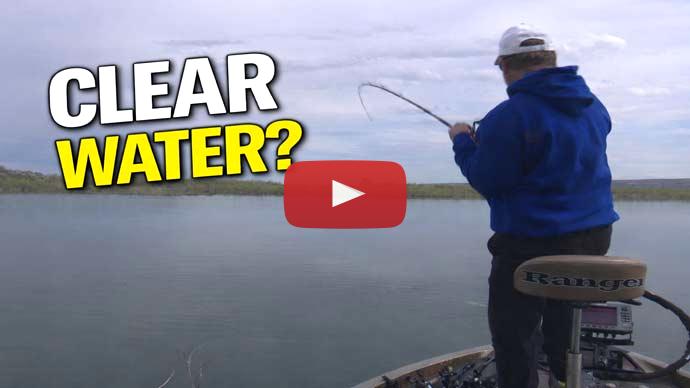
Now I've been fishing clear water for decades and what I mean by clear water, I mean sometimes it's ultra clear like bathwater, but most of the time it's 8 to 10 foot visibility, which I know for you is really clear water and I've gotten really accustomed to it and and proficient at doing it. So I want to give you my little tricks that I use in clear water. If you ever come across that, don't be intimidated by it guys. It's actually going to be very productive. I actually enjoy it now and prefer it.
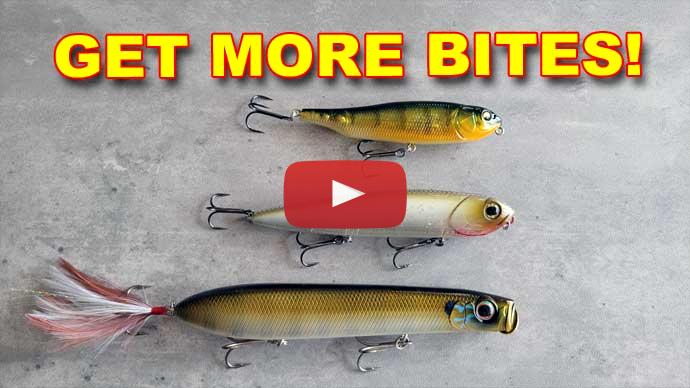
So one of the key things about. Is the lures that you choose. So I’m going to go to my top five baits that I use in clear water, starting with translucent top water baits, specifically The Walking baits and the poppers. Translucent. What I mean by that is you can hold it up to the light and the and the light will go through it. It doesn't mean it's clear like, you know, colorless, like a window, but it is you, the light will go through it. So it's a little more subtle and you can still use, you know, your shad colors, perch color. Be any kind of bait fish color, and I would highly recommend that. But because they're subtle and more translucent in clear water, it kind of conceals itself a little bit better. And the bass, you know, if they're going to bite it. You know they typically do out of curiosity. They're not quite sure if it's real or not. If you use a solid color, it doesn't, it looks fake. clear water, so translucent is best, working real slow, just a top water walking bait. You just work it back and forth and back and forth with long pauses in between.
I like to work them along docks because you know this provides shade and in clear water shade is the key. You really fish those shade pockets. So docks offer a lot of shade. So work those poppers and walking baits along that. If you've got some sunken brush, brush piles, things like that, that can offer shade and protection. Some thick weeds working it over the top of those sometimes calls those bass right out of deep water outside weed lines. A lot of times the bass will cruise that. I'm talking those bass will be 15-20 foot deep. This is a kind of clear water. Those weeds grow that deep.
Here's the thing with top water guys in clear water, typically what top water is, it calls bass from farther distance horizontally you're fishing it's shallow and bass that are out in longer distances will come in. That still works in in clear water, but you've got an added dimension with clear water, and that is depth, you can call fish up from deeper water than you normally would in dirty water. So fishing at over 20 foot of water is not unusual. If you fish it over a rocky point or a point that's got some stumps or scattered boulders on it, all the better. Or a deep weed line like I just mentioned, it's 20 foot deep. You can fish as a popper or a walking bait right over the top of that and it seems really weird. You're in deep water and all of a sudden a small mouth comes screaming out of it like a Polaris missile. Bam, you know, comes clear out of water with it in his mouth. Man, that is so exciting. A large mouth will do it too, so don't be afraid to fish it over deeper water. That's a key thing in this kind of water.
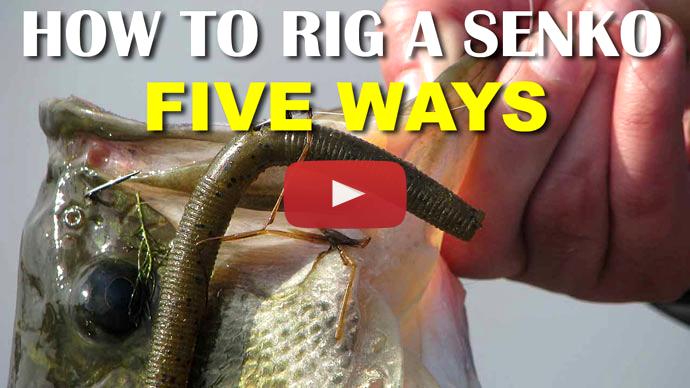
The next bait has become a staple in my arsenal and that is a soft plastic stick bait. You know like a Yum Dinger or a Senko. You got kind of style bait works great in clear water. Stick with your watermelon, watermelon seed or your green pumpkins, right? Those work really well for clear water conditions.
The normal 5 inch size works great guys. Don't be afraid to use them. And I catch a lot of fish, especially if the fish are in like weeds. Or they're in sunken brush piles, or they're under docks. A 5 inch works really good, but a little bit in open water I'll downsize to that 4 inch size. That tends to get more bites for me. So a 4 inch sized bait in the same colors works really really well.
There's two ways to rig it that work the best in clear water. One is the wacky rig. Most people rig it that way. That's where you take the hook, put it right in the middle, and then that bait kind of undulates as it falls, gives a lot of extra action. In clear water, sight and visual appeal mean a lot, and that'll attract the bass in further distance when it's got that action to it. So the wacky rig works really well.
The problem with a wacky rig is that the hook is exposed and you can get snagged in a lot of stuff when there's fish are up in those weeds and sunken brush piles and flooded bushes and trees. Wacky rig, you're getting hung up a lot. So that's when I flip over to a Texas rig style. Again, totally weightless. Texas rig in this matter means the way the hook is is rigged, not because it's got a weight on it. So keep it weightless, but now it's not going to get hung up. You can now throw it in and around all that stuff that I just mentioned and you're not gonna worry about getting snagged. It's also a really good bait to skip up under those docks, so don't be afraid to do that too, because sometimes those big bass lurk underneath those docks in clear water, and skipping a little Senko underneath there is what it takes to get them.
The next bait are thin jerk baits like the Rapala, or Rapala some guys call Rapala a thin jerk bait or Cotton Cordell. These type of things that are they're pencil type stick bait. These work surprisingly well spring, summer and fall. A lot of folks think that the deeper diving suspending type is the only type you can throw, and you can only throw them in the early spring. No these ones are shallow divers, go to 1 to 2 foot deep. They have a real tight wiggle to them and they're certainly not limited to cold water. They work excellent in the warmer water especially. To me, the warmer the water, the better they work, especially in clear water. It really looks like an injured minnow and those bass just cannot resist it.
Throw it out over the top of those bushes over the submerged weeds. You know you don't. He's got treble hooks. If it's got emergent weeds, you don't want to throw it in that because this is going to foul hook and you're going to bring back a lot of weeds, but. Along those docks that I just mentioned, you throw it out there, let it sit, wait for the ripples to dissipate, and then twitch, twitch, twitch, let it sit, let the ripples dissipate, twitch switch, let the ripples dissipate and twitch twitch.
These baits are really light, so I'll throw them on spinning outfits using 6 to 8 LB test line. Fluorocarbon line is what I like to use, or monofilament. Either one works really well. Monofilament might actually be a better choice because it it floats. But wait for that bite. And when the fish, typically they hit it on the top and sometimes they come out and they pop it, they swirl on it. They don't take it right away. So if you see that strike, don't set the hook right away because you might get a bunch of treble hooks coming out your face at Mach 80. Wait, let that, let that fish grab it and wait till you feel and tug on it. Not, not when I hit it. You're going to feel that strike, You're going to feel that twitch, but you feel that weight when they pull back on you. That's what you want. You feel pulling on it. Now they've got it in their mouth and you can set the hook. Get them, reel them in, that's real critical at fishing these baits. Sometimes just letting it sit there and float on their surface is all it takes and suddenly a bass will come annihilated after it's been sitting for like 20 seconds. So a real fun bait to use. Don't limit it to cold water, use it during the warmer months and you're going to have yourself a blast in clear water.
Now, like I mentioned, they have treble hooks, which means they can get snagged on stuff. So if you're in areas where there's a lot of flooded bushes and timber and a lot of weeds, you know, Lily pads, things like that. You can switch over to using a soft plastic stick bait like a Fluke. Right, use that weedless rigged, weedless, weightless, and now you can use it in those areas without fear of getting hung up and they can be just as effective. I just I use the straight white one, but you can use alewife, you know, on the white and silver colors, even a green pumpkin or any kind of the green pumpkin tilapia, those type of things that got a green pumpkin hue to them with some sparkles in it. Tilapia is from big bite. Big Bite Baits is one of my favorites. And just use that to slowly, softly twitch it and work it across to all these. Areas that are real weedy and snaggy and you don't work real hard, just nice soft twitches at all it takes. And those work really, really well in clear water.
Now another bait I like to use. If you've been watching my videos anytime, you know that I love spinner baits and spinnerbaits work really well in clear water despite their appearance. This is big, clunky metal things that don't resemble any kind of baitfish or forage in the water. So why would a bass hit it? Well, it looks alive, that's the key. I use big ones, Yeah, despite you know, many people saying, oh, downsize using an 1/8 oz, use 1/4 oz spinner bait. No, I do the opposite. I'm using a three quarter oz bait and I'll tell you why.
The key in clear water is speed. When it comes to these large bays, you're looking for a reaction bite and this is going to elicit a reaction bite. You're throwing it out and you're burning it back just under the surface really fast, maybe a foot or two under the surface if that. So to burn it back really quick, if you're using a a heavier or lighter bait, it will lean over on its side. You just can't burn it back quick if it does tip over on its side. So a three quarter oz spinner bait. Will, stay true. It'll track really well.
I also use a double Willow or a double Indiana blade, silver or gold blades. Those have a little bit less resistance, so they're less prone to tipping over and they have a lot of flash and vibration to them. And you think, boy, I don't need a lot of vibration in clear water. Well, if they're in those weeds and those brush piles in that thick cover, you need a little bit of vibration to call them up out of it. And this does that bait. Flinging right by him at mach 80. They they have to either bite it or lose it forever. So all the strikes you get are often vicious. They annihilate it.
I'll add a trailer on to them. This again aids with the buoyancy, aids with tracking to help it keep it go straight. If you're fishing it and it is tracking to the side and you've done all this stuff, check your trailer. The trailer has to be straight, has to be true. You've got to make sure that it's aligned on that spinnerbait perfectly straight. If it's off by a little bit, it's going to make your spinnerbait track to its side a little bit. So make sure that's on right. And even if you check that and it's still. Not tracking right. You just take the trailer off. Flip it around, rig it back on, make sure it's nice and straight. Sometimes that's all it takes is maybe off just a little bit to the point where you can't see it, but that's what's causing it to track a little bit on the side.
If you've done all that, hey, take the trailer off and do it again. And if it still goes on its side, then you can tweak the blades, the arm, just tweak it to the left or right. If it's, if it's going over this way, then tweak the blades over this way a little bit. Or if it's tweaking this way, tweak the arm over this way a little bit and that generally brings it up and makes it run. Straight, so those little tweaks.
I don't use trailer hooks. The reason I don't use trailer hooks is because you can get it snagged and things and a lot of times I'm throwing these spinner baits in and around all this kind of cover and I don't want it to get hung up. So and it also interferes with the trailer too.
If you're getting follows or you're getting fish that are nipping at it, they're telling you, man, it's almost right, but something's not quite right. And typically that's the color. So change the color a little bit, make subtle changes, don't make drastic changes. So for example. We'll all go from gold blades to silver blades, or I might go from a white skirt to a white and chartreuse. Or if I've got. White trailer to a chartreuse trailer, right? Subtle changes oftentimes as all it takes for the get them to commit. Again, you're reeling it really fast, so they don't get a lot of time to examine it. They're just going to whack it. So don't leave out the spinnerbait in clear water.
And then finally, one of the baits I like to throw the most is a finesse jig, a small jig, like 1/4 ounce jig, maybe even 1/8 ounce, but 1/4 ounce works best for me. And again, downsize that trailer. You still want some action to it. So like a small baby rage craw is a great choice as a trailer. Keep it natural. The brown colors, the the green hues. If you've got some really dingy water, but we're not talking about that. That's when I use the the Blues, you know, the black and Blues and those type of things. But in clear water watermelon, maybe a little bit of hint of blue in it. Those are great colors to use. Green pumpkin.
You can use it on spinning gear on rocky areas. That's pretty traditional when people are fishing for smallies, so don't leave those out. The it's a ball head jig typically and those work great in rocky areas. They don't get hung up even if they do snag a little bit because the eye is straight up on the top. They can pop off pretty easily. You can either move along the bank and get a different angle or move your boat around and just give a little pop and it'll come right off.
So those are great for fish and rocky areas, but don't forget throwing them into weeds. Skipping them under docks like you would larger traditional jigs. A lot of guys flip and pitch jigs. Do it with the finesse jigs too. That's a little kind of unsung hero in clear water. What people don't do, and I have a blast doing it.
So when if I'm fishing in clear, open water and rocky areas, I'm usually using spinning gear. I'm using 6 to 8 LB test open water, no big deal. Fluorocarbon line because fluorocarbon is more abrasion resistant than braid. The one I'm using rock fishing rocky areas. However, if you're flipping and pitching in, all this cover in the thick weeds and the flooded timber and the bushes. Those type of things stumps. That's when braid works really well. And I'm using light braid, nothing too heavy, maybe 15 LB right in that 15 to 20 LB braid. Nothing too heavy and I'm using a lot of mono backing on my reel. Because I just want that braid at the end, I'm not using any. Leader or anything like that because the braid is where it works really well in that cover and the unit despite having clear water. Because those fish are in those snags and in that weeds, the braid gets concealed pretty well. So and that braid is what you need to cut through all that stuff when you hook the fish. So adding a leader that's monofilament or fluorocarbon kind of defeats the purpose there. So don't be, don't think. Oh, it's clear water. I have to use a leader. No, that's not the case. It's how you're using it, where you're using it in this case, because they're flooded. Weeds or Bushes or heavy cover that Bray is going to suit you well, so just flip and pitch it like you normally would. And be surprised how well that works.
So those are my top five baits for clear water and tactics too. I hope that helps. Hope next time you get you can encounter those real clear water conditions. You catch a lot of fish. For more tips and tricks like this, visit bassresource.com.