All right. We're getting into the topwater season, and it's gonna last all summer long. This is gonna be a lot of fun. Topwaters are so exciting to fish. But there are so many different types out there and so many different ways to fish, and it can get really confusing. So I'm gonna break it into six main categories and tell you exactly how to fish them all, starting with poppers.
Poppers basically come in two different styles. One is a larger popper that really chugs. This could be a Hula Popper or a Chug Bug. They bloop. When you pop them, they go bloop, bloop, bloop, and they make this noise when they pop along the water.
The second type is more of a spitting type of popper, and that'd be like a Pop-R. These smaller minnow-type style poppers. They just kind of spit water. They don't really pop or make a big noise. They can if you pop them really hard, but they're more designed to be more subtle, look more like a small injured minnow that's dying on the surface of the water and just kind of struggling. A little pop, plop, plop, makes these little noises.
The difference is, you know, sometimes the bass want that big noisy blooping, blooping, you know, big popping-type lure, and the other times they want something more subtle. I tend to use the ones that make more noise when there's a little more chop in the water. And when the water is really calm or clear, then I use the spitting style.
You cast them up, let's say, along an object, like a dock or laydown, let it sit for a couple seconds, and then give it a few pops. And the amount of pop you give and how hard you pop, it varies, but just start with what you feel is comfortable. Just give it a pop, pop, pop, and then let it pause. Let it rest a few seconds, 5, 10 seconds, then give it a pop, pop, and let it pause for another 5 to 10 seconds. And rinse, lather, repeat that cadence a few times.
And sometimes what happens is the bass will smack it while it's just sitting there, or when you start to move it again. And you got to experiment with it. Sometimes they want a much louder, harder, aggressive popping, and the other times they want a more subtle twitching action. And sometimes they want a really long pause in between pops. And other times, you can pop it all the way back to the boat, just pop, pop, pop, pop, pop, pop, pop. As you're reeling the rod, that can be a very effective way. It can just get the bass all excited up, and they attack it even while it's just moving across the water very quickly.
So there's a lot of different ways you can fish them. Just, you know, shallow is typically the areas where I fish them. If the water is really clear, though, 20 foot, 30 foot of visibility, you can bring it across points in deeper water, in rock piles that may be sitting in 15 feet of water, and you can draw up those bass from deeper water with a popper. So they can be very fun to fish.
And color-wise, I would use anything with a white belly. I mean, you can use shad colors and bluegill colors, and they come in a whole variety of different colors. I tend to use a white belly or a chartreuse belly or an orange belly, just trying to imitate the bottom side of various different bait fish there, and they work just great for me.
The next category is darters. These are characterized by baits that look like a cigar. There's a variety of different manufacturers out there. They make quite a few different ones out there, but they all kind of do the same thing. They sit in the water with the nose up, and the line ties a little bit below the nose. And when you twitch them, they'll dart to one side. And if you twitch them again, they'll dart back over. And if you get a good cadence of twitching while reeling the line in, you can get it to zigzag back and forth to you. And that's called walking the dog.
And you can vary how far it saunters to each side, to really slow, wide, you know, back and forth to a very quick, almost like snake-like, reeling it in very, very quick and just let it come back very, very quickly. And you can also pause anytime while you're doing this cadence.
Yeah, it doesn't look like anything in nature, but it drives the bass crazy. They blow up on this lure. And this type of lure has been around for decades, guys. I mean decades, a long, long time. Bass do not seem to get accustomed to it. They always fall victim to it. And I think it's just that crazy wild walking the dog action that attracts them, and they just can't stand it, and they got to blow up on it.
Color-wise, I use a frog pattern or anything with a white belly. Again, with the yellow belly, works good, or, you know, orange belly. Those are really what I'm looking at, not necessarily the colors on the top of it. Now, if I'm fishing really clear water, then translucent bodies tend to work a little bit better. They just have a little bit more invisibility to them in that clear water, and that tends to work a bit better in those real clear conditions.
Sometimes, it works to downsize. A lot of these baits come in smaller sizes like a Zara Puppy, and that works really well right after the spawn, for example, when the bass are just feeding on smaller bait fish, or in the fall when bass are feeding on smaller bait fish during that time of the year as well. That smaller profile tends to catch a little bit more bass than the larger ones during that time of the year. If there's a little more chop in the water, the bigger ones create a little more commotion, a little more action, and they will draw bass in where the smaller ones may not. So you have to play around with that a little bit, depending on your current conditions.
Prop baits is the next category, and these are fun. These, again, have been around since, seems like the beginning of time. I mean, at least since the '50s, if not before that. There's two different types. There's one that just have a propeller on the back and the other that has a propeller on both the back and the front. Both of these type of lures sit on the surface, and they come in a whole variety of different shapes. You've got the thin-bodied kind, like the devil's horse, and then you've got the thicker-bodied bait fish-type style bait.
There are so many different kinds that are out there that... You really have to look at the forage and what's going on with the bass. Sometimes, they want a really big lure. Keep in mind, you know, bass will hit big lures. Don't shy away from them. So some of these bigger prop baits can work really well.
The big thing with these is the difference in commotion that they make. The ones that only have a prop in the back make less commotion naturally than the ones that have props on the front and back.
How you work them. Cast alongside of a dock, cast it out there by riprap, or cast it over a point or a hump, anything where the bass might be hiding in, maybe a big flat with submerged weeds. You can draw the bass up out of the weeds this way. Cast it out there, let it sit for a little bit, and then you can give a little slight twitches and jerks, little pops to make that water spit and make a little bit of commotion in the water, and then let it sit.
And you can imitate a struggling bait fish on the surface of the water. And that's very appealing. You know, bass are predatory in nature, and they will attack anything that's struggling. So you're trying to imitate that struggling bait fish. So give it a little quick...little twitches, pops. It's almost like working a popper, you know, those popper-style baits I talked about earlier.
Here, you can give it a harder pop and give it a lot more, like, action, a lot more noise and draw them for further distances, or just give it slight little twitches and barely move that prop just to make it almost look like a tail fin that's barely moving, and you can attract them that way.
Another way to do it, though, is cast it out and just reel it in. And you can try at various speeds of reeling it in. There's really no set way. You can do it really slow. You can do it super fast. Spin out a whole bunch of water. Something's just [vocalization] going across the water. You would think a bass would never hit that, but you'd be shocked at how many of that do, mainly because it doesn't see that presentation very often. And bass are curious by nature. They don't know what it is. The only way they can figure out what it is is by putting it in their mouth.
So appeal to that. Bring it back a very, very fast retrieve. Sometimes works very well. Or a moderate speed. There's different ways you can fish them. And with the different profiles, you can pretty much match the type of forage that's in the lake, and you can have yourself a ball.
Crawlers are another type of bait. And that's characterized by, you know, a jitterbug, is like the Marquis bait. That would be called the crawler. And it looks kind of weird. I get it. And what it does when you slowly reel it, it floats on the surface and it plops back and forth. And you can hear it. It'll plop, plop, plop, plop, plop, plop, plop as it comes back to you.
These have traditionally been used at night. And you just...that noise and that commotion and using a black one because the bass are looking up and they can see a better silhouette, especially on a moonlit night. If it's totally black, they can see the silhouette. And you just slowly cast it and reel along docks and other types of cover, and the bass will come out and annihilate it.
But they're not limited to just nighttime. As you can see, there's a variety of different baits out here. And some of these are from Japan. They got some awkward, weird-looking, you know, appendages, but they all kind of do the same. They kind of splash and gurgle as you retrieve them. And they look like something could even be a bird, you know, struggling in the water, and they make a bit of commotion.
And even in the daytime, particularly in really clear water, the bass will come up and smash it. Or you bring it across weeds where the bass are buried in the weeds, the water's a little bit dingy. That noise will draw them out, and they'll come up and hit it even in the middle of the day. So don't relegate these to just nighttime fishing. They work throughout the day, too.
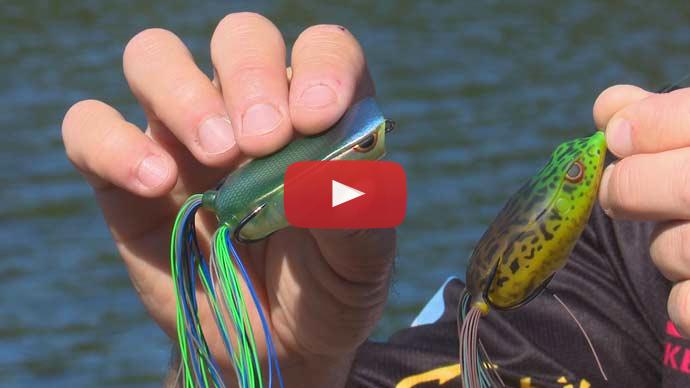
Hollow body lures is another category of topwater baits. I'm talking frogs and rats primarily. These are designed... They float on the surface, of course. The hooks, they're hugging the body of the bait, which makes them really weedless. It makes them great for throwing over matted vegetation. It also works in more scattered vegetation like lily pads or in reeds where any other kind of lure might get hung up in there. And because they're collapsible, once the bass hits it, the body collapses, exposing the hook, and that's how you hook them.
Typically, you throw it over matted vegetation and just a steady retrieve over the top of it, works it across that top, and bring it to an opening. And when you get it to an opening, give it a pause. A lot of times, the bass will track this thing going across the surface, across the canopy, and when it gets to an opening, boom, that's when they attack. So you want to look at those openings in this, you know, matted vegetation, cast over it, and bring the lure to it and stop it in those openings.
Sometimes, if the canopy is thin enough, the bass will blast up right through it and, you know, that'll startle you. It's exhilarating, it's scary. And what can happen is a lot of times when that bass blows up on it, your tendency is to set the hook real quick. Don't do that because a lot of times, especially with the canopy, the bass will blow up on it several times before they finally actually get it. And if you set the hook on that first blow up, you're going to pull the bait away from them, and then they don't get a chance at hitting it again. So make sure you wait until you feel that weight of the bass pulling back on the line. That's when you set the hook.
Buzzbaits are another category of topwater baits, and they can split into two subcategories. One of them is the inline buzzer, and it's the blade that's in front of something. Now, this might be a frog, it might be some other kind of, you know, maybe a skirt, something behind it that has more attraction, more appeal. Typically, I like to use something that's a little more buoyant to help it stay on the surface. But it buzzes across the surface, and sometimes these have frog legs, and they kick and they make a lot more commotion.
These work great over the tops of submerged vegetation, alongside docks, over points, humps, any kind of brush piles, over the tops of anything where bass can be hanging out in. It draws them out, has a good drawing power. And again, you can fish these at any kind of speed. Slower speed generally is better while keeping it on the surface, but a real fast retrieve too can elicit a strike. The problem with these is that the hook's exposed, and it can get, you know, tangled in stuff pretty easily. So throw it across matted vegetation or in between lily pads or into reeds. You're going to get hung up a lot and get frustrated.
Enter the other kind of buzzbait, which is more of a... It's this style of buzzbait here. What you can see here is the bait is below the surface while the actual blades are on the surface. And the wire itself acts kind of as a weed guard. So these are a little bit more weedless. So you can throw it in a little bit more areas and not worry about getting hung up.
You can fish these around the same sort of areas. And again, you can have a skirt on it, or you can have, like, a frog-type trailer on it, some kind of plastic body on it to give it more appeal and a little more buoyancy. The key with these is fishing them as slow as you can. Most of the time, that is the best retrieve.
So usually, ones that have a bigger blade tend to be able to stay on the surface at a slower speed and can create quite a bit of commotion. I like the MegaStrike Cavitron for that reason. Really, you can crank that thing real slow and keep it on the surface, and just plodding it along. That's all you need to do, a steady retrieve. Sometimes, give it a little pop with the rod to splash a little bit, and give it a little bit of sudden movement. Sometimes, that elicits a strike or calls bass in from far distances by doing that. But typically, cast it out, bring it along your docks, along this other cover I've been talking about, and boom, you know, it works very, very well.
Topwaters, in general, all of these can work throughout the course of the day. A lot of people think they're only good in the morning and in the evening, but I've seen them work in the middle of the afternoon on a bright sunny day. So it just depends. If the bass are up in that cover, if you can get it by that cover, they'll come out and whack it. So don't relegate yourself to just the morning and evening hours.
The key thing with fishing all of these topwater baits is how you set the hook. If you have to, remind yourself not to set the hook when the bass boils on that lure. A lot of times what happens is bass, especially the bigger ones, they're pushing a lot of water in front of them, and when they come up and hit the lure, the lure gets pushed out of the way. They open up, and they miss. And then the lure comes down, they come back down, they find it, and they catch it. Or they might just catch the side of it or the tail of it in that initial blowup, and they bring it underwater, they open their mouth again, bring it down further, and then they've got it.
When you see that initial blowup, it's so easy to go [vocalization] and just jerk, you know, just set that hook. It's just a natural reaction. Everybody does it. We all do that. It's exciting. What you got to do is tell yourself, "Don't do it." And I have to remind myself, the best way for me, at least works for me, is as I'm using this lure, I keep reminding myself, "Don't set the hook, don't set the hook, don't set the hook, don't set the hook." Every time I cast and reel, "Don't set the hook, don't set the hook."
The blowup happens, stop reeling, hold the rod. And when you feel that tug-tug, like you would on a jig or a plastic bait or something, you feel that tug-tug, now you know the bass has it, set the hook. So typically what I do, the bass blows up on it, I reel down in the hook set position, wait until he makes the move, and I feel him, then I set it. If you preemptively set the hook and he doesn't have it, you're going to have, especially those treble hook ones, coming back at your face at Mach 80. That is not a pleasant experience.
So don't be that guy. Don't get hooked in the face with a topwater lure. Just be patient, wait for that weight, and then set the hook, and you'll catch a lot more fish that way. I hope that helps. For more tips and tricks like this, visit bassresource.com.