Alright, if you're a beginner at bass fishing, no doubt. Have you seen crank baits and is a bit overwhelming. There is a ton of different crank baits out there and gosh, how do you choose? Well, let's let's break it down. Let's make it easy. Very simple. You don't need to go too crazy with with crankbaits. Think about crankbaits. The key thing to consider is their diving depth. That's like #1 deciding which crankbait to use. Diving depth is often printed right on the package and it's often. Range like 8 to 10 feet. 5 to 8 feet, 10 to 12 foot.
Why is it a range? Well, because there's a lot of variables that go into how deep a crankbait will dive. So line diameter for one. The thicker the line diameter, the more resistant it is in the water and the less it won't get as deep. Line type if you're using braid. Braid is buoyant so braids going to get this arc in the water and it floats somewhat and it's going to prevent your crankbait from reaching the maximum diving depth, whereas fluorocarbon sinks. And fluorocarbon, can you have a direct connection? You'll have less line in the water and you can get it down deeper.
How far you cast is another variable as to how deep it will get if you cast way out there. The crankbait gets down to its diving depth and stays down there before it starts coming up towards you as you get it closer to you. If you make a short cast, it doesn't have time to get down its diving depth before it comes back up to you. So long casts are critical in getting the maximum diving depth out of a crank pit.
How do you choose what depth to go? Well, you want to crankbait to dive a little bit deeper than the depth that you're fishing. So if you're fishing 8 foot, you want to crankbait that dives 9 or 10 foot. Why do you want to do that? Well, the crankbait, a lot of times you’re fishing open water, open, you know, like a point or a hump or a ridge that doesn't have any weeds in it and or riprap. And you want it to get down there and bounce off what's down there, bounce off a rock or a boulder or stump. You know, when it hits that and deflects off of it, that sudden change of action and that erratic movement, that's often what triggers a strike rather than just straight reeling it back to you and then cast again that bouncing. Around on the bottom. Yeah, that's the key to fishing these things. So you'll want. A crankbait to dive a little bit deeper than the depth that you're fishing.
Now if you're fishing. Weed bed. The bottom then is where the weeds top out. So you might be in 15 feet of water, but the weeds will top out. Say it's 6 foot, so you want to crankbait that runs 5 to 6 foot, maybe 7 at the most, and you want to get down there and just kind of tick the tops of the weeds every once in a while. When it does that and you feel that resistance, you give it a good hard yank. Rip that crankbait right out of the weeds. It blows the weeds off of it, and that sudden change of direction once again often triggers a bite. So that's the key to figuring out what depth to use.
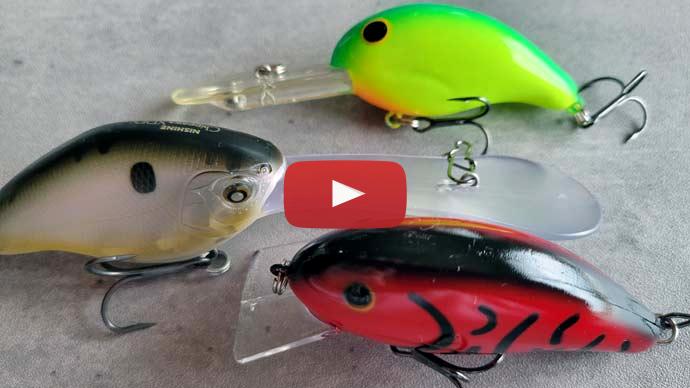
Crankbaits generally can be categorized into three different. Categories shallow diving, medium diving, and deep diving crankbaits. So the shallow diving ones typically are your square bill crankbaits and your lipless crankbaits and a variety of other crankbaits that are very short bills on them and the only dive down to about 5 or 6 feet and that's it. Those are great for like springtime when the fish are shallow. Same thing in the fall, they're back up shallow again. Sometimes even in the summertime they'll be up under docks or along weed lines, shallow weed lines. On the outside weed lines, those shallow diving crankbaits work wonders along that square Bill has become very, very popular because it can bounce and ricochet off those things without the hooks getting snagged up on anything. They're not completely weedless, you can still get them hung up, but they do a better job of going through these things without getting hung up, so they become immensely popular.
Going a little bit deeper. At 5 to foot, 15 foot range, that's like the majority of your cranking. That's where most guys are crankbaiting all the time. You're fishing outside weed lines, you're fishing deeper ridges, humps, those tapering points with scattered weeds or boulders on them, Creek channels, ledges, it goes on and on. But that depth range is where a lot of bass are at year round and so a crankbait works really well to reach them.
Thing about it is I just mentioned year round. One of the things you want to consider is the wiggle action of a crankbait.
Those thinner, flat side crankbaits with a longer, thinner bill, they've got a real tight wiggle to them. Those work better when the water temps are below 55°. That tighter wiggle, I don't know why, but that tighter wiggle is what the bass key on during colder water temps, with the exception of the lipless crankbaits. Lipless crankbaits work year round regardless and I know they got a tight wiggle, but they work just as good in the summer as they do in the winter time. So I got a bug in my eye. That's really key. As far as that wiggle action, the other side of the of the coin is the. Wider wobble.
These are the crankbaits that are kind of bulbous. They've got a round bill, kind of a wide round bill to them, and what they do is they wobble, they have a pretty. Violent action back and forth, you know, real pronounced wobble back and forth. And that works best in the warmer months. That aggressive movement often triggers aggressively feeding bass. They'll go out there and justice wallop the snot out of it so. Having a wide wobble crankbait during the warmer months is key in having a tight wiggle crankbait during the cooler months is key.
The last depth is the deep diving crankbaits and this is the one. A lot of guys don't fish as much but these are the ones that go 18 foot 20 foot 25. Some are even known to go deeper than that. These crankbaits can get down to areas where a lot of times the bass don't see crankbait. OK, a lot of guys don't fish crankbaits that deep, for one, because it's hard. I mean, you throw it out, there's a lot of resistance to it and it works your forearms and your arms and you can get tired pretty quick. You got to use stouter equipment than your regular crankbait rod. Something is a little more strength. These crankbaits typically have larger hooks on them. They have a thicker diameter to them, so they need a stronger rod to set the hook anyway. But throwing them way out, these are bigger, you know, bigger size crankbaits typically. So they work best in the summertime in my opinion, going after those deeper offshore ridges and humps, rock piles, those type of things.
If you can get your rod tip down towards the water, you can get into reach even a deeper depth. And a lot of times you can have great success fishing that way because a lot of anglers don't do that. So the bass down there, you're giving them something different.
So the other thing. To consider with crankbaits is color. And there's a dizzying array of color, but I I break it down to just a couple of categories. 1 is your baitfish category. You got to have that. So shad color works even if your lake doesn't have shad. So Tennessee shad or sexy shad, that color, you've got to have that in your arsenal, but also bluegill and perch color. If you have those three patterns, you're good. You don't need a ton of other ones.
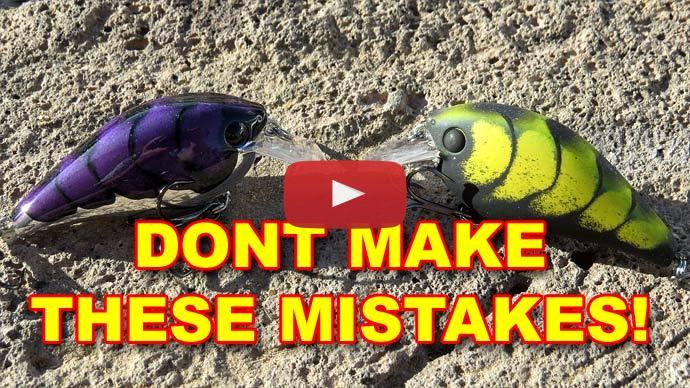
Also crawdad patterns. Crawdads work best to me in the spring. Particularly after the jerk bait bite starts to die off, so you're talking to mid 50s, that's when the crawdad bite starts to pick up, mainly because crawdads get a lot more active then and the bass are keying on crawdads. So I'll have you know green crawdad, red crawdad and brown crawdad. And as the fish get shallower, I'll shift to that red. I'll use the brown and green when it's deeper, but then they get that shallower depth. Red works very, very well. So a red crawdad lipless crankbait for example, is my go to. Or in the early spring, mid spring the temps are in around the mid 50s, great color to use.
And then the lastly is to use some colors that have some flash, you know bright colors, the chartreuse and the fire tiger colors. Those for me work best in the fall. When the bass are keying on bait fish, when the water is dingy or when the water's muddy, even in the summertime. Or in the spring when the water is muddy or dingy. Those bright flashy colors tend to work really well. Chrome fits into that category as well. That's I have some of those. Not a ton of them, but I'll go to them because I don’t encounter those situations as often. If your water is often muddy and dingy, then maybe you might want to get more of those, but I don't encounter that as much in my neck of the woods. But they still work really well in the fall. Those fish are keying on bluegill, for example. That chartreuse. That's something that they're going to go after, so make sure you have some of those colors handy.
That's it, guys. That's the basics of it. You don't need to go buy a ton of different ones out there. I'm going to link a bunch of productive baits here on the bottom for y'all so you can pick and choose those. Those like top producers tried and proven they work really well. If you don't know exactly where to start with your crankbait fishing, go with those and you can start catching fish. Hope that helps. For more tips and tricks like this, visit bassresource.com.