

The Gear
Smith's Diamond Combo Sharpening Stone - https://amzn.to/2GYLt4Q
Split Ring Pliers -- https://www.tacklewarehouse.com/catpage-SPLITPLIERS.html?from=basres
The Gear
Smith's Diamond Combo Sharpening Stone - https://amzn.to/2GYLt4Q
Split Ring Pliers -- https://www.tacklewarehouse.com/catpage-SPLITPLIERS.html?from=basres
Alright guys, it's about that time to get back out on the water finally, you know, and when you get out there, you want to be fishing. You don't want to be spending your time messing with your gear. So let's talk about getting your gear ready to go. I'm going to focus on tackle today, so let’s just dive right into it.
First of all, what you want to do is check your baits for a variety of things. So one of the things you want to do is grab yourself a good pair of split ring pliers. If you don't have any, you can buy some. And you want to check you know the split rings. That are like the hook hangers here and a lot of baits come with a split ring at the top right here or wherever the connection is on crankbaits. They almost all of them come with split rings. So you want to look at those and you want to look and see if they're misshapen or if they're coming apart that sort of thing because that's going to end up being a failure on you probably when you got a lunker of a fish on. So now's the time to replace those split rings.
Another thing if you notice on this bait real quick. But I I changed out the hook in the front for a larger size hook, so it's a good time to start playing around with that and changing some hooks around. Speaking of hooks, you want to sharpen them. It's funny, these baits, your crank baits will sit in a box and you don't even use them. Some of them you don't even use at all for a whole season or maybe even a couple, and they get dull just sitting there. It's like, how does that happen? Well, you know, you're jostling around, you're carrying your gear around, or it's in your boat and you're hitting. Maybe you have a couple rough days on the water. It's bouncing around or just driving down the road. These are banging around inside and the hook points can get dull just being stored in your tackle box.
So check. I do this meticulously every single crankbait every year. I check the hook points and make sure they're sharp and if they need to be sharpened, then I touch it up with a hook sharpener and make sure they're razor sharp.
The only thing what you got to do is when you do it, just make sure when, when it's sharp that it doesn't just scratch your fingernail, but you want to feel it dig into your fingernail when that happens, you know? You got it really sharp and while you're sharpening them, check to see if there's any bent points or anything like that or maybe a hook is bent out a little bit and you want to bend that back in place. Just do those kind of things. Just checking up on all those hooks and those split rings will time consuming, but especially if you have a lot of tackle. But it's worthwhile doing.
And while you're at it, check out your other baits that have hooks on them like spinner baits and jigs. You know you want to go through them and. Replace any skirts on them if they need to be replaced. Sharpen the hooks again on those, check them all, make sure they're nice and sharp and things like this. Like the blades on the spinner baits. Make sure that they spin freely. I mean. Sometimes sitting in storage or maybe you put it out on your boat and let it sit outside for you know, maybe hanging on a hook, hanging out on your boat for all season long and they tend to get, you know. They won't run very well and the blades aren't turning very well. The spinner baits is not going to work very well. So just check on those things and change the bearings out, change out the swamp, the Sampo bearings, that sort of thing. If you need to do that, I always use Sampo swivels, but that is just something to check.
And same thing with your jigs. Notice this one? It's ready to go, but it doesn't have a trailer on it. OK, I don't put the trailers on them until I'm ready to fish. And the reason is because I like to store all those trailers nice and flat in my tackle box. Plastics have a way of becoming misshapen and deformed if they're not stored perfectly flat. And now is a good time to check your plastics to see if any of them have warped. And if they do, don't throw them away. All you got to do is throw it in some boiling water for a little bit. And then put it out on a cookie cutter and a cookie cutter on a cookie sheet and just let it lay flat and let it dry and it'll, it'll straighten right back out.
And I'm not if I'm purposely not telling you how long to keep in the boiling water because the types of plastic and the makeup of plastic and you know, the formula they use to make the plastics vary from manufacturer to manufacturer. So the amount of time that you put in the boiling water is going to vary. So you're just going to have to play with that a little bit. But anywhere from. Start with 15 seconds to 30 seconds and then go from there. Some take a few minutes, it just depends. But start in a short amount of time and see if that straightens it out. But that's a great way just right now going through and making sure all that stuff's ready to go.
Now, another thing to do while you're doing this is look at your crankbaits and look at the finish on them. Again, they're sitting in there and they're bouncing around your tackle bag and your tackle box. Or maybe like some of us do, we put it in a cup holder on the boat and it stays like that for several trips and going up and down the Interstate and whatnot. And they get scuffed up. You know, and it's not necessarily a bad thing. I mean, if you look at this, you know, it's it's doesn't have its as new finish anymore, right? It's all kind of scuffed up and at a plastic bait. That's not a big deal. You know, if it really bothers you, you can use a little bit touch up paint on or something like that. It'll still very functional.
However, if it's wood, the baits made of wood, then if that paint's come off, then you can get water intrusion and if water gets into that wood, then it's toast. You're going to have the hook hangers all rip out or the line tile rip out or something like that, usually while you're fighting a fish. The bill, I've had a bill come rip out right on one of my wood baits once because I had a nick right above it and water got into it.
So the best way to prevent that is if you see that on your wood baits, just take some clear fingernail Polish and just kind of seal it back up. Or if you're a woodworker and you happen to have some lacquer or something like that to use, just put a little dab on there. It doesn't take much just to seal it back up and prevent the water from getting back into it.
While you're at it, take a look at the the line ties on these. Sometimes they become bent or they become loose or like on these. Sometimes a lying tie is screwed into the front. And they tend to work themselves out. Wood crankbaits are the worst. But even on any of these baits. Or maybe they're not straight, they've become crooked, whatever. But it's a good time to just give it a good once over and make sure your line ties are in good shape.
And then one other thing you want to look at is. On while you're looking at the line ties. Sometimes, you know, when you're fishing it, you just cut off the line and to get another bait and put another one on, so now you've got this little tag ends on them right. So you know, cut off those tag ends, get them ready to fish.
And if you notice like a my crank baits, you know that I keep going back to this one, but it doesn't have this the split ring on the top. So most, most crankbaits all come with a split ring. I take my split rings off because I use a snap when I fish. It's a lot easier to change baits using the snap. I don't have to cut off and then worry about those tags later and all that stuff. So before I fish and I just make sure all the split rings are off my line ties. So it's just a small little thing. You save a lot of time now because when you're on the water, you don't want to be messing around with your gear, you want to be fishing.
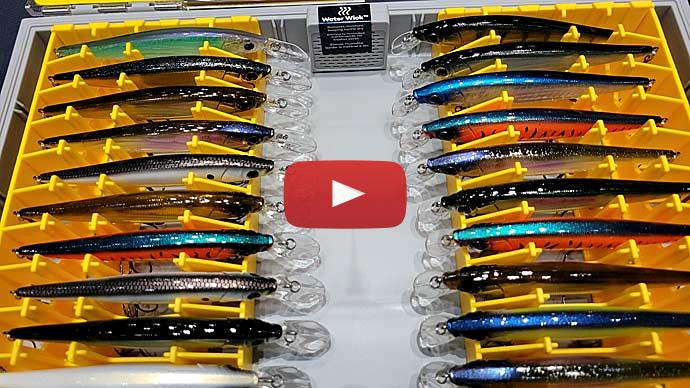
OK. And then finally, you want to look at the organization of your lures, so your hard baits crank baits, for example. I'll just give you how I do it. I have separate Plano boxes. I have shallow. I actually have top water, shallow divers, medium divers and deep divers. And then I break those up into style of bait, which usually is dictated by their bill or manufacturer and then by color. Right. Or by size. That's another way to do it. But I have a little individual compartment and it might be all the same size of bait, different colors, for example. And I just organized them that way so it's easy to find what I'm looking for when I'm out on the water.
And then same thing with your jigs. Break them down by color, by size, whatever makes sense to you. But usually I have a jig box of all, say brown and green pumpkin, and I have them by different jig heads styles and different sizes. In those jig head styles and. And then I'll have some black and blue and black and chartreuse and same thing. Organize them that way. Spinnerbaits, I have a dedicated spinnerbait box for that. So that's taken care of. We're good.
And then with plastics. A lot of people like to keep is stored in the original bag and that's fine. And you can get a soft plastic bag, you know, a soft sided tackle box to store them in. People use zip ties and a variety of other ways to sort and organize them by color, by type, by manufacturer, whatever, by brand. However you want to do it makes sense to you, but it's a good time to go through and make sure that you've got them all organized the way that makes sense to you so they're ready to go again while you're out.
I've seen this happen. I've seen guys dig. Dig and dig through their tackle boxes looking for a particular bait or lure. And they spend a lot of time doing that and they can't find it. Yeah, that's a whole waste of time. When you fishing, time is precious. We don't get nearly as much time on the water as we want. So spend the time now getting that all sorted and organized ready to go. So all you got to do is open your protector box, grab that bait, tie it on and start catching fish.
For more tips and tricks like this, visit bassresource.com.