All right, we’re just getting into that pre-spawn migration where the bass are coming up from their winter areas to where they’re going to spawn. Our whole goal right now is to intercept them on the way.
So first you have to think about where they’re coming from and where they’re going. They’re going to end up on the flats, in those protected bays and shallow areas where they’ll eventually make beds. They’re coming out of their wintering areas – those deep zones with humps, long tapering points that drop into a river channel, and other deep structural spots where they’ve been parked all winter.
Between those winter holes and the spawning flats is the migration route, and that’s where you want to focus. Look for contours, ridges, ledges, and creek channels – especially where a creek swings into the shoreline and runs along a steep bank. Those steeper banks, deep weedlines that lead up into shallower ones, and that “highway” structure are the paths bass use to move shallow, and that’s where you can intercept them.
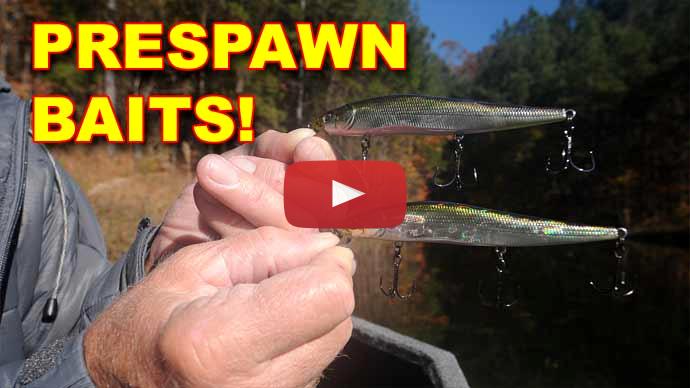
A great bait for this period is an underspin. It’s basically a little minnow-style jighead with a blade under it that imitates the forage perfectly. I like the Gamakatsu underspin jighead in 1/4 oz with a Rage Swimmer-style boot-tail swimbait on the back. Remember, the water is still cold – we’re talking roughly 47–52 degrees – so the baitfish aren’t very active and the bass aren’t either. You want something subtle. That little boot tail just thumps gently, and you retrieve it slow – just fast enough to keep that blade turning.
You can fish an underspin over the tops of trees, humps, rock piles where fish are suspending, or along those long tapering points with scattered boulders, stumps, and laydowns. The beauty of this rig is you can cover a wide range of depths, from mid-column all the way down near the bottom, depending on where the fish are that day. Once you find them, they’re usually still pretty bunched up, and you can catch a pile of them on that underspin.
For tackle, I like a 7' medium-power, fast-action rod with 12-lb fluorocarbon. That setup lets you cast it a long way, get it down to depth, and crawl it slowly. The bites usually aren’t bone-jarring thumps; with those sharp Gamakatsu hooks you just lean into them, reel down, and they’re pinned. No need for a giant hookset.
As the pre-spawn progresses and those bass start sliding shallower, they’ll move into cover: weeds, brush piles, sunken timber, laydowns, stumps – all in that staging-to-spawning depth. Now that open hook on the underspin becomes a liability because you’re hanging up more than you’re fishing. That’s when I switch over to the Neko rig.
For this setup I like the Gamakatsu Cover Neko hook – it’s weedless, so it comes through cover really well – and it has a built-in swivel, which is a big deal. Neko rigs are notorious for twisting your line, and the swivel really cuts that down while also helping the bait fall more naturally.
On the hook I’ll fish a Missile Baits Magic Worm in the Morning Magic color. It’s kind of a purple-based translucent color that bass just love in the pre-spawn. I don’t know what exactly in nature they think it is, but they eat it. In the nose of the worm I’ll insert a Missile Baits Neko weight – usually I start with 1/16 oz, and if it’s windier or I’m fishing a bit deeper I’ll step up to 1/8 oz or close to 1/4 oz. The whole idea is still subtle: this is not a fast, aggressive presentation. It shines when the fish are up shallow but not willing to chase cranks and spinnerbaits.
Water temps for this Neko setup are typically low- to mid-50s. In spring you get a lot of fronts blowing through, and when that happens those fish will bury up in that shallow cover. Dropping a Neko rig into that stuff is a great way to pick them off with a finesse approach.
Tackle is similar to the underspin: 7' medium-power, fast-action spinning rod. Instead of 12-lb, I’ll bump up to 15-lb fluorocarbon because I’m around more cover. I don’t go to braid here because the cover usually isn’t super heavy yet – weeds are just starting to grow – and braid can actually hurt the action. Fluorocarbon sinks, stays in contact with the rig, and gives you all the sensitivity you need.
So if you want to simplify your pre-spawn approach this year, you could easily narrow it down to just these two setups: an underspin for those migrating fish in mid-depths, and a Neko rig for when they slide up into cover. Fish them in the right places, at the right times, and you’re going to have a lot of success.
Hope that helps. For more tips and tricks like this, visit bassresource.com.