All right guys, what's going on? I'm Kyle Welcher, Bassmaster Elite Series pro. We're here with bassresource.com and we're talking about one of the tried and true techniques. It's a Texas rig. Everybody knows the Texas rig and you know we're going to talk about how to maximize a Texas rigs potential in the spring and this is the time when it's probably at its most powerful.
I bet there's more top 10s professional tournaments on the Texas rig in the spring than any other time of the year. I know that's skewed because that's the number one bed fishing bait and we're going to get deep into that because that is you know. One of my favorite ways to fish in the spring, but it's also a great way to just generate bites. And there's so many big ones up shallow. And in the spring they can get funky.
Like their spring is a very polarizing time of the year. Like some of them big females that are getting up there, they just want to move shallow because they want to be up there in the sun in the warmer weather and just kind of wait till those eggs are ready for them to actually lay them and then start guarding. And when that happens, they can get super, super aggressive. But up until that point, they can be extremely. Fickle and extremely hard to catch.
And that's why I typically have a 2 pronged approach to springtime fishing. If I'm not actively bed fishing, the number one thing I'm going to do is in spring. I guess I'm a little bit of an optimist. I want them to bite a certain way. I want them to be in the heaviest cover right outside the spawning areas. I mean I want I want to fish for them in the exact immediate pre spawn places. Like there's a lay down tree in the back third of a pocket. That's where I want to go and that's. I want to fish for and try to catch those big females.
Now that does not always work, but that is always my first thought that time of year. And it, you know, it can be a pattern in the spring to where you're catching them in the very back thirds of pockets. And you know, sometimes you'll go in there and you'll catch one out of a lay down and then you may go to another pocket and you say, well, there's not a lay down in here. So it doesn't fit the pattern.
But it's not as much about the cover that you're fishing as it is about the location of the cover and, you know, relative to where they're going to spawn. So one pocket, it may the back dock, one pocket, it may be a laydown. The next pocket it may be, you know, a little rock vein, it could be any kind of thing that they're going to sit on and stage on really close to the spawn.
And in the spring, that's all I think about is where those females are going to spawn, because you can catch a male anywhere, you know, but you only catch those females in certain places in the springtime and those places can reload like phenomenally, so.
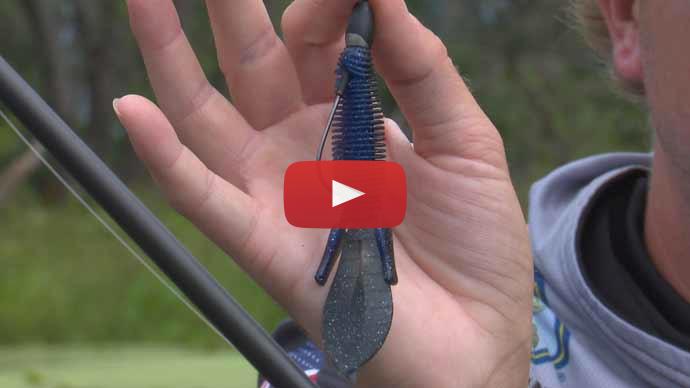
My number one approach is always going to be 1/2 ounce bulky bait. This time of year I want to go pretty fast. I want to find those aggressive fish that have already decided. Like I'm moving up, I'm going to eat up a little bit and then I'm going to spawn in this area. And a lot of times it's really strange to see even before they decide exactly where their bed is, they'll actually guard a big area first.
They'll get really aggressive towards kind of where they know they're going to spawn, even though there's not like a bed made yet. So you'll see that like I've, I've seen fish with my eyes cruising up and down areas that are, you know, 50 feet long. And they'll just circle it back and forth to kind of just hang out in that area for a day or two even before there's actually a bed.
That's one of those things in my mind before I see those fish, I know there's a fish, you know, those fish are in that stage and kind of guarding those areas. So I'm always going to get really close to spawning places and I'm going to try to go as fast as possible because I want to in my mind, if I can put that bait in front of more of the female bass's face in a day, I can generate more of the bites than other people, you know, and that's that's kind of my approach to it is it's kind of a run and gun kind of as fast as you can go, you know, if the weather. And those fish are in that stage. That's how you're going to be the most effective.
That time of year. That's the easiest time of the year to actually pattern fish and run and gun and catch those pre spawners when they've transitioned from that to hardcore, you know, on the bed and really lock down, that's whenever you have to slow back down. But I'm talking about early spring straight pre spawn. That's where I'm going to go super, super fast now.
I've always felt like there's pivot points in the spring like there's certain water temps that are more important than others, and it seems like 48 to 52° water temp is a huge difference in bass behavior, but it doesn't seem like 52 to 56 is near as big of a difference. You know, then obviously, like when you get late in the spring, you get your water temp goes from like 70 to 75. It doesn't seem to affect anything at all.
But for whatever reason, there's like a tipping point, in my opinion, from like 48 to 52. And, you know, depending on the weather, it could be where you've got an entire spring where the water's over 52, you know, creeps up the entire time. And those fish are going to stay, you know, getting more energy and more aggressive and more active and getting closer and closer and progressing very fast.
But then obviously, you know, Mother Nature sometimes throws a throws a curveball to all of us and puts a wrench in our plans. And that's whenever I feel like I can't run as fast, whenever the, you know, the water's a little bit colder. I haven't been able to really put together a pattern with those fish in the back of those pockets.
That's whenever I'm typically going to go really, really slow and I'm going to try to fish the isolated cover that's a little bit deeper out in front of those places where they're going to spawn. And I mean, it's so hard to beat a worm anytime the bite is really, really fickle.
So this here I've got a 3/16 ounce weight. I've got it pegged and the reason I keep it pegged in the spring is because those fish will pull up and they'll get in that cover and they don't suspend quite as much in the spring. It doesn't seem like to me as they do, the females will suspend still, but they don't suspend quite as much in the spring as they seem to do in the winter.
So I want it pegged so I can get that bait through the cover, whether it be brush around docks, you know, brush out on a on a secondary point, main lake point. Whatever the case may be, I want that bait pegged so that I can feel exactly where my bait is and I know what I'm feeling. The cover. My worm is right behind it.
Like so whenever I feel my bait leave the cover, I want to know that I'm out of the strike zone. I can reel it in. And a lot of times if you're, if you're fishing brush, your weight can get 4,5, 6 feet away from your worm because it'll it'll slide off if it's not pegged. And then you're feeling with your weight. So your worm may be in the strike zone, but your weight is out in front of it. And as soon as you feel you get away from that cover, you'll reel it up when you still have a chance to catch a fish.
So I like it to be pegged just for that situation in the spring. And that's. Like I said, that's whenever those fish are being really, really fickle. That's, you know, the hard time to kind of balance that because you know, what kind of potential is there whenever those females pull up and get, you know, ready, you know, that potential is there.
So it's super hard to kind of back off and go really, really slow. But it's one of those things that you literally just have to do. You know, it's, I still get burned by it a lot and I, I don't want to back off and go slow, but that can be your most productive time of the year and how you catch some of the biggest fish. And whenever they backed off and they're staging on those. Places you can get some really, really big ones.
Now that's the that's the main approach I've taken pre spawn like immediate pre spawn, which is what I think of and I think of spring. Another thing that I do is I throw a Texas rig a ton for bedding bass and whenever I know that I'm going to be sight fishing almost exclusively I'm going to have two of these rigged up I'm going to have one that's pegged and I'm going to have one that is not pegged and basically.
I feel like the pegged one is going to generate more female bites because it keeps everything together. And when you find that place on the bed, you can just make sure everything is right there, creating the most disturbance as possible because a lot of times. The actual spot in the bed will be the size of a baseball or softball, but the bed may be 24 inches in diameter or bigger. But there's one little place and I don't want anything separated. I want my bait and my weight to sit right where I want it to sit.
And every time I move it, I want to know that the weights wiggling, my bait's wiggling, everything's right there. And the female typically is going to bite the bait off the bottom a lot more than the male will. The male, a lot of times you want to be hopping it and kind of like really agitating him with it, make him get aggressive with it. So. So that's why typically if I'm fishing, you know, there's not really a female in the bed. I'm gonna throw one that's that is unpegged because whenever I hop it, that weight and that bait will separate and that bait will hang up in the air for a little bit longer where it feels pegged to pull it right back down to the bottom.
So I don't peg it. So whenever I hop it, that bait will kind of linger in their face for a little bit longer and give him more of a chance to bite. But that is literally my favorite way to fish. And that is a super productive way because whenever you're sight fishing. What you don't want to do is sit there on a big fish for an hour or two hours, however long it takes, get her to bite and then have her on a bait that's a low landing percentage.
I want to know whenever I hook that fish. That it's 99% chance I'm about to land that fish. And that's one of the main reasons that I actually throw as big of a hook as I can possibly get in my bait whenever I'm sight fishing. This right here is a 4/0 Gamakatsu G-Power super strong hook, got a big barb on it. If you get this hook in past the barb, you can just let slack out and they're not going to come off. And I've got so much confidence in this. I mean, I just caught a 10 pounder on this two weeks ago doing this exact technique.
So that's one of the things to me that makes a difference on bed, whenever you're bed fishing is just having those two baits that are so similar but then vastly different in how you're actually implementing what they're doing.
Now whenever they start to come off the bed, the first thing those females do is they go deep. Where they go to heavy cover as soon as they get done spawning, it's like they go to a place where they just kind of want to reset and chill and just hang out. And you know, depending on where you live in the country, it could be grass mats, it could be big lay down trees or they go all the way out to a ledge.
And that time of year that's whenever the fish are kind of, you know, tired and beat up a little bit. Something slow is still super productive. Obviously if there's a huge school of them out there on the ledge, a Texas rig is kind of a clean up bait. You know, you may throw something else in there that a crank bait or whatever it is. Try to fire up the school and catch a couple, but as soon as that's over, you've got to throw a Texas rig in there and just try to generate another bite or two.
And then for me, when they come off bed, it's the same thing. I want something that I'm thinking of as a reaction strike. I want, I know they're in there, they're not aggressive, they're not going to come a long way to eat. I want to flip something in there that's a little bit bigger, heavier weight that falls really, really fast or the heavy cover and can actually make those females react to it because they're not really trying to feed back up.
If they're trying to feed back up, they're going to be around a shad spawn, brim beds, they're going to be out in a bait ball, something like that. When they go to the heavy cover, that's where they're trying to reset and recharge. And that's another great way to pattern fish is the same places they were pre spawning. They'll post spawn right there on their way back out to a little bit deeper water. And I want the same bulky bait that I was flipping in there pre spawn because I want it. I want them to react to it and bite it.
And this, I mean, a Texas rig in the spring has been super productive forever. And like I said, I bet there's more top 10s on it in the spring. Any other time of the year and the main reason for that is, like I said, the bed fishing, it's just a couple more tricks. You know, to kind of optimize your Texas Rig setups.
I don't see a lot of guys. A lot of guys will have one rod rigged up. I almost always have three or four rigged up with different versions of Texas Rig tied on because I've got so much confidence in it. But try those out and hopefully catch more fish in the spring.