Man, there’s a bunch of topwater baits out there — and there’s different ways to fish them — and it really depends on how you fish and what gear you’re using as to how successful you’re going to be with them.
So I bet you’ve tried quite a few different topwaters at this point and are kind of struggling to get a lot of bites. Hopefully we’re going to rectify that today.
First of all — yeah — lots of topwaters out there. So let’s break it down a little bit.
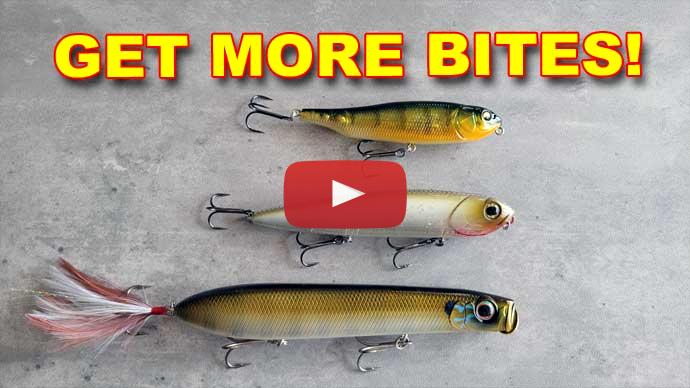
The most common one — and the most productive one, in my opinion — is the walking style baits like the Zara Spook and the Sammys.
You can fish those when the water’s got a little bit of ripple and chop — like it is right now today — because that breaks up the water and the light penetration.
You can fish them in super clear water and it’s gonna call them from great distances — 20, 25 feet deep water over a point. I’ve had smallmouth come up like a Polaris missile and clock them — I mean 4-pound, 4-and-a-half, 5-pound smallies — on a bright bluebird day like this.
You can also fish them along riprap. You can fish them along docks. Over the top of weeds. Over points with boulders, stumps, scattered weeds — that sort of thing.
Dingy water works really well. Even dirty water. It’s just the commotion they make — and the way you have to work them so they walk back and forth — that action, man…
That Zara Spook has been around since the 70s, dudes… and it still catches fish. It’s a very productive bait.
Walking style baits are extremely popular — and very popular for a reason — and that’s because they catch fish.
So don’t be afraid to throw them — not just early morning or evening hours — but throughout the day. If the fish are there feeding on baitfish, they’re going to hit a Zara Spook.
Another category is poppers — like the Rico, the Pop-R, pencil poppers, Chug Bugs.
Those work best when the water is slick calm — really calm — when the wind is down. Early morning works best for me. But also, you know, just when you’re not getting a lot of movement — even on a sunny day like this.
Throw it out there, let it sit… and give it a couple pops.
And here’s the thing — don’t tug it so it goes through the water. You want to pop up and make it spit water. Hard jerk — pop, pop, pop — make it spit some water… and then let it sit.
That’s the key: letting it sit.
You’re trying to imitate an injured baitfish — a dying baitfish — struggling on the surface. So you’ve got to let it sit for a while because that’s what happens.
If you ever sit there and watch one struggling on the surface, they flail about a little bit… then they rest… regain their energy… hang out… then they flail some more… then they wait.
So that’s what you do.
Pop-pop-pop… and then give it a rest — 10, 20, 30 seconds… then pop-pop-pop… and wait again.
And a lot of times you get blasted when the bait isn’t even moving.
Those excel in slick calm conditions, and even clear water — clear to super clear — is better. But they’ll work in stained and muddy too. They just excel more when it’s calm because it’s more of a visual style bait.
Then you’ve got buzzbaits.
Buzzbaits, to me — if you want to cover a lot of water — buzzbaits work really well.
You can cast and reel and just go along the bank and cover water.
Works great when you’ve got submerged weeds like milfoil or hydrilla just under the surface. You can call a lot of fish out of those weeds with a buzzbait — they make a lot of commotion.
But fish them right alongside docks — you’ve got to run them parallel to docks. A lot of times those fish are right up under docks, especially if there’s some weeds next to the dock.
If you can run that buzzbait right along there… man… it’s golden.
If you’ve got reeds, running it through pencil reeds can be good too — yeah — don’t be afraid to do that.
Or if you’ve got lily pads that have openings — not fully matted out — kind of sparse lily pads… running them between all those… a lot of times you can catch fish that way with a buzzbait.
And then finally: frogs and toads.
These work great when the weeds are at the surface or even matted over a little bit.
These sit on top and you can work it across the top, create quite a bit of commotion, and the fish underneath will track it… and when you get to an opening — boom — they’ll blast it.
Or you can fish along the sides of docks — same thing like you would a buzzbait. You can catch a lot of fish that way.
Or across scattered boulders, scattered stumps on a point, outside weedlines.
Now the difference between a toad and a frog:
A toad is a solid body — it’s got the legs that kick and they gurgle — and it makes a more subtle bubbling action than a buzzbait. And sometimes that’s what the bass want.
Just reel it and cast it like a buzzbait, but a little slower.
You can move it slower than a buzzbait.
You’re rigging it on a 4/0 or 5/0 keel-weighted hook — like a 1/4 ounce hook — with a screw lock on it.
Work it across the weeds… find an opening…
And here’s the deal — sometimes you pause a frog in the opening and they’ll blast it like I mentioned.
But other times they won’t.
And if they’re not going to come up and blast it, that’s when a toad falls down and goes right to the bass — and they can’t resist it.
They’ve got to blast it.
And fishing outside weedlines — you can almost pitch it like you would a jig — let it run for a while… then kill it… let it fall on the outside weedline.
A lot of times that gurgling action gets their attention… you kill it… boom… they hit it when it’s falling.
That change of action, change of direction… triggers a bite.
So those are your categories.
Now one of the most critical things with these lures is: a lot of times it’s the retrieve. Mix it up.
What the fish want one day, they may not want the next day.
Sometimes a really slow retrieve — like I mentioned with poppers — letting it sit… sometimes you’ve got to let it sit for 30 seconds or longer.
Other times they want it really fast and you don’t make any pauses — you’re popping it back to you fast — that skittering, fleeing action triggers a bite.
Same thing with frogs — long pause versus burning it back quick over the weeds can be the difference between a bite and not getting bit.
Buzzbaits — a lot of times I bring it back as slow as I can while keeping the bait going and the blade turning.
But sometimes a quicker retrieve works.
Sometimes giving a quick pause or a quick yank with a buzzbait — to make the blade spit out more water — that little change sometimes triggers a bite.
So you’ve got to play with it.
Sometimes you’re not getting bit on topwater and it’s not the topwater’s fault — it might be because you’re working it at a cadence or speed that just isn’t attractive to them.
Try different retrieve speeds and different cadences and see if that triggers a bite.
Now the other key thing with topwaters is make sure you have the right gear.
So when you’re fishing walking baits, for example. if you’ve got a really stout rod with an extra-fast tip, it’s going to be really hard to “walk the dog.” It’s really difficult when it’s a strong rod like that.
Plus it’s got treble hooks.
And when you do catch a fish, you’ve got to have a rod that gives a little when the fish surges so it doesn’t rip the hooks out of his mouth.
So a medium power, fast action rod is perfect for walking baits.
You can fling it out there a country mile, you can work it the correct way. It’s a lot easier to work it with a rod like that, and when you do catch a fish, that rod’s going to work in your favor to help keep the hooks pinned and coming to you.
When you’re throwing a buzzbait though, you want something a little more stout — a medium-heavy power, fast action rod. Like a 7-footer — that jack-of-all-trades kind of rod. You can throw a bunch of different lures on them, and a buzzbait is one of them.
That's got a little bit more backbone, a couple things for it because first of all, you're throwing usually over, over weeds or through weeds, through the reeds, things like that. So if you catch a fish, you can get them out of that. You're using 15 to 17 LB line. And that lure has a single hook, a stouter hook, and so you need a little bit of extra backbone to set the hook and keep the fish pinned. So a stronger rod works in your favor for those type of lures.
But if you're throwing. Those little poppers, they're lightweight, lot of them made out of balsa wood. They're hard to cast on bait casting gear. Plus you need a real light rod because these hooks are small. Those treble hooks are thin wire. It's easy for a fish to rip the hooks out of his face by leveraging a stout rod.
So this is when I go spinning. I'll use spinning rod, and I'll use a medium power light action rod, or maybe even a medium light power light action rod. I'm using real light gear here. I can fling that light bait way out there and work it properly. It's still got enough backbone in it where I can pop, pop, pop.
But when a fish hits it, that rod's going to give right away. It'll bend right away, and it's that rod's gonna do a lot of the work for you. Do a lot of give and go and it's gonna keep those those hooks pinned and help you get that fish back to you.
On the other end of the spectrum is the frogs and the toads. Here you're throwing in heavy cover, heavy weeds. A lot of times the fish grabs it and he buries back down on the weeds. You need stout equipment. This is hand to hand combat fishing.
So a strong, heavy power, extra fast or fast action rod is what you want. That fast tip is going to allow you to throw it out there, but once that fish. Hits and you got them on. You can wrench them through those weeds with that stout rod and get him back to you. You gonna keep him pinned.
Those those frogs and tones again have a thicker, stronger like a 5/0 hook on them. So a stouter rod. You're going to need that to help set the hook and keep them pinned.
Let's talk a little bit of some tips though. This is like next level tips. One is the line you use.
So when you're using the spinning outfit, I'm using lighter line. Using 8-10 LB line, but what's more important is I'm using monofilament. Monofilament floats. And I'm same thing when I'm doing the Zara Spooks and the walk the dog, I'm using monofilament.
The Zara Spooks I'm using like 15-17 LB line, but it's monofilament because monofilament floats, fluorocarbon sinks and it really is difficult to work a top water lure properly when your line is sinking. Braid has some buoyancy to it, but it still sinks.
So when I'm working those baits that are designed to float and stay on the surface, it's always monofilament with me. Plus again, guess what those hooks have treble hooks or those baits have treble hooks and monofilament stretches, so that's what you want.
That's actually a good characteristic. Some people talk about stretch like it's a bad thing only because it's a little bit harder to set the hook with a line that stretches. But once you have that fish hooked, now when the fish surges, you're line, your rod's going to give, like I mentioned earlier, but now your line is going to give a lot of stretch too. It's going to absorb a lot of the impact of that fight and keep that fish hooked.
So you're going to need a little bit stronger of a hook set, but when you're fishing those smaller. Poppers, they already have small thin hooks so it doesn't take a lot of effort to hook them anyway.
It's the Zara Spooks. They have the thicker stronger hooks, but again you're using a bait casting outfit. A little bit stronger rod there too to make up for it. So just make sure you get a good hook set and the rest will do you good.
When I'm fishing buzz baits I'm usually fishing braid, not heavy braid because I'm usually fishing through reeds, Lily pads over the top of weeds. Typically the fish don't get wrapped up in that too much, so 30 LB braid works really well for me.
Those instances, A thinner braid, I can cast it further, cast it really well. It's smooth casting line and it's got that ability to cut through the weeds if the fish does get me in those weeds.
But when I'm fishing those frogs with a heavy rod and those stout hooks and those, those, those fish can get those frogs and pull them down into those weeds. Now I'm using 50 LB line, 50 LB braided line. That's hand to hand combat.
I like Seaguar Smackdown line for that. It's never failed me. Great knot strength and I’ve pulled some fish out of some real thick cover with that line and it comes out unscathed. So that's really key.
And then one more tip is setting the hook on these baits. Number one problem people have with these baits is they set the hook too soon. Why? They see the blow up. And they get excited and they set the hook on the blow up.
And a lot of times when there's a blow up, the fish hits the bait and you feel that on your rod. You'll feel that tick and it feels like a bite. And so you instinctively set the hook.
The difference here is the fish has his mouth open and he has still coming down. He still has yet to close his mouth. And a lot of times when you set the hook right away, you actually yank the bait right out of his mouth before he has a chance to grab it and you miss the fish.
So #1. Wait and you wait, wait until you feel the weight. It's like what I like to say and that is you feel the fish pulling back on you like like a worm or a jig bite.
When that fish is pulling back on your rod, you know he's got it now and then set the hook.
It's really hard to do. I have to remind myself when I'm I'm fishing top water, I'm like don't set the hook, don't set the hook, don't set the hook. Wait for the weight, wait for the weight.
I mean, I'm reminding myself as I'm reeling and working the lure because that it'll startle you when you get that. Blast the fish comes up and just. Nails it.
You gotta – don’t set the hook, don't set the hook. Now he's tugging back, Boom, set the hook.
One more tip I want to give you as far as reels, reel speed doesn't really matter in this instance. I mean, a faster real speed helps a bit when you wanna work the lure really fast.
But it's more important that if you if you do miss the fish, you wanna reel up quickly and cast back out there and get that lure back out there, maybe he'll bite it again.
So a 7 to 1 or 7, five to one gear ratio is what I'm looking for. Something relatively fast. I can work the lure fast that way if I need to, but also if I miss that strike. I can reel it up quick and fire it back out there and hopefully get bit.
So those are some great tips for you to go out there and catch a bunch of fish on Top Waters this summer. Hope that helps.
For more tips and tricks like this, visit bassresource.com.