Hey folks, Brian Schmitt here with Bassresource.com. We're going to talk about The Four Seasons of Neko rigging, Neko rigging. Excuse me, the proper announcement or name is Neko. So we are going to talk about the Four Seasons on how we apply it, what we're looking for, the fish migration, the different styles of baits I put on, weights, et cetera.
So it's a, it's a pretty cool deal too. You know, Neko is a big tool of mine on Elite Series guys. It's something almost every event I'm applying at some level. It's a fish-catching deal. I will be honest with you, you could win an event exclusively doing it. So it's a proven deal.
So let's dive into winter. We're going to start with the winter or work to spring, summer and fall. But we're going to start in the dead of winter. I associate that with the coldest time of year wherever you're at. You know, fish and bait is, is, is a big combination then. So I've noticed that on lakes, the bait kind of gets really, really confined and, and, and you can have like just huge areas of bait and almost can black out the screen. I'm looking for that. OK, I'm looking for bait. The bass and the bait a lot of times will winter in the same kind of area so you find the bait, you find the fish.
So that's what we're going to look for and how I'm going to go about that is, a lot of times, the last deep water available in a major creek, a cove, a basin of the lake. Like if you took like a Lake Champlain, you have this huge inland sea, the last deep water at the top of it—that kind of deal, like how it coves out. Just areas the fish and the bait can just kind of pin into a corner. You can find this a lot on your electronics. OK?
You know, winter time fishing, it can be cold but it could be worth it. It's some of the best fishing you can experience when you find it because of the confinement—because everything is pushed together a lot of times. And what's weird is, even in the winter like this deal we're talking about, how I like a nasty day over a real nice kind of warmer winter day. They'll kind of spread out. The colder, the nastier—everything gets real tight. They bite.
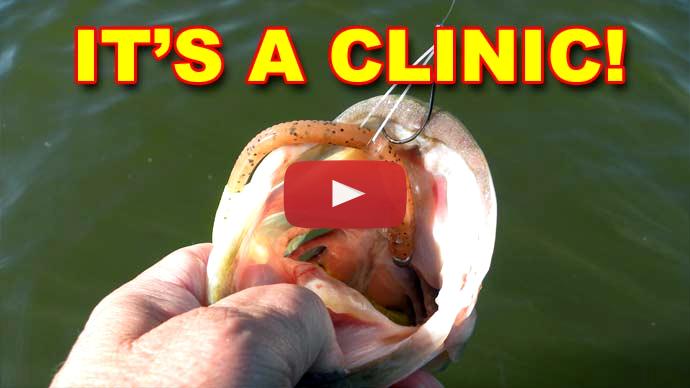
So real quick, how will I use a Neko rig in the winter? Well, first and foremost, I'm going to use this deal right here. This is a Fishalicious color Missile Baits Quiver Worm. This is the 4 1/2 inch model. Very big fish, color-oriented profile, everything. So I'm kind of matching the hatch. So right now there's a big frenzy with minnow fishing. You could minnow fish the same areas, but with the Neko rig, you're giving just a different look, guys.
So a lot slower fall if you want, or you could speed the fall up. But to really be able to work this fish—you see these fish on your forward-facing sonar, or you just found all the bait and you back out and you're making blind casts. You throw this out, you can count it down, let it get down, and you can shake it, let it fall, shake it, let it fall. You control the rate of fall by the weight size you put in here.
So I usually put my nail—my weighted nail—in the top or the front of the worm, the head of the bait. And I have three different sizes I usually use. If you look here, these are three extremes: a 1/32nd, a 3/64, and then this is a 1/18. So these weights—I can get this bait to really fall very quick or I can get it to slowly, slowly sink. And I'll change it up depending on what I'm seeing from the fish, from the bait, everything like that.
And I'm pretty standard for winter time fishing—a Neko rig with 8 LB fluorocarbon. The 8 LB is plenty strong. I'm OK. I want to also stress something. If I find this baitfish-bass frenzy going on, if it's in open water, no timber around, the 8 is fine. If I find this and these fish are suspended over timber doing it, I'm going to beef it up to 10 or 12 just because I want to get them away from the structure quick if I do get a hook up.
The 8’s fine. The 8 also allows the bait to sink faster than a 10 or a 12. The lighter line—less resistance on the water—will get down quicker. Not to mention, the lightest line you can go to a lot of times I think that helps the presentation. And we all feel like they shy away from heavy line. It could be a myth, it could be true.
But fluorocarbon—you know guys—you got to use fluorocarbon. The sensitivity and the sink of the fluorocarbon. So I got it on a pretty long leader. I like about a 12 to 18 foot leader of fluorocarbon and I got on 10 LB braid.
This is a 7'2" medium heavy Vursus Series from Fitzgerald. It's a very, very light medium heavy. This is a Jason Christie SPRO MG3000 reel. Excellent rod-reel grip right here.
And guys, just get around the bait and fish with this. You know, the winter time—those fish are 100% trying to pack on the weight, the calories, et cetera. They're going to spawn in the spring. The winter time is where it's at. Like, if you truly want to go have fun fishing, winter time can be an incredible time. And the colder, the better. So that's a little deal for the winter time.