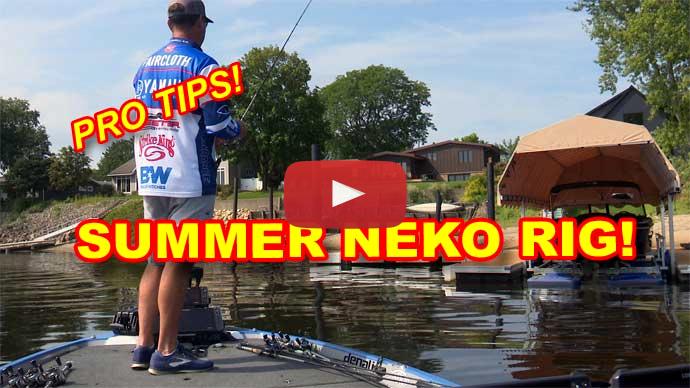
Hey guys, Matty Wong, Elite Series Pro tuning in with bassresource.com. Going to educate and teach you a little something about one of my favorite finesse techniques, the Neko rig. Some of you may have heard it as Neeco, but it is a Japanese technique. Named after a cat, and in Japan the word for cat is neko. So that's how you correctly pronounce the technique and what it is. It's a finesse worm with a little weight in the nose and a finesse hook that's rigged right in that upper 4th of the bait.
Now this technique is utilized across the nation. For me, it is not only a great way just to get just to catch fish, but also almost utilized as a secret weapon to cast on isolated cover. Now I'm going to be talking to you about the full setup—the rod, the reel, the line and the hook—and why this whole system right here is important when utilizing the Neko rig.
So first off, I'm going to start with the rod. This is the MegaBass Orochi X10 and this is the Medusa. This is for a little bit of a lighter presentation, anywhere from an eighth ounce to 1/2 ounce. I wouldn't really fish anything more than 1/4 ounce with this. When it comes to really utilizing the strength of this rod, which is the finesse, the high sensitivity because it has a Stinger tip. This is a three power ST, so the very tip of the rod is extremely, extremely sensitive. This upper section, the first, like I would say 8 inches or so, has a really really really sensitive tip which helps to detect those bites on a long cast or at very very deep water.
The next thing that I like to utilize is a 3000 size spinning reel. Some of you might ask, why not use a 2500? Well, the reason why is because with a 3000 size reel, your Arbor is bigger. And what is an Arbor you may ask? Well, that's your spool size and on every rotation you're picking up that much more line than something that has a smaller Arbor. So that's why I like to use a 3000 size reel versus a 25. It also helps because the drag is a lot smoother on a larger reel.
Now, the line that I'm utilizing for this technique is the Sunline Almight. It's a sinking braid that's extremely thin in diameter and it holds up with a lot of strength. The thing about sinking braid is that you're able to keep the rod-to-bait connection from a long ways because you no longer have a bow in your line that's up on the surface. You have a straight connection to your bait, giving you about 20% more feel when it comes to these types of techniques.
The next really crucial part of this whole deal is your leader material. And what I like to utilize is Sunline FC leader and this leader material is more abrasion resistant. It's a little bit more rigid and it's different from the type of fluorocarbon that you would spool up on your reel. So when you have this—the suppleness of Almight and the braid—matched with the leader material, you're able to get a long cast, which is really important when fishing highly pressured fisheries. I like to use anywhere from 8 to 14 LB test for my Neko rig.
And the next thing that we'll talk about is the hook. So right here I have a hook called the Antenna by Gamakatsu. And this hook right here has two fiber weedless kind of—big keeper off the back—and then these are also to keep it weedless. And I will hook the bait, whether it's wacky just like so right in the middle or the traditional way is to then hook the front of the bait and up like that.
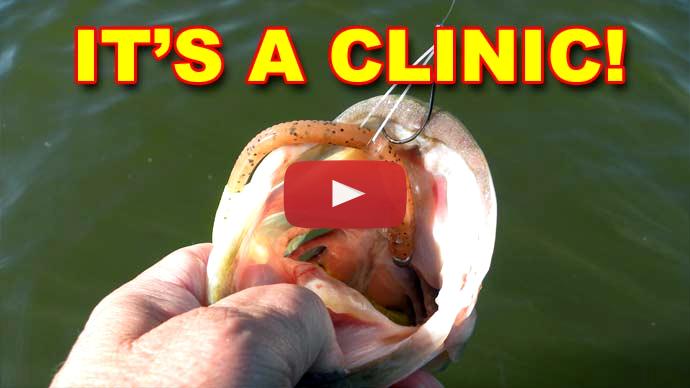
Making sure—this is a really important part—making sure that the point of your hook is facing up. Now when you're dragging this bait across wood or rock or anything like that, if your hook tip is facing down, when a bass picks it up or eats it, the angle of your hook is not going to be conducive to getting a fish in the boat. So when you're able to rig it like so, the hook tip is facing up, so when the bass picks it up, the hook tip is already facing up. They get it, set the hook, you can get the fish in the boat.
Now some people say like, oh what do you do when it comes to feeling the bite and then what? Do I set the hook really hard or not? With this, I don't like to set the hook hard. I literally like to reel into the bass because most of the time they have it down their throat. So you don't want to do a heavy hook set with a Neko rig.
So this time of year, what we're talking about—this summer—is these fish are more so pulled into brush piles. Now, some of your lakes might not have brush piles, so docks are another good place to look. Now I look at your deeper docks that are closer towards the main lake. These fish aren't going to be in the backs of pockets right now because it's just the wrong time of year. They're not thinking about spawning. They're thinking about running around and eating as much as they possibly can.
And it just depends on where you are in the nation. It could be a little bit different. Sometimes in the summer they roam around and other times they're pulled in tight to docks and whatnot. But for the most part a lot of them like to utilize cover—whether it's brush, a dockpiling, a laydown—and a Neko rig is a great way to target those fish.
What I'll do is I'll pull up and if I am able to scan for some brush piles then I can make isolated casts to those brush piles, making numerous casts and changing up the angle every 15 or 20 minutes or so if there's really good key fish in that brush pile.
Now if I'm fishing from shore in the summertime, I'll still utilize the Neko. And what I'll do is I will target isolated cover. So if I see a laydown on the shore, I will parallel cast with the shoreline and kind of thread my worm through that laydown or that stump that you see in the water because those tasks are going to be kind of closer and relating more to shade lines in the summertime now.
The Neko rig is a versatile, versatile bait. And you can fish it from shallow—up to 1 to 2 feet of water—and you can fish it all the way out to 60 feet of water. Now for me, in the summertime, I personally like to target brush piles that are anywhere from the 15 foot down to the 40 foot space. So it's really important that I have a mixture of different weights.
So I'll utilize my Gamakatsu G box right here and I have an assortment of a bunch of different types of nail weights, screws, and that allows me to fish a multitude of different depths when it comes to this technique.
Now some of you may ask, isn't 3/8 a little bit of an overkill? Well, if you're fishing down in 40 to 60 feet of water, it's not, because otherwise it's going to take you a really long time to let your bait hit the bottom of the lake. That's a great way to keep all your nail weights nice and organized.
But yeah, it all depends on the type of fishery that you're fishing. And always remember, in the summertime, work it a little bit slower than you would. Especially if it's midday. If it's early morning in the summertime, I like to fish it a little bit faster because the bass are a little bit more active. But when the sun comes up and it's really, really hot out, I feel like those fish get kind of sluggish.
And so when you're able to make long casts to an isolated piece of cover and slowly drag it and shake it, slowly drag it and shake it, that's probably going to be your best cadence for the summertime when it comes to this technique.
But I hope that's helped—maybe learned a couple things. And that is my favorite way I like to fish a Neko rig in the summertime.