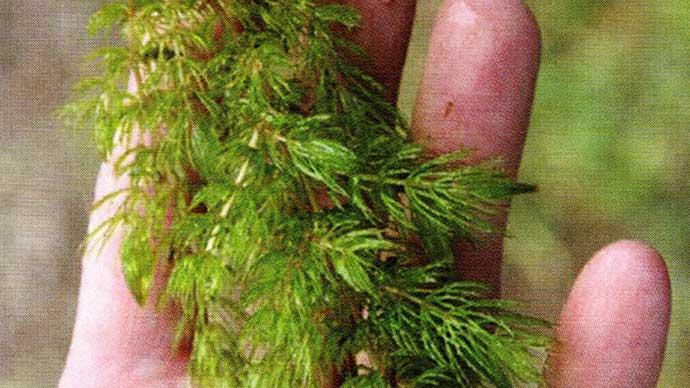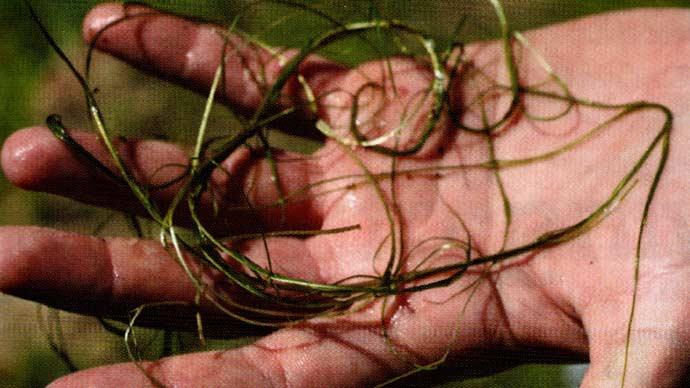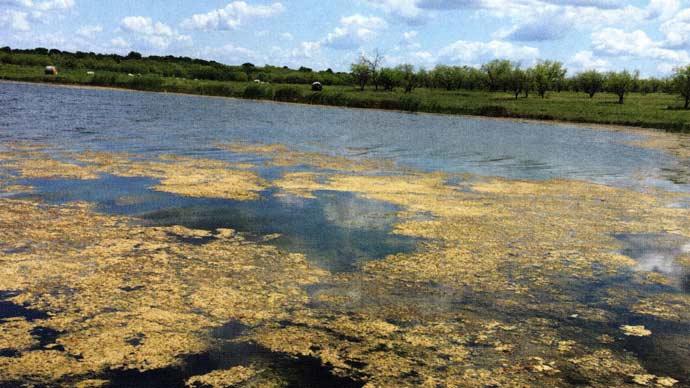


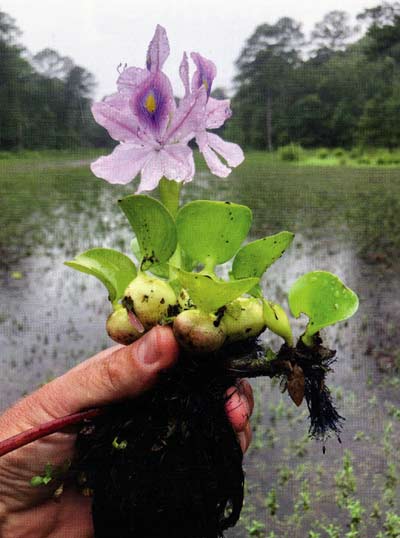
More than half of my time in Extension is spent identifying aquatic plant species and making recommendations for eradicating them. It can be a little depressing, as plants are an important part of the natural world and killing them seems counterintuitive. Some plant species, especially the more invasive nasties, can reach nuisance levels and must be controlled, but some plants are good for pond life.
For years, there were not many updated resources available for the management of aquatic plants. Almost all herbicide recommendations were derived from outdated reports or from the manufacturer's label recommendations. While older data may still be valid, newer, better options are often available. And I will go ahead and say it: relying on manufacturer labels can introduce bias. After all, the manufacturer wants to sell a product, so this desire could lead to pushing a product that is less effective than a competing one.
Another concern is that herbicide recommendations are often written for experienced pesticide applicators who have complex application equipment. Jane T. Pondowner was often left confused by the complicated instructions on the label and from me as she struggled to translate high-volume applicator-speak into her 1-gallon handheld sprayer. Which part of "9.6 oz/acre-foot Florpyrauxifen-benzyl (0.0052-pound formulation) with 0.25-1% v/v non-ionic surfactant" did you not understand?
Further, many pondmeisters may want to add beneficial plants to and around their pond paradise. I occasionally answer calls about which plants to introduce, how to create more fish habitat, and how to enhance the pond's aesthetic value. However, there appears to be no resource available on which plant species you can introduce to ponds with minimal risk of becoming a problem.
Perhaps it is time to update how we make herbicide recommendations and develop advice for people when plants are desired?
Back in the early days of the COVID pandemic, while working from home, I started contemplating these issues. Once I returned to the office, I teamed up with several colleagues to create a suite of new aquatic plant resources. These efforts are finally starting to bear fruit (plant pun intended). We have developed a new website that provides information and print-on-demand fact sheets for many common plant species, including up-to-date recommendations for control and management, as well as the value of letting each species remain.
We are also putting it all into a waterproof field book for management personnel.
How are these resources any different from those already available, you may ask?
First, we do not consider all aquatic plants as inherently bad or undesirable. Not all plants are obstacles to pond use or otherwise damaging. In fact, some species can provide habitat and aesthetic enhancements with little or no maintenance. For each plant species, we provide the traditional identification and control methods, but we also include a section on management value. What value does the plant have to wildlife and fish? Who eats it? How have humans traditionally used it? Can it be used to enhance ponds, and what maintenance may be necessary?
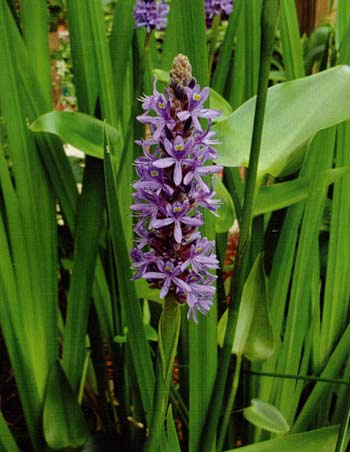
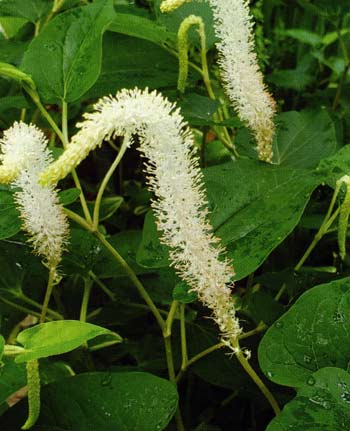
For example, native Pickerelweed is a beautiful, shallow-edge plant whose flowers resemble those of the non-native and invasive Water Hyacinth, but Pickerelweed is rarely a problem species. Deer will eat the plant, waterfowl eat the seeds, butterflies and bees use the pollen, and dragonflies will perch on top of flower spikes as they hunt for their next mosquito meal. Muskrats eat the rhizomes, and they provide shallow water habitat for fish. Humans can eat the seeds and young leaves. Combine Pickerelweed with native Lizard's Tail to get a lovely edge of purple/yellow and white bottlebrush-like flowers. Although animals do not eat Lizard's Tail (it is toxic to mammals, but your dog won't eat it), it can still provide habitat. And while Lizard's Tail will spread rather quickly via underground runners, it is rather easy to control.
Conversely, American Lotus is a beautiful native species that serves as a source of food and fish habitat, and its roots, leaves, and seeds can be eaten by humans. In small quantities, it is part of a healthy pond ecosystem. However, despite all these favorable qualities, American Lotus should never be intentionally introduced. It can be highly invasive, especially in shallow ponds where it will quickly take over.
The other big difference is how our recommendations are derived and presented. First, we only recommend herbicides and approaches that have demonstrated excellent control. If no herbicides have demonstrated excellent control, we recommend the best available option(s). Unlike similar publications, these recommendations are not based on old reports and herbicide labels. We searched the scientific literature, agency technical reports, and other third-party studies to identify peer-reviewed assessments of herbicide treatments, especially those based on real-world applications. This eliminates potential biases and recommends only herbicides that have demonstrated success outside the laboratory.
And our recommendations are largely written for the untrained landowner with their small-capacity sprayer. Other resources often present herbicide mixing instructions for a 50- or 100-gallon sprayer. Most landowners do not require such quantities, and few have the recommended equipment. We have simplified recommendations for easy use with smaller equipment commonly available, simplifying the recalculations that may be necessary. In most cases, mixing instructions are given on a per-gallon basis, so you can follow them directly for a 1-gallon sprayer or simply multiply by five for a 5-gallon backpack sprayer.
For example, to control Iris, mix 5 ounces of glyphosate (the 5.4-pound formulation) with 1.3 ounces of non-ionic surfactant, then add water to make 1 gallon. Then simply spray to wet all exposed plants. In a 1-gallon sprayer, that's all you need - just spray and repeat until you are done. In a 5-gallon sprayer, use 25 ounces of glyphosate, 6.5 ounces of non-ionic surfactant, and then fill the tank with water.
Our goal was to make control of nuisance species simpler and more effective. Anyone should be able to follow these recommendations. Of course, when you simplify, you can lose some information. Herbicide use can be nuanced and at times complicated, so our resources are not intended to be a substitute for product labels.
Product labels are the law, and off-label use is illegal. We focused on keeping our recommendations in compliance with the label, while simplifying them for the applicator and removing much of the guesswork.
We hope that, when this article is published in March 2024, most of these resources should be publicly available. The address for the online resources will be http://extension.msstate. edu/water-weeds. It may still be a work in progress for a while, but all the individual fact sheets should be complete and available for online browsing and download.
Most common species of algae, including submersed, emergent, and floating growth forms, are presented. We have started with 47 taxa (some individual species, some larger groups), and we hope to add fact sheets for less common species over time. For a list of all available species and fact sheets, go to https://extension.msstate.edu/natural-resources/water-weeds/list-aquatic-weeds
Although the project focuses on Mississippi, these plant species, approaches to their control, and their management value certainly do not recognize state boundaries. The resources will be especially useful to pond owners in the southern United States, but we invite people from all over to use them. However, keep in mind that not all herbicides may be legal in every state, so double-check with your state before following any recommendation not provided directly from your state.
So next time you need to kill a plant or want to establish one, check out the new website and request a copy of Aquatic Plant Identification, Uses & Control for Mississippi Waters. Hopefully, it will answer your questions, and I can get to do what I love - managing fish!
Dr. Wes Neal, Extension Professor at Mississippi State, serves as the State Extension Fisheries Specialist and is passionate about educating the public on small lake and pond management. He is an avid researcher on topics from farm pond management to sport fish genetics. Wes is the lead editor of Small Impoundment Management in North America, the only textbook on the subject. He loves to hunt and fish, wes.neal@msstate.edu.
Reprinted with permission from Pond Boss Magazine