

Should we measure the dissolved oxygen concentration or the percentage saturation of dissolved oxygen in pond water?
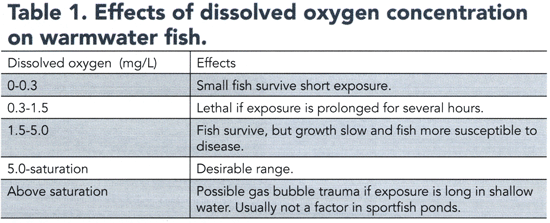
The responses of fish to different dissolved oxygen concentrations are typically reported in milligrams per liter (mg/L) or the equivalent of parts per million (ppm), as shown in Table 1. Some newer dissolved oxygen meters can display concentration in milligrams per liter or in a variable known as percentage dissolved oxygen saturation (or percentage saturation).
Let me say before you read any further that I am not going to recommend that pond owners start measuring percentage saturation of dissolved oxygen. Thus, if one is not interested in knowing about percentage saturation, one can stop here without any danger of missing out on some secret of a better way of assessing the status of dissolved oxygen in one's pond.
The concept of percentage saturation is based on the effects of water temperature, water salinity, and atmospheric pressure on the capacity of water to hold dissolved oxygen in solution (Table 2). I will not include salinity in this discussion, because most pond owners have freshwater ponds with salinity typically below 1 part per thousand (ppt). Normal seawater has a salinity of 35 ppt. But, to give you some idea of the effect of salinity, at 20°C, the dissolved oxygen holding capacity of water is 9.08 mg/L in freshwater (Table 2). This capacity falls to 8.56 mg/L at 10 ppt salinity, 8.06 mg/L at 20 ppt salinity, 7.60 mg/L at 30 ppt salinity, and 7.17 mg/L at 40 ppt salinity. Let us forget about saline water in the present discussion.
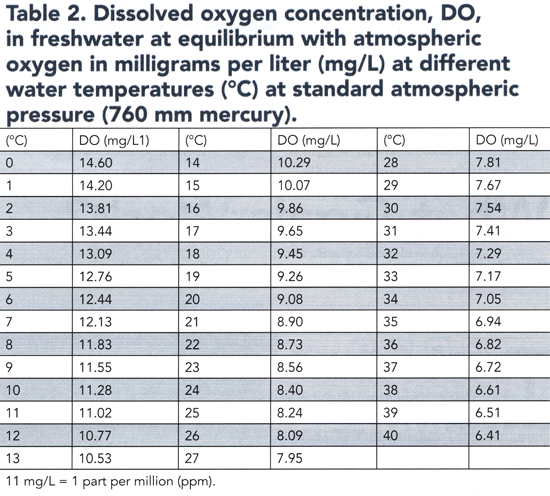
The dissolved molecular oxygen (O2) concentration in freshwater at an atmospheric pressure of 760 millimeters (mm) of mercury is also called the saturation concentration. This is because the water will neither gain nor lose oxygen molecules from or to the atmosphere at the dissolved oxygen concentrations listed in Table 2 for each water temperature. Thus, Table 2 could just as well have been titled as: The Dissolved Oxygen Concentrations at 100% Saturation in Freshwater at Different Temperatures and 760 mm Mercury of Atmospheric Pressure. Standard atmospheric pressure at sea level is 760 mm.
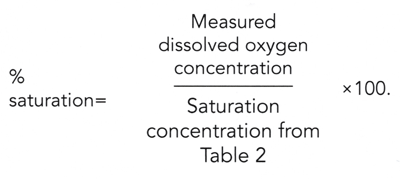
The computation of percentage dissolved oxygen saturation is relatively simple at standard pressure:
For example, suppose the dissolved oxygen concentration in a pond is measured to be 5.5 ppm at 28°C:
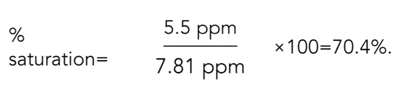
This particular pond was, at the time of measurement, undersaturated with dissolved oxygen. But suppose this measurement had been made early in the morning, before phytoplankton in the pond began releasing dissolved oxygen through photosynthesis. In the afternoon, the water temperature in the pond rose to 30°C, and the dissolved oxygen concentration rose to 9.5 mg/L. Doing the percentage saturation calculation again, the results are:
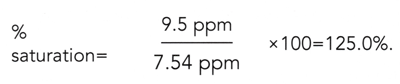
Now, the same pond is at 125% saturation with dissolved oxygen, or supersaturated.
It is a fact that, during the process of extracting molecular oxygen for respiration, fish respond to the pressure of dissolved oxygen in water rather than to its actual concentration. The oxygen pressure in water is directly related to the percentage of saturation, but I will not explain this, for it is not essential here. Nevertheless, Table 3 shows that, at a given measured dissolved oxygen concentration, the percentage saturation values for water do not differ significantly across the range of water temperatures typically seen in a pond during the growing season. This is particularly true for low dissolved oxygen concentrations (1-4 mg/L), which may adversely affect fish (Table 1).
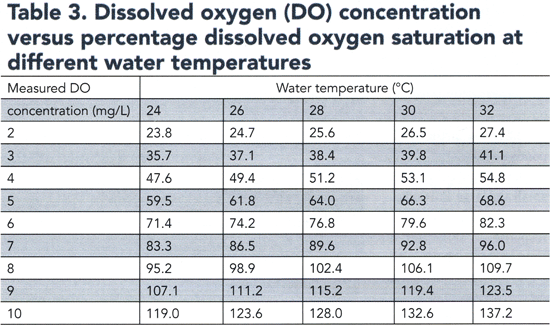
Most of the printed information available to sportfish pond owners refers to dissolved oxygen concentration and its effect on fish on a weight-over-volume basis, e.g., parts per million or milligrams per liter, as shown in Table 1. There would be much confusion in trying to change the traditional practice, and no improvement in dissolved oxygen management would result, even if confusion eventually settled down and everyone started using the percentage saturation measurement.
There are many applications in research on fish respiration and oxygen transfer between air and water in which the percentage saturation or the oxygen pressure in water are critical factors. However, attempts to get pond owners to use percentage saturation would just be another case where scientists, wanting to appear extremely rigorous in their approach, cause more confusion than they provide assistance.
I will return to Table 2 to explain one more point about dissolved oxygen solubility. The data in Table 2 are for an atmospheric pressure of 760 mm. The atmospheric pressure changes with the time of day and in response to weather fronts. These changes are typically not meaningful with respect to dissolved oxygen solubility effects on pond fish. There is a much greater change in pressure related to elevation or altitude. For example, at sea level, the standard pressure is 760 mm, but at 500 m (1,640 ft), the minimum atmospheric pressure drops to about 717 mm. In a pond at 500 m altitude, the saturation concentration would be less than indicated in Table 2. For example, if the temperature of the pond water is 20°C, the saturation concentration at 500 m would be:
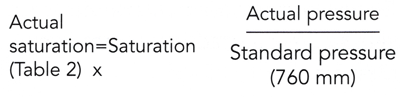
In this case, it would be 9.08 x (717/760) = 8.57 ppm.
Modern dissolved oxygen meters either automatically compensate for altitude or offer a manual method.
Dr. Claude Boyd is a professor emeritus in the School of Fisheries, Aquaculture and Aquatic Sciences, Auburn University, Auburn, Alabama 36849. His work with water quality is internationally renowned. His most recent book, Handbook for Aquaculture Water Quality, is a must-read for anyone interested in water chemistry and its relationship to your pond. It's technical, thorough, but easy to read and understand. Buy it at www.pondboss.com in the online store.