

Over almost five decades of evaluating ponds and lakes to help landowners make theirs the best fishing hole they can be, I've developed a sound process. It's made up of five basic principles, each one building off the one before it. These principles are the foundation for building a management strategy.
While each principle is basic, we can dig into each as deep as needed to figure out how that piece of the puzzle affects the whole picture.
Every pond starts with its water.
I call it "Happy Water." If your water isn't happy, nothing else matters. Happy water is healthy, vibrant water with a good mix of minerals, some metals, and nutrients in combinations that allow the biology of what happens in that wet stuff to produce healthy organisms.
To figure out exactly what "Happy Water" is, a water chemistry analysis is required. While that analysis gives us a starting point, it's more of a reference point for the future. Happy water, from a basic standpoint, has a pH between 6 and 8, with total alkalinity above 40 parts per million (ppm). When alkalinity surpasses about 200 ppm, water isn't quite as "happy".
Part of analyzing water is physically seeing what it looks like. Water clear to ten feet? Does it look like iced tea? Is it pea-soup green? Or does it look like the Caribbean? (Caribbean color isn't necessarily good in fresh water.) Next, what does the water produce? Are the fish healthy? Is there a nice plankton bloom?
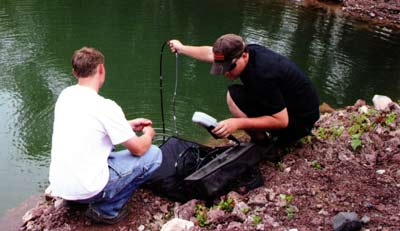
Measuring the visibility depth is a good dataset, especially if it's checked at least weekly during the growing season.
Keep records...good managers refer to visibility records regularly.
The consequences of unhappy water lead to periods of stress on your target... your fish. The basic tenet of unhappy water is that the chemistry isn't stable. pH can fluctuate throughout the day. Alkalinity is your pond's Rolaids, Prilosec, and Tums all rolled into one—chemical autonomy leads to fewer stress points for your precious fish. When a fish is dealing with unhappy water, it can't thrive. It can't feed well; it can't grow as well. A fish's sole mission when water is in dire need is not to die. When a fish is dialed in on survival, it loses precious time to grow to the size you want...if it doesn't die.
Happy water is moving water within healthy pH parameters, with a good mix of the aforementioned minerals, nutrients, and metals.
Water temperature is a big deal, too. You can't do much about that...Nature handles that tidy little tidbit...unless you have an aeration system. Manage aeration, considering how it affects your pond's temperature.
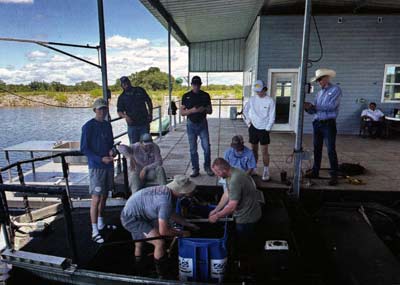
That's another one of those management decisions, when the time comes to make it.
The second fundamental of managing a great fishing pond is habitat. My little catch phrase is, "As goes the habitat, so goes what lives in it." When speaking in front of a crowd, I'll often pose the question, "If you wanted to go have a legitimate chance at catching a trophy-sized bass, where would you go?" Enter your favorite trophy bass lake here-_______. In Texas, the first answer is "Lake Fork." Others will chime in with "O.H. Ivie" or "Falcon". Then, I'll ask, "Where would you go to catch the biggest Striped bass?" The answer may be Lake Texoma, or Santee Cooper over in South Carolina, or maybe off Block Island, Rhode Island. Then, the closer, "If I asked where you might go to catch the biggest lake trout?" People from the south give you a blank look. Folks in the northern tier suggest the Great Lakes, or somewhere in Canada.
My point?
Those fish thrive in those environments because they have happy water and the kind of habitat they prefer.
As you think about your lake or pond, ask yourself whether it offers the best habitat for the fish you are targeting. Even deeper, think about whether it has the best habitat for all the different life stages of those precious fish you want to raise. If Largemouth bass are your target, does your waterbody have all the elements of habitat for all the different sizes of bass, from egg to giant fish?
When I'm evaluating a lake, I'm studying the habitat. Lots of good folks understand the type of habitat they want to tie into a giant hawg bass and wrench it out of a tree-top on the business end of their favorite rod and reel. Still, those same folks often don't give enough brain time to what it takes for those top-end bass to grow to those huge sizes... when it comes to habitat.
Habitat, collectively, is what something needs to reproduce, feed the young, hide, congregate, ambush, cruise, and live as close to a harmonious life as possible, as hard as that is with different species of fish, many of which are trying to eat each other.
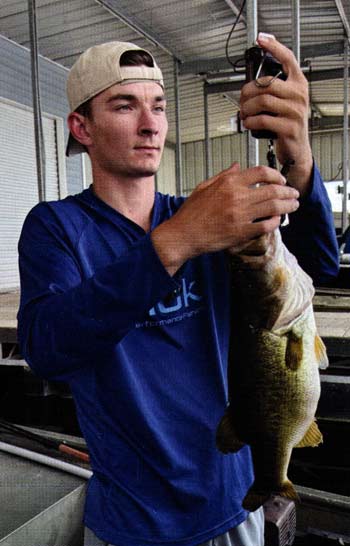
Remember this: it takes ten pounds of baitfish for a bass to gain one pound. Heck, it takes ten pounds of any underwater food to grow a pound of anything. It takes ten pounds of plankton to grow a pound of insects. It takes 10 pounds of insects to grow 1 pound of tiny fish or larger bugs. When a baby bluegill is hatched, for example, it weighs about 12,000 per pound. If you can keep it alive for 45 days, with plenty of food, it weighs 30 per pound. With that ten-to-one conversion rate, you can begin understanding the value of habitat for those little creatures that play a big role in growing those beastly, healthy fish we all want.
With that happy water and prime habitat, the next part of this big-league evaluation is the food chain. To stay with the "H" theme, think "Happy Meals". Since we know it takes 10 pounds of baitfish to produce 1 pound of game fish, understanding the status of the food chain is the next crucial step. When looking at a pond or lake's food chain, we need to know which species exist, what their roles are in this ecosystem, and how many different size classes there are. Those are key clues for decision-making. Do you have the right species? Are they reproducing adequately? Can you decipher their significance?
This part of an evaluation is typically one of the easiest to figure out. Are there enough baitfish to support the game fish? Electrofishing at the right time of the year (spring or fall) often gathers enough data to make an educated call to offer solid insight to the pond owner. Digging deeper into that data also gives us clues about the impact the habitat and water quality have on that particular fishery.
At this point, the jigsaw puzzle pieces are starting to fall into place, so we can begin to see the bigger picture.
The fourth piece is genetic structure. Think "Heritage". It's not common, during an evaluation, to dig deeper into the genetics of the different species of critters lurking beneath the depths. But all biologists understand the significance of having the proper genetics in any given lake.
We don't want Florida bass trying to make a living in Michigan waters. They won't do well.
The most important long-term part of this evaluation is a harvest plan. Look at a pond or lake as a garden. You'll plant it, nurture it, and at some point, you'll need to harvest something. So, pray tell, what do you need to harvest?
Landowner goals determine which part of the management strategy to pursue. When a landowner tells me, which is common, that they want a "well-balanced, healthy pond", then the evaluation suggests harvesting fish in a "balanced" way. Typically, we look for the different size classes of fish that aren't thriving, compared to the rest of the fishery. Those are the target fish. If a landowner tells us the goal is to manage for trophy fish, the mission is to strive to protect the biggest fish, with judgment to protect the best of the junior varsity, and with some discretion to look at the junior high school performers. Those young of the year can be a little tricky to judge.
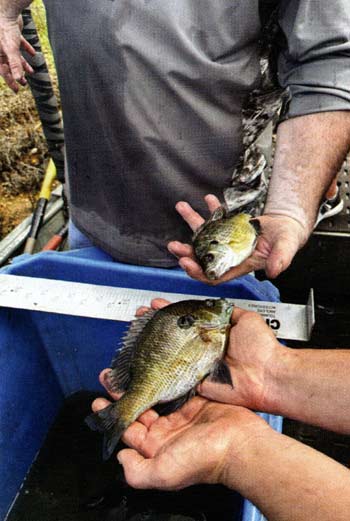
As the evaluation rolls, we are also looking at the plant community. Aquatic plants, native ones for sure, add to the habitat part and can play a role in the food chain, as well as influence water chemistry. While the last part of that statement may seem far-fetched, it isn't. Plants photosynthesize and respire. Natural biological metabolic systems can affect water chemistry, which in turn affects your fish. That's one spot where we circle back to water chemistry. Happy water, if you will.
Part of the evaluation involves examining the population dynamics of the fish. It's common to examine populations to determine whether external forces are at work, affecting the waterbody as a whole, with particular emphasis on the fishery.
Double-speak, you say?
Nah, just a biologist-guy telling you he can probably detect outside predator influence on your fishery. Are those cute little back-swimming darlings, river otters, pedaling their way around your lake? They aren't peddling joy amongst your fish population.
They are eating the biggest and best fish you've got, usually in the dead of winter in the south, or much of the year in the Midwest and north.
Seasoned fisheries guys can look at the mix of fish making a living in our ponds and see the impact of predators, whether they be marauding otters or migratory thieves, like those pesky double-crested cormorants.
As you are deducing, evaluating a lake involves quite a bit more than a biologist launching a boat, collecting some fish, scratching notes with a Number 2 pencil on a Big Chief Notebook page, and then reading paragraph 28 of the fisheries manual.
Evaluating a lake is a collective, deductive process. It's one the landowner should embrace and partake in.
Oh, one other part of this evaluation process... a lake is an ongoing, dynamic ecosystem. It changes day to day. Fish reproduce, and then eat each other. Plants come; plants go. Water, that magic medium, grows stuff and then grows less stuff. Water is a vehicle.
When evaluating, we try to get a snapshot to project what to expect and which management strategy to embrace.
When that evaluation lends recommendations, and those suggestions are followed, there are consequences. Part of the fun is projecting the consequences. A bigger part of the fun is seeing the results. There are results, whether those recommendations are followed...or not.
It all starts with a dive into Happy Water, Habitat, Happy Meals, Heritage, and is topped off with a Harvest plan.
Reprinted with permission from Pond Boss Magazine