

Some time ago, we reviewed several studies on fish senses. How do fish senses work and what are they? What unknown factors cause fish senses to go off, and how do they react?
Keep in mind that fish senses, whether physical or biological, are likely similar across multiple species. What goes on in Bass, Yellow Perch or Fatheads may also exist in other pond fish species.
One of those issues is spawning suppression i.e., little to no spawning/recruitment? We do not see this often, but it does happen and can quickly unbalance populations if not addressed. The question asked is, "What is causing this problem?" The fish are in good condition, and the water is fine. Why are there no little fish?
There were no cold snaps or large-scale water changes, so what happened? Several studies use the term "physical and biological factors." What possible factors are those, and how do they arise?
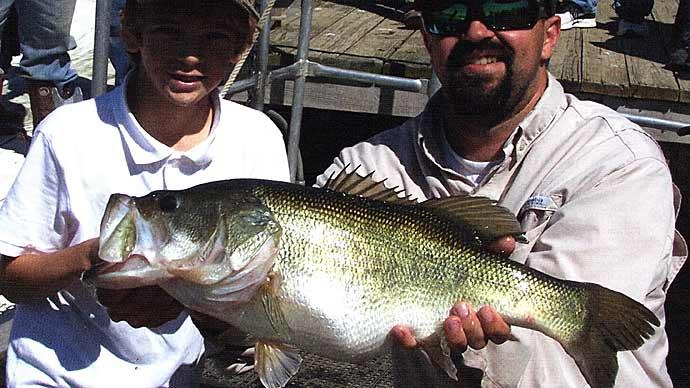
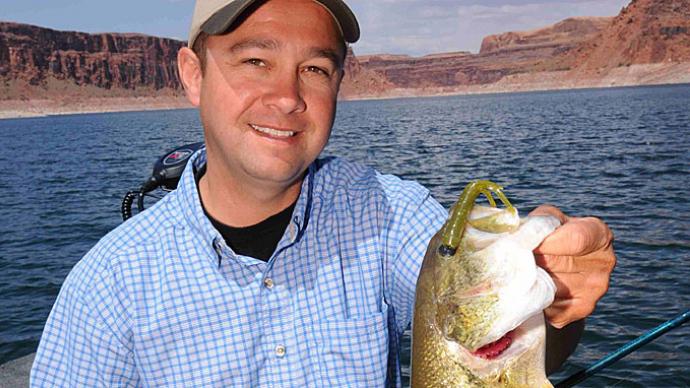
One such study, titled "Factors Influencing Nest Survival in Florida Bass" by Z. Slagle and S. L. Shaw in Transactions of the American Fisheries Society 146:696-702.2017 Volume 146.2017 - Issue 4 (© American Fisheries Society 2017), provides insight into differences in Bass spawning. The survival of both Largemouth and Smallmouth bass offspring can depend on several physical and biological factors, including the size and age of the guarding male, bed fishing pressure, and environmental changes during the nesting period.
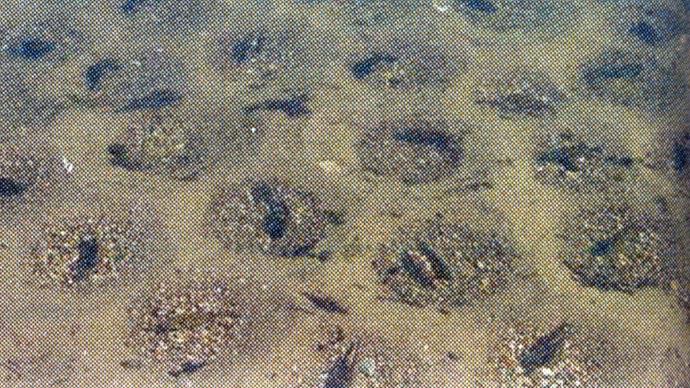
Many nest attempts fail, and hatchling abandonment is common due to storms, sudden temperature changes, angling, and nest predation. If the male bass abandons the brood (or is fished or run off the nest), the brood is unlikely to survive long.
Another older study, Behavioral Suppression of Spawning in Largemouth Bass by Interspecific Competition for Space Within Spawning Areas by Stephen Lee Smith in Transactions of the American Fisheries Society, 1976. No. 6 pg. 682 notes the inconsistencies in prior studies on this exact question. The results from these studies were mixed, with some indicating an excretion and buildup of a hormone-like repressive factor by overcrowded sunfish and forage species. Others found a link to physical factors, such as aggressive interaction with forage species, primarily affecting the male bass. That was effective in suppressing the spawning behavior sequence even before nest building.
These are the probable "physical and biological factors" of spawning suppression. The sight of swarms of harassing forage species and the chemical suppression factors they release can suppress bass reproduction. Further, it appears this situation is more common in highly fertile waters. Bass failed to produce offspring in several eutrophic Florida lakes that boast large populations of sunfish. It was further determined that reproductive failure was due to a refusal of the adult population to spawn and, in females, was characterized by retention of enlarged, ripened ovaries long past the spawning period. Further, that condition could be replicated in hatchery ponds, and the reproductive suppression attributed to the excretion and buildup of a hormone-like repressive factor by overcrowded sunfish and forage species. Others documented similar reproductive failures at high population densities in the blue tilapia but did not elucidate the mechanism of repression.
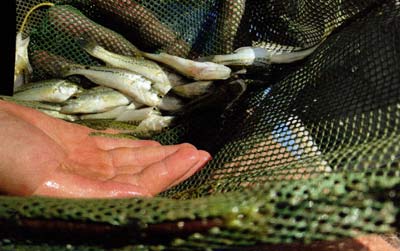
Another sense issue concerns growth rates and is discussed in "Chemicals Released by Predation Increase the Growth Rate of Yellow Perch, Perca flavescens," by T. P. Barry, G. K. Dehnert, P. D. Hoppe, and P. W. Sorensen, Journal of Fish Biology (2017). doi:10.1111/ ifb.13475. online wileyonlinelibrary.com, where water-soluble factors associated with walleye predation on either yellow perch or fathead minnows markedly increased the early growth rate of Yellow Perch. The findings suggest that Yellow Perch possesses an inducible growth-promoting mechanism regulated by water-borne chemicals. Note the "water-borne chemicals" which can be sensed by the fish.
Yet another study addresses predator recognition and is titled, Population Differences in Responses of Fathead Minnows (Pimephafes promefas) to Visual and Chemical Stimuli from Predators by Alicia Mathis, Douglas P. Chivers, and R. Jan Smith in Ethology 93.31-40. This study demonstrates that fathead minnows recognize pike as a potential predator from a two-tiered predator recognition system that incorporates both visual and chemical cues.
Here, two populations that vary in exposure to pike predation under natural conditions show corresponding variation in their ability to recognize pike as a potential predator. Chemical cues may be particularly important in identifying a predator such as the northern pike, which is often well hidden in the weeds.
Here, the authors note that reliance solely on visual cues may be of limited utility under conditions of poor visibility (e.g., in muddy streams) or when predators are hidden.
Because of pike's concealment under natural conditions, predator detection via nonvisual cues may be critical to the survival of potential prey.
This study demonstrates that fathead minnows from a population that is accustomed to living with northern pike are better able to recognize pike as potential predators than are minnows from a population that is unaccustomed to living around pike. These results are consistent with other studies of small fishes that have reported differential predator-recognition abilities between those habituated to predators and those that are not.
In other studies, it has been documented that fish caught and released emit a warning-signal chemical that other fish detect, and they quickly stop biting. In addition, other works show that male Bluegill can chemically identify (smell) and distinguish their fry from those of others. So, we know through more recent studies that fish readily produce and use chemical signals for various purposes.
There is still a lot we must learn about fish senses. But for those stocking fish into lakes with existing predators, investigate (see the Pond Boss Forum), habituating those stocker fish for much better survival.
Reprinted with permission from Pond Boss Magazine