

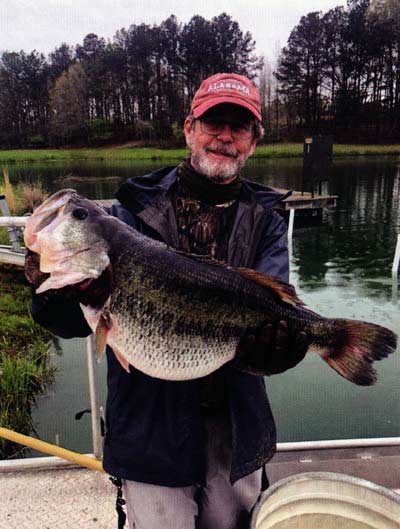
Growing trophy bass is incredibly rewarding. Over the years, lessons have been learned and strategies modified. Ongoing advancements in technology and science provide biologists with greater opportunities to succeed. Although modern breakthroughs have helped, it is still challenging, creating an enjoyable backdrop for fisheries professionals to stay motivated.
Whether you are seasoned or new to trophy fish management, everyone has the opportunity to continue learning and become more effective. There is too much opportunity for complacency... assuming all is well beneath your favorite fishing hole.
In my opinion, we are another decade away from really dialing in fisheries management to a point where it becomes routine and less challenging to grow huge fish consistently. Although it may be hard for some to comprehend how the industry will evolve to a point where trophy fish management is simple, recent breakthroughs have shed light on this reality headed our way.
Until cutting-edge advancements, especially better ways of defining genetic traits, are further developed and taken mainstream, you need to operate with the understanding that your probabilities of success are lower than you likely expect, and that you need a solid, data-driven, adaptive approach to accomplish your goals in today's world. You will benefit significantly from a strategy that provides the highest odds of success. Over the years, I have learned four founding principles at the heart of my trophy-fish management philosophy. Although this article is based on growing Largemouth bass, you can apply these principles to any predator fish species.
Maintain the proper number of genetically superior predators relative to the waterbody's productivity
This is typically the most difficult principle to accomplish. Knowing the number of bass you have, their genetic potential, as well as how many pounds of forage the waterbody produces annually is incredibly hard to assess...and to accomplish...for most people. Starting with the predator headcount, it is paramount that you do not have too many bass. They cannot reach trophy sizes if they do not have enough to eat. Think about how many superior mouths are feeding at the trough. At the same time, too few bass make fishing painfully slow and represent an opportunity lost, because your water body can support more. My preference is to maintain a female-dominant bass populations that lack natural bass recruitment.
While that sounds easy when reading these words, it's not.
Smaller waterbodies afford managers the luxury of managing individual bass, allowing managers to really stay on top of the population. Depending on variables such as water depth and cover.
I typically start managing age-classes (cohorts) of bass rather than individuals, at around 10 acres. With enough resources, you could manage the individual fish on larger waterbodies, but the effort required to do so can typically be better spent in other ways.
Interpretation? It's not possible to track all big bass in any given lake. The bigger the lake, the harder it is to track individual fish.
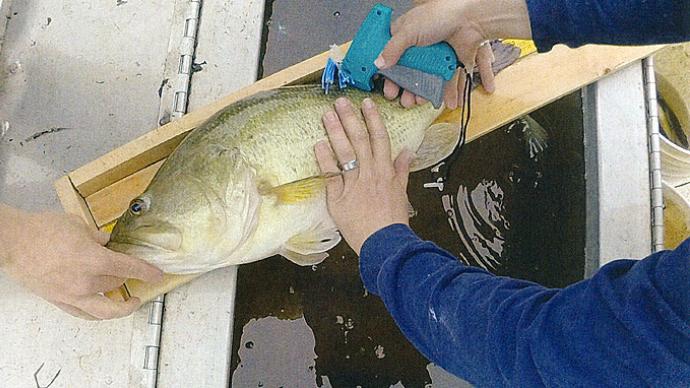
Thanks to recent advances, we can now test bass to assess their genetic potential. Analyzing a small tissue sample, such as a fin clip, for trophy DNA markers provides some of the information needed to ensure your young bass have the genetic propensity to reach your top-end growth goals in the future.
This data point improves your odds of success. Well-identified genetics is important. Today's methods are much more efficient than yesteryear's - one would hope to have good genetics, then years later find out if they did... or not.
Accurately projecting the fishery's productivity, in terms of how many pounds of forage fish the waterbody will produce in a given growing season, is a challenge. Having a strong aquaculture background is highly valuable when assessing fish biomass in a waterbody. Raising bait in hatchery ponds year after year, and seining those waterbodies annually to harvest the fish grown, fosters both a knowledge set and an instinctive ability to forecast how many pounds of forage you will likely produce. Since most people lack this knowledge, you either need to hire someone who has it or try to calculate it yourself.
To project forage production, you want to have a good understanding of your predator population, as well as how the forage population is doing in the spring. Healthy water quality, coupled with a good plankton bloom, is important for maximizing forage production. The amount of fish food consumed will also need to be factored into your calculation. Using these key data, you can start calibrating your forage production estimates. By teaming this information with the number of predators you have and how well they are performing, you can start setting yourself up to make educated decisions.
I encourage you to assume each mature bass needs 40 pounds of forage fish annually. Depending on variables, such as waterbody size, depth, water quality, flow rate, latitude, elevation, budget, etc., the biomass of forage fish you can produce will vary significantly. In many cases throughout the south, a well-managed trophy fishery can produce 800-1,000 pounds of forage per acre annually, although it will never have a standing crop that large. Fish are produced and eaten. Doing the math, this means that most fisheries that are well managed should strive for 20-25 bass per acre, or fewer, depending on how large those fish are.
Congregate predators to enhance the angling experience and data collection
Trophy fisheries have inherently low numbers of predator fish. Congregating them increases catch rates, providing anglers with a more enjoyable experience. For a great spring and fall bite, cover should ideally be distributed around the perimeter or in water less than six feet deep. When surface water temperatures are between 60 and 75 degrees, largemouth bass often congregate near the perimeter or in shallow water. As water temperatures warm or cool, bass tend to move deeper in search of more favorable conditions.
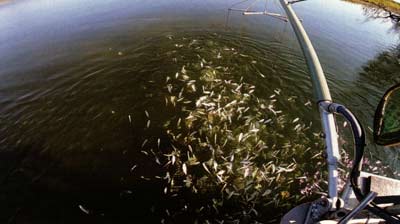
In most situations, I prefer minimal cover, which encourages bass to congregate as much as possible. If done well, it is common to collect 20-40 percent of the bass population when electrofishing small to mid-sized lakes and ponds. This critical data sets the stage for success. If we can collect this many bass using electrofishing, anglers can also catch more when fishing.
Since largemouth are predictable, pushing into shallow water cover each spring and fall, we use this time to electrofish and collect the data needed to make accurate management decisions. Springtime, in particular, is incredibly predictable. Capitalizing on this predictability allows biologists to collect a large sample of the bass population, assuming the cover is ideal. Dialing in your cover is critical if trying to maximize your catch rates. With better catch rates, assumptions can be reduced, and the probability of long-term success increases.
Minimize fish stress
Fish under stress shift to survival mode, consume less forage, and even become vulnerable to parasites and diseases. This results in bass failing to meet their genetic potential. Water quality is often the most prevalent stressor and typically involves thermal stress or low dissolved oxygen, although other parameters, such as undesired pH, are also common.
Maintaining healthy water with dissolved oxygen at 100 percent saturation throughout the entire water column is ideal and provides a great backdrop for fish to focus on growth.
Keep in mind that stress comes from a variety of sources, including over-handling by anglers, pressure from both otters and fish-eating birds, and toxin-producing golden and blue-green algae, to name a few. Minimizing stress on bass should be a primary focus.
Mitigate limiting factors and risks of failure
This is typically the second-most-challenging principle. If you have been around fisheries management, it is at least a big setback. Although rapid and widespread fish mortality leading to complete failure is a real concern, failure often occurs in subtle, incremental steps, each reducing the top-end size potential of your bass. Sometimes, these failures affect only one size class of bass; other times, they can affect the entire population.
Complacency is common among landowners, assuming things will go to plan even when they think they are paying close attention. In many cases, people are satisfied with their successes but lack awareness of how much better their bass could have grown if the fishery had been managed better. Although happiness and satisfaction are important, growing trophy fish is not a forgiving process, and there's little room for complacency if you want high probabilities of success.
So why is failure common? Most of the time, failure involves a lack of awareness. Unlike managing deer, where you can easily see details such as the quality and quantity of available food, managing fish means you lack easy access to key information. Sometimes, the fisheries data you use to make decisions are not representative. So not only do you lack key data, but you also end up trusting the inaccurate data you do have, leaving your bass vulnerable.
Often, the things that lead to complete failure are the same things that lead to lower-than-desired top-end growth. Here are some examples to illustrate these failure points: drought, flooding, nuisance fish species, power failure, elevated nutrient levels, dense blue-green algae, nuisance aquatic vegetation, lack of primary productivity, overpopulated bass, underpopulated bass, poor genetics, bass small for their age, forage too large, insufficient biomass, forage, otters, cormorants, and poachers, to name a few. The full list is extensive, and trophy fisheries continually face relentless internal and external risks.
Although trophy bass management is both complicated and potentially stressful, the challenging journey of learning and strategizing can be highly gratifying when it works out. Watching bass grow over years of hard work brings great joy, and in many cases, they are family pets. Whether you are just starting your journey or have been navigating it for years, I encourage you to follow these four principles to enhance your odds of success. Even with extensive experience managing many trophy fisheries, it is difficult. In almost all circumstances, it makes sense to partner with a biologist to ensure the highest odds of success. ^^
David Beasley is a Fisheries Biologist and the Director of Fisheries at SOLitude Lake Management, an environmental firm providing sustainable lake, pond, wetland, and fisheries management services. Learn more about this topic at www.solitudelakemanagement.com/ knowledge.
Reprinted with permission from Pond Boss Magazine