

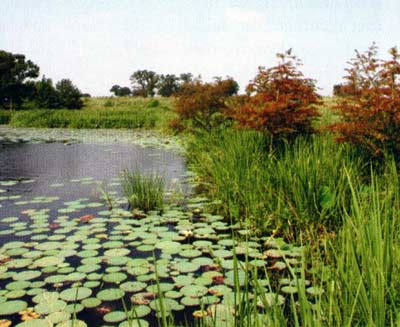
Here we are, July. Our side of the earth has tilted in favor of heat. Heat is a generator of authority and stimulus for all kinds of natural things, like your aquatic plants. All spring, you've watched your beautiful pond do what pretty ponds do—come to life, reproduce, and grow.
That includes your underwater salad bar. That greenery can surely cover a lot of ground in short order. If you happen to be in the category of people who tell guys like me, "Well, I saw it growing back in May, but sure didn't think it would get out of hand so fast," then this article has your name written all over it.
First, understand why plants (and most of nature) do what they do. I call it the "Big Three". Plants need the right temperature, which we cannot control, the right food, which we usually cannot control, and sunlight penetration into their growth zone, which we can likely control.
Take away any one of those "Big Three," and plants won't grow. Just look at those cattails. Back in March, all you saw was a bunch of tan, dead cattails leaning over in the water. Then, what seemed to happen all of a sudden: you had six-foot-tall cattails, some growing in areas you didn't see any last year.
The temperature rose, and those plants took off. That's what they do.
How do you manage sunlight penetration, you might ask? I should have done that earlier in the spring. In the south, we fertilize as needed to initiate a plankton bloom, which decreases visibility. In northern states, look at herbicide treatments before the plants blow up.
Purchase a Secchi disk and begin recording visibility depths. That's a good management strategy, especially starting late winter.
But here we are, and you are looking for answers. Be very careful, however. If you choose to treat plants, you must understand the consequences. If you have too much and then remove too much, you run the risk of excessive mass decomposing too quickly, which can cause oxygen depletion and potentially kill your fish.
So, what's a pondmeister to do now? In July, August, and even into September?
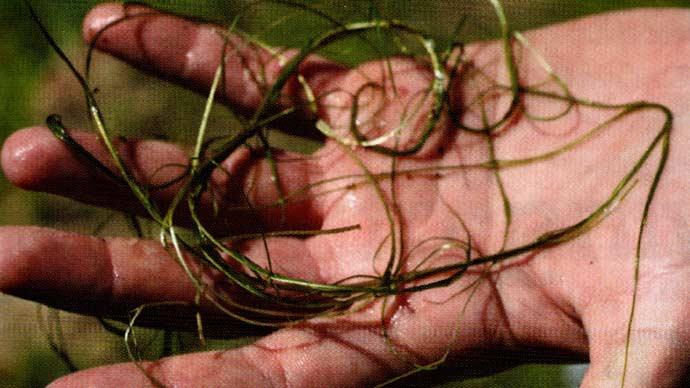
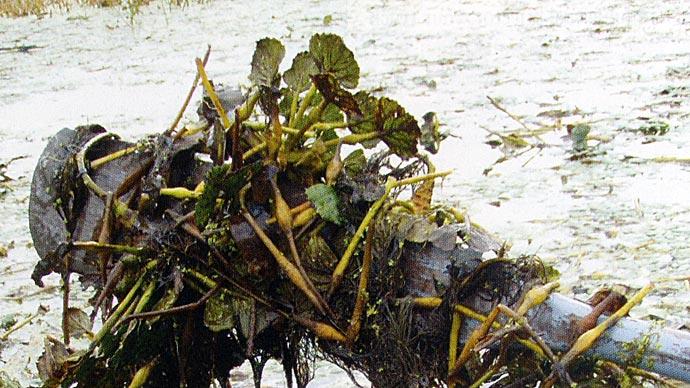
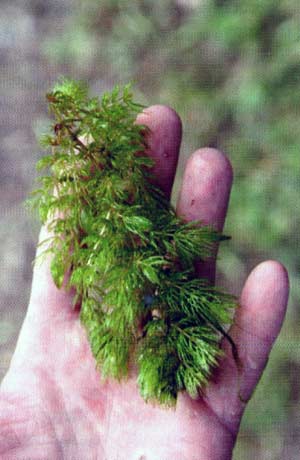
Job One is to identify the plant or plants that have become invasive. Just today, I got a Facebook message from a guy who "Has too much moss." That statement, while accurate, is meaningless. Too much of what kind of 'moss'? There are several resources available to meet your pleasure and plant identification needs. I've seen some iPhone apps that work well. The Noble Foundation, located in Ardmore, Oklahoma, offers a free book about plants in that region. So does Mississippi State. Pond Boss writer and fisheries professor Dr. Wes Neal penned that one.
The University of Florida has a reputable and helpful website for plants. My personal 'go-to' is the Aquaplant website at Texas A&M University.
Identify the species of plant. Then, decide if it's a good plant or a bad one. Then, decide if it's invasive enough to take action. Here's a tip: Many species of native aquatic plants lend value to your habitat. If aquatic plants cover 5-10% of your pond, especially around the shoreline in shallow water, that's a safe haven for baby fish. That habitat element supports the growth of periphyton and bacterial colonies, which provide food and substrates that benefit bugs, crustaceans, and small fish. Consider that before removing those plants.
If plants are invading areas where you don't want them, by all means, figure out what to do. No one wants to launch a boat through a thick mat of bushy pondweed.
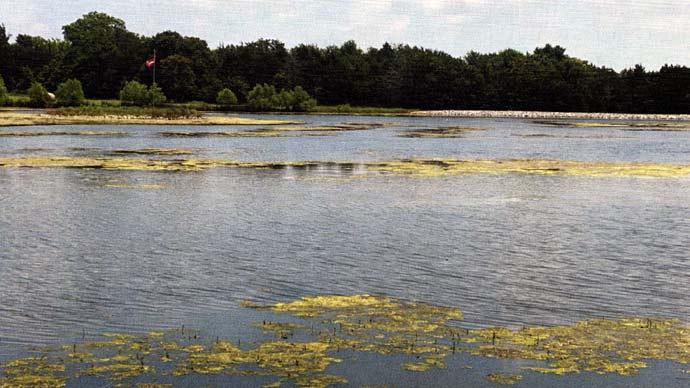
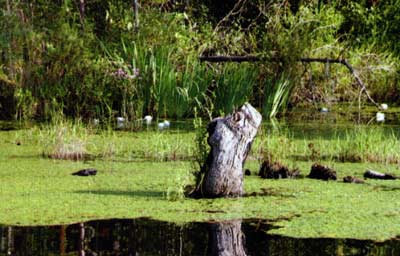
Some ponds actually benefit from as much as 20% surface area coverage of plants, especially if there is little other fish habitat under water. But get much more than 20% and enjoyment is affected. Not many of us like pulling mats of gunk off a crankbait.
The health of your pond begins to deteriorate as the percentage rises. Up to 50%, and the fishery begins to decline. It's simply an issue of supply compared to demand. The forage fish can stay tucked into those plants where bigger fish can't access them for dinner.
Additionally, the large amount of plant mass respiring at night and photosynthesizing during the day can lead to compromised oxygen levels, especially with three or four consecutive cloudy days.
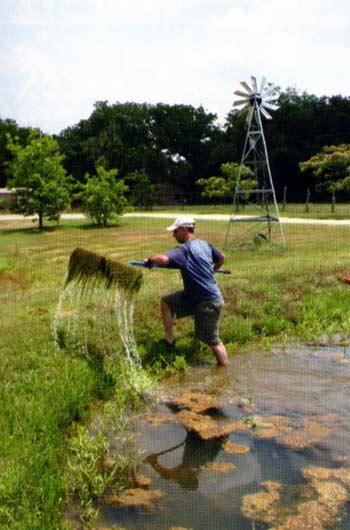
Here's the deal. Correctly identify your plants. That's critical. Decide if you like them or not. Then, decide on a management strategy. You don't have to pick one way to knock out some plants. There are three things to investigate. You might be able to get some strong-backed youngsters to pull out those plants around the dock and boat ramp as you apply for a permit to stock two or three triploid grass carp (if they are legal in your state). To give those weed-eater fish a jumpstart, you can choose to use the safest approved aquatic herbicide that's effective on that species of plant. That's a good strategy.
One last thing—those plants didn't become invasive in one year. You may be facing a problem that began four or five years ago. Don't expect it to go away in a few weeks. That's the word of caution to keep from upsetting the balance of what's become the underwater environment of your pond.
Reprinted with permission from Pond Boss Magazine