

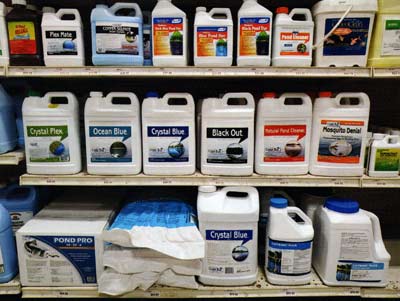
Okay, this article is going to ruffle some feathers. In the past few decades, it has become increasingly common to see dusty bottles of "bacteria" on store shelves for introduction into ponds and lakes. The claim is that these bacteria will perform all kinds of miraculous feats, such as removing ammonia, increasing water clarity, and reducing organic sludge. I know this statement may upset some people, but I have always considered these amendments to be snake oil.
Yes, bacteria are critically important to the chemical dynamics in ponds. For example, we have known for many years about ammonia-oxidizing bacteria and their importance to fish. In fact, recirculating aquaculture has come to depend on them. When fish process protein in their bodies, they pee out the waste products. Human pee is a nontoxic byproduct called urea, but fish pee contains ammonia, which is toxic. If you have a high density of fangle-toothed goblin fish (don't Google it, it is made up) in a small recirculating tank, the ammonia that is produced either needs to be removed or detoxified. Otherwise, the fish will literally die in their own excrement.
People smarter than me recognized this and, using their knowledge of the denitrification process, created biological filtration for recirculating systems. You may have seen something like this on an aquarium filter. You know that funny little sponge wheel after the carbon filter that turns with the water flow?
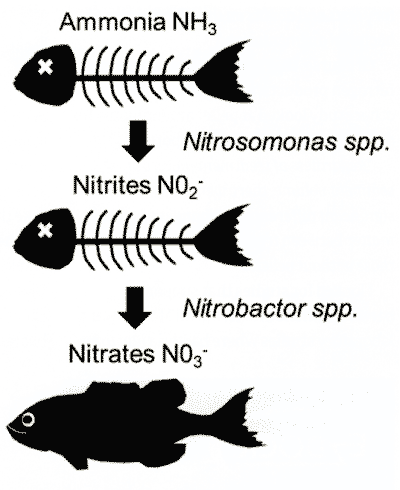
The way it works is that a substrate, such as a fibrous rotating wheel or an aerated canister of small plastic beads, serves as a surface for bacteria to attach to. Nitrosomonas species of bacteria are excellent at converting ammonia to nitrite. Unfortunately, nitrite is also toxic to fish. Fortunately, Nitrobacter bacteria are excellent at converting nitrite to nitrate, which is not toxic.
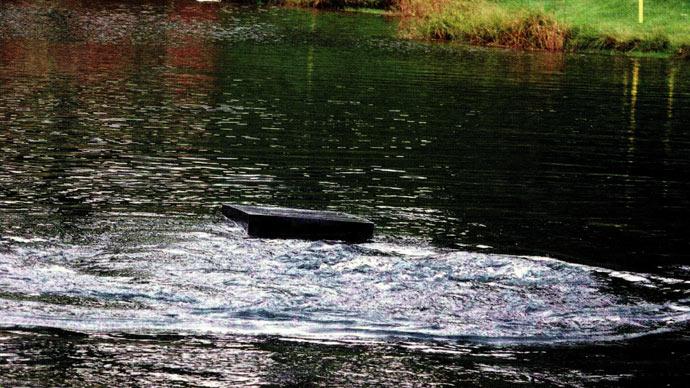
The aeration is extremely important to the process. Bacteria are living things. As living things, they need to have oxygen to survive. They are much less effective at doing good things when oxygen levels are low. So, the beads are aerated to keep the oxygen level high and the bacteria happy. The wheel's rotation does the same by allowing direct contact with the oxygen-rich air before plunging in for another ammonia feast. We will come back to oxygen in a minute.
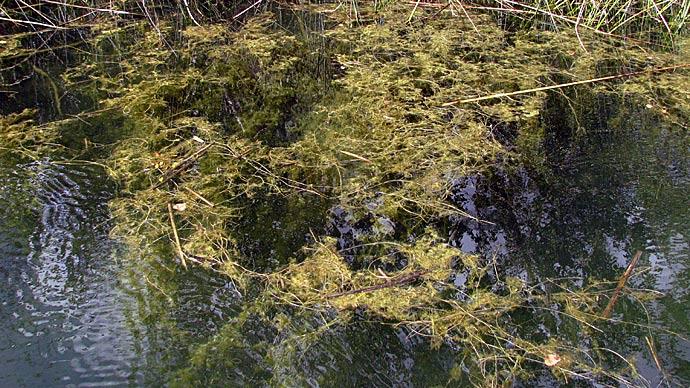
Another issue that bacteria can help with is organic matter buildup in ponds. People call this muck or sometimes sludge. When terrestrial leaf litter and aquatic plant material accumulate in areas submerged in water, it can cause several issues, including poor water quality, increased algae growth, low oxygen levels, and foul odors. This can harm fish, plants, and the overall ecosystem.
Bacteria break down non-living and organic matter, and these microbes are responsible for transforming harmful ammonia into less harmful nitrogen byproducts. Obviously, you should be adding bacteria to your pond regularly, right?
Let's analyze this. First, it is highly likely that any bacteria you can buy are already in the pond if the environment is suitable for them. Otherwise, how does organic matter break down, or how does the ammonia get detoxified in nature? Pouring in a bottle or a few scoops of powder probably isn't really adding anything new. I have never seen a muck-removal company claim to have unique bacteria, and if they did, I certainly wouldn't want to pour exotic bacteria into my pond.
Next, although they claim their amendments will work without aeration, they always recommend combining them with aeration. Remember, bacteria need oxygen to do their thing. So, you buy and install an aerator, then add monthly (or weekly, as directed by some manufacturers) doses of Dr. Manny's Magic Muck Magnet. Two years later, lo and behold, things seem to be marginally better! Best $8,000 ever spent.
But was it the bacterial amendments? I think not. Most likely, it was the natural bacteria already in the pond that finally had the oxygen that they needed. After all, it is a process called oxidation! You just gave them the chance to do their thing. Aeration has been shown, in many studies, to help with oxidative processes on its own.
Further, if what you added had been sitting on the shelf in your local agriculture store long enough to collect dust, chances are that any live bacteria that were originally in there had run out of oxygen long ago and have become muck themselves. Even if they were viable, how do you prove it was the bacteria, not the aeration?
Dr. Claude Boyd, who also writes for Pond Boss and is an authority on pond water quality, studied some of these amendments in an aquaculture context. After all, that is where the idea first originated. What did he find?
"This research showed no benefit of bacterial amendments on water quality in laboratory tests and doubts on the effectiveness of bacterial augmentation."
Of course, that study focused on toxic nitrogen products, not organic muck. Another study looked at pellet amendments for digesting organic matter. It reported:
"Regardless of treatment factors or sediment volume, there were no statistically significant differences in changes of organic matter between treatments with pellets and those without pellets."
I looked for studies supporting bacterial amendments, but all I found were laboratory studies that required adding bacteria. The "research" I have seen that found a positive effect in actual ponds was case studies highlighted by companies that are selling these products. It is always best to take that with a grain of salt.
These products also recommend weekly, biweekly, or monthly treatments. Biological systems don't work like that. If there is adequate food and habitat, those bacteria should expand their populations towards carrying capacity. I ask you this: if your muck isn't all gone, why are the bacteria gone too? What caused them to disappear, and what makes you think the habitat is going to support them this time? No, I think the frequency of application is more of a business decision than a biological rationale.
Notice that I have focused on bacteria. Some amendments include enzymes. I am a little less pessimistic about enzymes, though I can find precious little direct research. If you are an enzyme supplier and want to fund an objective third party to evaluate your products, let me know!
Some companies are now producing custom amendment slurries for ponds. These are freshly brewed, so there is less concern about the bacteria dying or enzymes breaking down while trapped in an anoxic bottle on the shelf. Also, they can theoretically be customized for a specific pond and application. Maybe you send a muck sample, and they provide a diagnosis and prescription? Paging Dr. Manny. I honestly know very little about this.
My take-home advice is this. I am skeptical that adding a bacterial or enzymatic amendment to your pond or lake will have a significant positive effect compared to aeration alone. If there is a specific reason to think you may have had a bacterial crash, it may help them reestablish. I could be wrong, but even if it is snake oil, I do not think it will hurt anything. So, what the heck, if you want to give it a try and are okay with the cost, go for it. But if you do, go custom. Don't order a dusty old bottle from Amazon.
Dr. Wes Neal, Extension Professor at Mississippi State, serves as the State Extension Fisheries Specialist and is passionate about educating the public on small-lake and pond management. He is an avid researcher on topics from farm pond management to sport fish genetics. Wes is the lead editor of Small Impoundment Management in North America, the only textbook on the subject. He loves to hunt and fish, wes.neal@msstate.edu.
Reprinted with permission from Pond Boss Magazine