

When traveling through most of the area surrounding Lexington, Kentucky, it's hard not to notice all the blackboard fences, the historic rock walls, and everything that makes that region famous for what it is: thoroughbred racehorse country.
Beautiful horse ranches dominate the landscape. It's also bourbon country. It's not possible to travel the countryside without seeing beautiful horses, bred for the track, and distilleries famous for generations, bred for those with a taste for fine spirits.
Think Woodford Reserve, Buffalo Trace, Wild Turkey, Maker's Mark. The area gained worldwide attention for its pioneering science-based horse breeding decades ago. Queen Elizabeth II, a British royal with a great fondness for thoroughbreds and racing, made several trips to the area to learn what Americans were doing and then became passionately involved in the rapidly evolving science of the day. She had a strong business relationship with Mill Ridge Farms, sending mares to be bred, producing foals to be trained. Keeneland Race Track has seen the fruits of many well-bred and well-trained thoroughbreds, including some from the royal family.
She's not the only Brit to stake a claim in that region.
Sixteen miles from Mill Ridge Farm perches Corser Thoroughbred Farm, owned by Mark and Corinna Corser.
The first part of this story is enthralling, believe me. Read on...I promise we'll talk about fish, ponds, happy water, and habitat. After all, this is Pond Boss magazine, not Horse Boss for beginners.
Mark and Corinna are from Great Britain.
Via Corona, California, to Lexington, Kentucky.
Mark, in his soft, proper British accent that southern Americans can actually understand, told me his story. He worked for a company that manufactures food processing equipment for major entities. He was dispatched some years ago (in 2008) to lead the sales force and manage the mother ship's company branch in Corona. Three months later, the market crashed, and Corser had to make a choice. The mother ship decided to close its American branch and gave Mark the option of being terminated or heading back to England.
Mark had become a strong aficionado of raising and showing Japanese koi, but that's a diversion to this part of the story. His fancy for colorful, expensive show-fish plays a role in his thought process right now. More on that, later. Science seances with his brain.
Corser decided to decline both offers.
He rolled the risk dice, bought the equipment, and started his own gig, with a small bank account and a good name.
With a strong work ethic, fierce curiosity, and a motivated wife, the couple kicked things into gear and built their own future.
Fast forward a few years, and this couple's American Dream was coming true...quickly.
Mark attended a conference in Louisville, Kentucky. After the conference, his host took him to the airport and dropped him off for his late afternoon flight. As fate would have it, his flight was cancelled. He worked with the flight agent to book the next flight...but it was full, as were all the flights for the next day and a half.
We'll talk about a fishing lake, I promise.
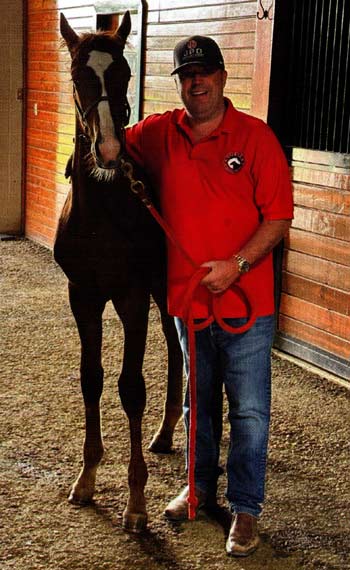
Mark Corser with one of his thoroughbred colts.
Mark was stranded in Louisville and arranged a hotel with the mindset he was not going to get home for a couple of days as it was Memorial Day weekend, a couple hours later he took a call from his horse trainer in California who was calling to give an update on a colt he had in training, Mark commented he was in Louisville and was stranded for a few days, His trainer offered him the chance to take a trip to nearby Lexington to see the recent triple crown winner American Pharoah, which he said he jumped at.
The area's beauty struck Mark. As an amateur horseman, Mark was fascinated by the culture, the sheer number of horse ranches, the track, and the excitement of what might be for him and his family.
The science of breeding and the hypothalamic thrill of the winner's circle coursed through his blood...forgive the pun.
He'd already invested in a racehorse back in California.
He made up his mind on that trip— they needed a horse ranch in Lexington, Kentucky.
Corrina wasn't thrilled. She loved the West Coast, the climate, the culture, and the whole environment.
But she especially loves the foals. And, they love her.
They bought a rundown ranch and began the task of dolling it up and figuring out how to play the racehorse game at a higher level.
I suspect you've figured it out by now. Mark lives passionately, works the same way, thrives in the work environment, and has figured out how to pave and pay his way around his world.
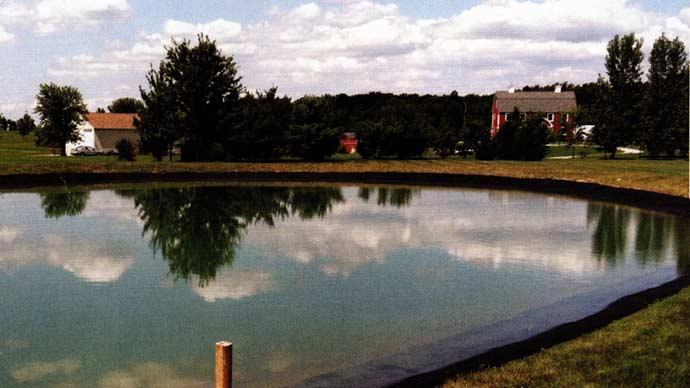
While we think of Lexington and the surrounding area as whiskey and horses, we don't think so much about bass lakes. That may change. Mark Corser is here. Pond Boss World Headquarters received an email in March 2023. Two ponds reside on the ranch at Corser Thoroughbreds, and Mark decided he wanted to have a couple of bass ponds. When those emails came across our inbox, we did what we always do. We referred him to our Resource Guide with a couple of suggestions on how to approach his questions. He fired back a response to us. He'd already contacted a guy he'd found online, had him come out, evaluate both ponds, and write up a report. He said he wanted a second opinion because he didn't have much confidence in the guy he'd hired from his initial online search. This guy, whose reputation is pale at best, had suggested that Mark either stock some fish or drain the ponds and do some excavation. One pond is about 3 acres, and the other is about 4.9 acres. The recommendation was to drain, excavate, and rebuild both ponds for a paltry $700,000.
Mark saw that as excessive...as does the rest of the planet.
We referred Mark to several reputable people who gave him some ideas and thoughts that were much more reasonable. He kept emailing, with more questions.
Finally, yours truly, fingers worn out and tired from keyboard answers, invited Mark to a phone call. It was to be the first of many.
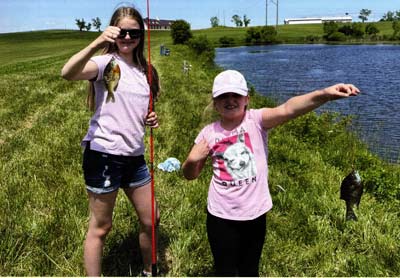
He interested me with his detailed scientific knowledge of water quality and how it affected his koi (I told you this would circle back), and his two ponds, and how he'd like to make them bass fishing lakes for his two young daughters to be able to learn to fish.
Believe me, I talk to a lot of people and refer them to our worthy catalog of experts and providers. But his persistence was impressive.
As I processed his curiosity, I became even more curious myself. I started asking him a bunch of questions. Those queries almost led to a series of mutual, fun interrogations, as we each dug into the other's level of knowledge.
When I dialed into it, I was intrigued with a guy from Great Britain, who came to California, forged his acumen into a thriving American Dream business, bought a horse ranch in Kentucky, and wanted to create the best bass fishing lake he could build.
Tell me, who wouldn't want to work with that guy on that project?
I was sucked in.
By late May, we were discussing the possibility of a site visit. But time was running out for me, as I was about to disappear for a couple of months, a hiatus, if you will. I was exhausted and needed an extended respite.
Mark understood that...well, he sort of understood it. He was getting anxious to get some better answers about what to do. We'd conclude that he should drain the ponds and see what it would take to reshape, reform, and rehabilitate them, giving them a fresh lease on life, complete with the best habitat.
He was juggling many projects. He and Corinna had finished the home remodel. He was building new fences around the horse paddocks and had broken ground on a state-of-the-art barn for his growing herd of beautiful thoroughbreds.
So, early June, I began my hiatus with a road trip to meet Mark and take a look.
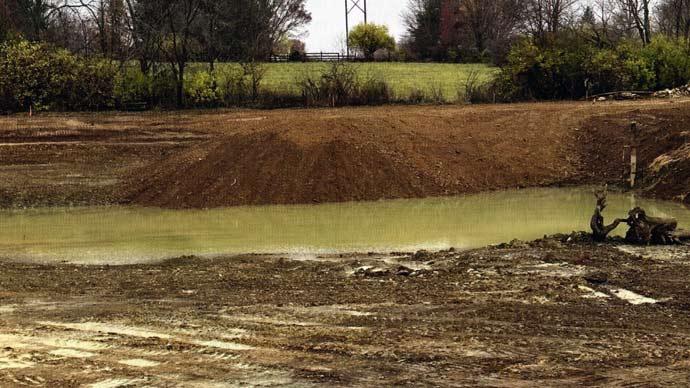
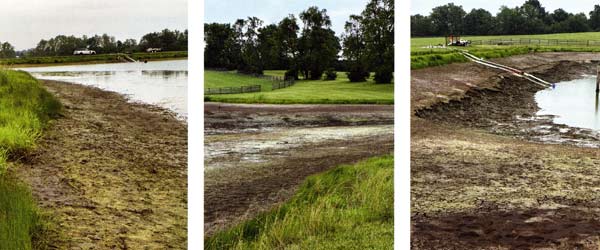
He'd worked with his ranch hands to drain each pond so we could see what the bottoms looked like. As you might imagine, the basin of each pond was silt-laden. Both ponds were built before 1985. That's as far back as Google Earth shows. My gut says both ponds were built in the late 1960s, maybe early 70's. That's pretty old for ponds in pasture country.
Mark could only drain them down so far, so he rented pumps to remove the rest of the water.
I could tell he is what I call a "process thinker". He digs into the process and then figures out how to apply it to whatever he's working on at that time. That made it easier to consult.
We met with his earthmover and began figuring out what it would take to move some dirt around. As we all expected, there was a lot of shallow water around the edges of each pond. The natural, gentle flow of his land suggested that. When the water was off, it was much easier to discern just what needed to be done.
This is where pond renovations get a little bit tricky.
How much dirt do you move? Where do you put it? Should we raise the dam and make the pond bigger? Will the watershed support it?
These were the questions discussed on the pond dams that day.
When I left the next morning, Mark had at least enough information to fuel his next line of questions.
Further discussions with his earthmover at least gave him an idea of what the basic earthmoving costs would be... if they left the silt in the bottom of the lake. Silt was a great big unknown, and without literally digging into it, there wasn't a quick answer.
In the second part of this series, we'll dig into Mark Corser's thinking and how he drew some logical conclusions to make the choices.
Here's a teaser: he decided to do one pond at a time, starting with the biggest one.
Stay tuned, you'll be interested in his thought process and decision-making.
Oh, one other little tidbit. When I left his home after staying overnight, I noticed his British decor formal living room wall lined up with brand new STIK5 bass fishing rods.
I'd say he was excited and ready to make this project happen. Continue to part II.
Reprinted with permission from Pond Boss Magazine