

Last article, we introduced you to Mark Corser, a British guy who built a company, plays to win, knows an immense volume about championship Japanese koi, specialty food processing equipment, thoroughbred racehorses...and wants to create the best bass fishing lake possible in Lexington, Kentucky.
In the first article, we followed his start-up due diligence, beginning with Mark having the idea to improve his Kentucky horse ranch's ponds. He was scratching his head after a less-than-scrupulous or, at the very least, inexperienced guy made highly questionable recommendations for Corser to spend a considerable amount of money to drain and renovate his small ponds.
In this piece, we dig deeper into Mark's approach to the process.
Mark is curious and highly inquisitive. As a consultant, I love that trait. It means that the person has the passion and is able to absorb information at their own level. To Mark Corser, that means peeling back the layers of what, exactly, needs to be done to get to his end goal.
In this case, should he drain both ponds and renovate them simultaneously? Should he pick one over the other and spend some hard-earned dollars improving habitat, then call it good?
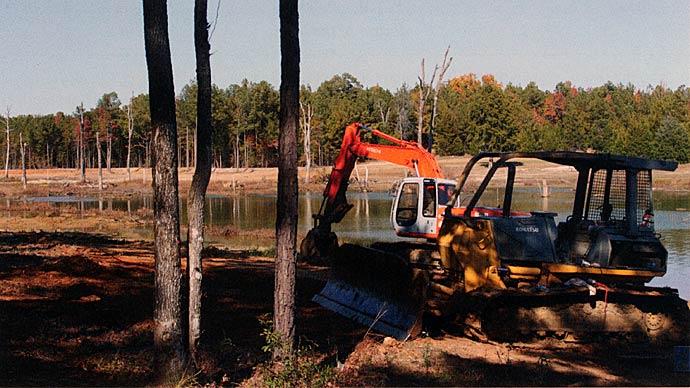
I made a site visit back in early July. He arranged for one of the local earthmovers who had done some work around the property, building a pad for the new horse barn, plus other work to be met on site. He wanted to have a roundtable discussion about what it would take to renovate both ponds completely.
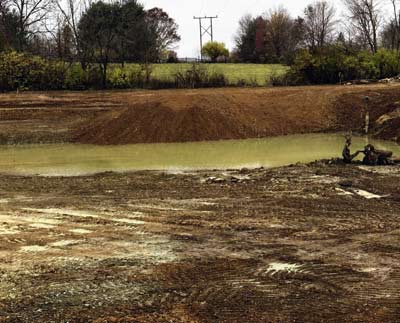
He'd already de-watered both ponds enough to get some idea of the scope of the work. There was still an unknown because no one could estimate the volume of silt in the bottom of each pond. The earthmovers and I could give a general idea, but since it costs at least $10 per cubic yard to move silt—since it has to be removed from the pond, then hauled to a place to store it, let it dry enough, and then spread it out—we needed to be pretty accurate.
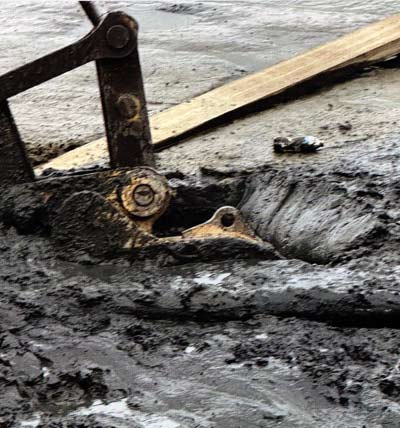
The earthmover would need to bring out an excavator, dig around, and assess the pond bottom. Do some exploratory surgery, so to speak. One fear this seasoned contractor expressed was the depth of clay in the bottom of each pond. That geographic area is notorious for having good clay for pond bottoms, with rock and gravelly soils beneath the layer of clay...and he had no idea how thick the clay vein might be.
Digging some test holes made good sense. While checking clay depth, he could also reach out with the bucket to get an idea of the muck's depth.
When we finished the meeting, Mark had greater confidence that his contractor could provide a fairly accurate estimate of how much dirt needed to be removed and how much needed to be rearranged to achieve the desired depth by adding peninsulas.
Before he and I parted ways, he was already thinking ahead. While we were on site, he drove me all over the ranch, where he showed a stockpile of nice, big, flat limestone boulders that would make great fish habitat.
He'd also spent some time online going through the Pond Boss Resource Guide and magazine advertisers, and found one of the vendors that manufactures artificial structures. Mark contacted them, bought several, and already had them assembled in his older barn for me to inspect.
I assured him those artificial structures would fit his plan. He also had some submerged logs in the biggest pond that could be repurposed.
He was already thinking about his habitat plan.
His rapid-fire questioning is fun and entertaining. That enthusiasm is contagious. He also wanted to talk about the different ways to stock this lake.
When I left, in early July, we didn't talk again until September. He'd made a decision on what he wanted to do. He decided to completely renovate the biggest pond, taking it from just under five acres to seven or slightly more. The watershed could support it, and raising the level would decrease the volume of dirt to be moved. By raising the water level two or three feet, he could increase the size efficiently.
That was a good decision.
He'd done his due diligence, had figured out contractors would need to move around 15,000 cubic yards of dirt, most of it a short distance, and the cost would fall way short of what his less-than-reputable first consultant told him.
But he had a problem.
The contractor he'd invested some time and a few dollars with couldn't get to the project. Then, they ghosted him.
He was set to pull the trigger; the time was right, and the earthmover bailed out.
But this is Mark Corser.
Once he figured out his contractor wasn't going to be responsive enough, he had another guy, a huge company that builds big projects. They currently had a giant contract underway, but the owner of the company was intrigued by the prospect of building a small bass fishing lake—small by his standards. It helped that he, too, was intrigued by Mark. They made a deal, and the contractor hopped on it right away.
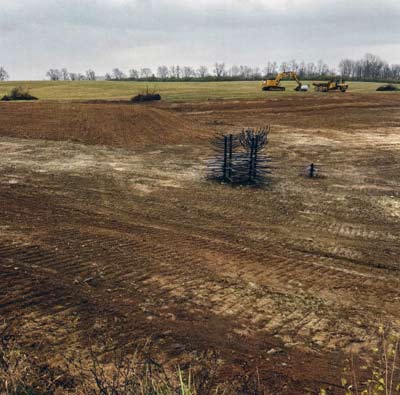
For this project, Mark decided to allow the contractor to remove all the silt, which was stockpiled next to the lake, to be used later and integrated into his horse pastures.
As the contractor roared through the project, the lake was taking on its new shape. They built two long, flat, infinity look peninsulas, then another one, broad and oval, like a flat putting green, next to the dam, opposite the emergency spillway. He envisioned it not only as a place to spoil some dirt to gain much-needed depth, but also as a place for the family to gather and enjoy the lake.
The contractor stored several of the logs for repurposing and staged them where they'd be easy to access when the project neared completion and was ready to be accessorized with his habitat plan.
As the contractors headed to the finish line, Mark reminded them to build several flat shelves under the water. Those are for spawning beds. Geotech cloth to be laid on the ground and covered with pea gravel, the perfect place for sunfish and Largemouth bass to be able to spawn.
By now, he and I were working together to fine-tune his habitat plan. He'd begun discussions with the guy who supplied his artificial habitat, but the two couldn't come to terms, so he started looking for another one, which he found on the Pond Boss website. Go figure.
The earthmoving part was completed and the contractor finished strong.
Mark was all in. He was digesting his habitat plan like an architect designing his finest work.
Next issue, we'll go in-depth about his habitat piece. It's like none I've seen before.
Then, we'll dig deeper into his thought process on how to stock and manage his newly rebirthed pearl of a lake.
Oh, and yes, we were talking about aeration, fish stocking, weed management, and feeding fish by then.
Did I tell you Mark Corser is a highly curious, inquisitive sort?
Just wait until you hear, like Paul Harvey used to say, "The rest of the story."
Reprinted with permission from Pond Boss Magazine