

For years, I have understood the lessons on aeration. Aeration is Magical. It does good things for your water like nothing else can. Moving water cleanses it.
Got it.
Being a pilot for a major freight company, I fly big planes and keep some pretty weird hours. On this particular trip around the world, it's 2:20 a.m., Covid is raging worldwide (the delta variant, as I remember), I'm in Osaka, Japan, and my cell phone rings.
My body thinks it's 20 minutes after noon—central time.
"Hello".
"Hi, is this Brian?"
"Yes, who is this?"
"I'm John, I'm a friend of Bob Lusk".
That is how this story started. John asked to help design a solar-powered battery-backup aeration system.
And for those who know me, this was a challenge I was willing to accept.
For those of you who don't know me, I love working with solar power, figuring out the math, calculating the parameters, and figuring out how to make systems work. That's an integral part of my pilot mentality and military training.
I told John, "Send me the parts you use for your non-battery backup system, tell me the requirements for run-time and depths, wattage, whatever specs you have, and I'll start from there.
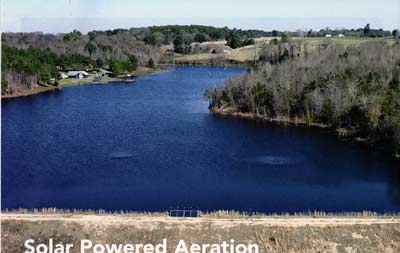
Before you stop reading this article because of the technical protocol I'm about to release, understand that I have property in East Texas with a nice-sized lake covering about 18 acres. It's my test zone, my study area, my haven for fisheries management, and a living classroom for a deeper understanding of its depths.
I've got hatchery ponds dedicated to George Glazener, a longtime friend and mentor whom I met through the Pond Boss discussion forum. In George's memory, we built ponds beside the lake to grow tilapia and other fish to enhance the big lake. My wife, Heather, is all in. She loves the place, too.
John sent some general requirements, if "general" works for requirements. They were more like "parameters". He asked me to work with him to design a system that could run 24 hours a day. That meant good batteries for storage. He wanted to aerate a lake with a depth of 7-10 feet. His environmental parameters were for pretty much anywhere in the world. Pretty bold suggestion there. He wanted airflow rates of 2 cubic feet per minute for two diffusers. (Told you I like technical data and goals.)
Currently, he uses an air pump, manifold, diffusers, a solar panel, and a mast/mount.
Since my body thought it was shortly after noon in the middle of a Japanese night, I started digging around to find the right solar parts for this build.
I started doing the math. We'd need two cubic feet per minute at 5 pounds per square inch. That would take a fair amount of energy. That means about 90 watts, continuous, maybe more.
Electrical engineering and math are part of how my brain works.
Looking at it another way, we'd need 24 hours at 90 watts, which means we'd need to supply 2.16 kilowatt-hours per day. If you're like most, I just lost you. Don't go yet. Stay with me.
Think sunlight. Think solar panels. Think "collecting" and storing that energy that can burn your skin in short order.
Your pond deserves the process.
To be able to use that much energy, we have to capture and convert all that energy from the sun...when it shines. There are losses from the solar panels themselves, from the panels to the charge controller, from the charge controller to the battery, and from the battery to the air pump. With all that said and thought about, we need to produce 2.4 kWh or more each day, every day, all year long, on average, to put in that much water. That's 876kWh a year—give or take. 1000 kWh is equivalent to 1 megawatt-hour of energy. All to run an air pump in 10 feet of water, but I was going for 14 feet just to see what the system could do.
Seemed bold.
We can have 365 sunny days a year and a smaller battery, or we can have a battery large enough to account for the lower production days...which are most of them. Darkness, cloudy days, rain... no sun, no production. That's the math.
So, how to begin? Lead-acid batteries can safely discharge about 40% of their energy without harm; discharging further shortens battery life. Some versions can discharge a bit further without harm, but they are more expensive. Money is essential in this exercise, and we needed to figure out how to store energy without killing batteries.
So now we needed to find the largest batteries at the best value pricing. Turns out, the RV industry goes through a lot of large-capacity batteries, and they understand these issues. We found the batteries.
These were 200 AH lead-acid batteries, each weighing over 100 pounds. We used two of those for our design experiment. That's roughly 5 kWh of battery capacity. 2.16 kWh out of the battery gets us close to the limit. Thankfully, these were the better type of batteries, so we had a little breathing room.
They worked great.
Storage.
Next, we had to see what the solar panels would produce. I set up our panel selection and started collecting data. I tried several charge controllers. Charge controllers are essential because they convert power from panels to batteries. I found one I really liked, and that is the one we used. The panels were producing around 3.5 kWh of energy to the batteries daily if needed.
So, we could have a few cloudy days before the system would run low on energy. One or two sunny days after that, and the batteries would be full and topped off, all while running the system during the battery refill.
With a solid theory, it was time to test everything.
This was going to be a lot of fun. If 7-10 feet of water was the goal, I was going straight to 14 feet of water. Go deep or go home. The system was requiring 2.6kWh per day. With this system design, I was making very close to 2 CFM, and the area of influence was larger than I expected. I got to thinking, could we do even more? Well, it turns out we could.
We ran the system for months, in good weather... and bad. There were a few days when the system was off due to a lack of solar production, but overall, we were able to build and run a substantially better solar-powered battery backup aeration system while protecting the batteries from failure and damage.
As a bonus, the improvements in our water quality were very noticeable. After all, that was a big goal. If we didn't design a system that could improve water quality, what's the point?
So, after designing, building, and testing to the requirements, it was time to see what the system could do. How far could it be pushed in different circumstances? At first, we ran the system in the middle of my lake. That is where we have 14 feet of water. I left the system there over winter and through the following spring. I have noticeably better water. Visibility was reduced due to micro-organisms utilizing nutrients reconstituted from the lake bottom, and the oxygen levels rose throughout the water column.
It was a big success.
I even saw Crappie reproduction surviving the spring. That's not normal. As summer approached, I wondered whether I could lower my thermocline... or even do away with it.
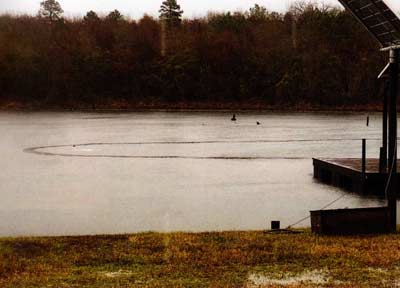
For years, my thermocline hovered between 12 feet 3 inches and 12 feet 9 inches, depending on the weather. I had a lot of data.
So, it was time to move the system to the deep end of the pond and see what it could do. I added 200 more feet of airline to the system, which changed the math on the volume of air moved and the energy required to move it.
We moved the diffusers to water that was nearly 20 feet deep and evenly spaced them 1/3 of the way from each side of the pond relative to the deep end. We turned the system on and watched. Typically, one would use a startup procedure moving water from that depth, but I figured we had enough water in the northern part of the pond to serve as a refuge if needed.
The system did bring up a little stinky water, but less than I expected. Water below the thermocline in summer is stagnant. But my reasoning and logic were because of our siphon system, which removes bottom water, and we had a wetter-than-normal spring in our area, so I went for it.
We did not notice any ill effects.
Now we were using over 120 watts to run the pump, and the chart says I was making a bit less than the two CFM we wanted, but I wanted to see what we would get.
Could we open up more usable water for the fish?
One modification I made was to replace the solar panels with larger ones. I used the larger panels because I did not want to move the mounted panels, and I was curious to see what would happen.
If you haven't figured it out yet, I am a data guy. The first thing I did was to get my DO meter out and find the baseline. The thermocline was 12 feet five inches.
Next, I waited a week or two and tested again. I was mildly and pleasantly surprised. The thermocline was noticeably lower. Way lower. I was able to measure usable 02 down to a foot off the bottom in the deep end, and the temperature was 84°F at that level throughout August.
That speaks volumes about this solar-powered aeration system.
The math turned into a biological predictor for my lake.
That math says I was moving over 5.7 million gallons of water per day. The system was not turning the body of water over once a day, but I was seeing improvements in 02 further down than the 12V2 feet we started. This system had opened up more water for the fish, but the resulting problem was leaving my bass without a cool-water refuge.
This year, I am going to move the diffusers to 15-17 feet of water and see what happens. I am hoping to see usable oxygen down to those depths and colder water just below for those warmwater fish seeking cooler temperatures in summer.
What were the take-home points of that experiment for John? That little pump made a lot of difference. It ran 24/7 most of the summer and nearly 24/7 in the spring and fall. The winter months, with days and days of overcast, proved to be a significant challenge. But I still saw improvements regardless of the time of the year.
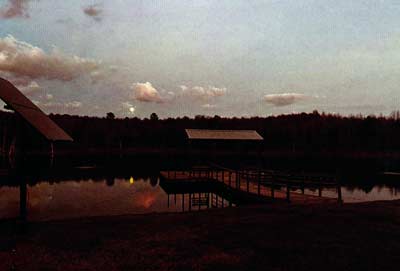
The system is now running on larger panels to see what improvements can be made during winter operations and going well into spring. It is back in the deep waters in front of the dock and is improving water quality at the end of the pond before the spawn as I write this article in March. I am hopeful for an even better year than last year.
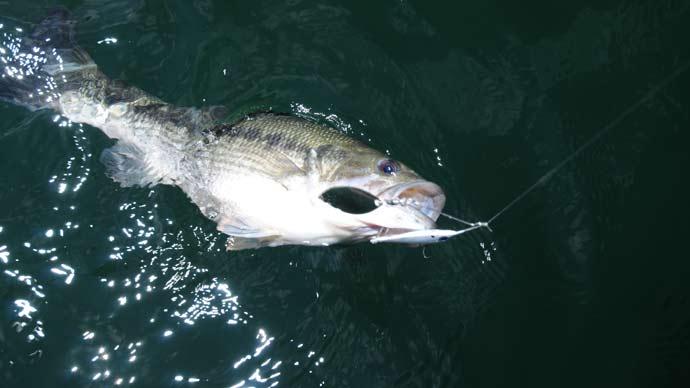
I had an aggressive Largemouth bass harvest removal program last year, and I am already seeing healthier bass and crappie. With any luck, this could be one of our best years to date.
I'll keep recording data as we go.
Oh, and I found some Lithium batteries to "test," so there is more data in my future!
Reprinted with permission from Pond Boss Magazine