

Water has unique properties. Properties are things that identify a substance, in this case water, that make it different than other things.
One special and interesting property of water is how its density changes when its temperature changes. Density is simply defined as how many molecules (how much stuff) are packed into a space. A fishing weight and a foam bead of the same size have different weights because the fishing weight is denser. Water density changes with temperature; this fact is not unique. However, the solid form (ice) of water is less dense than the liquid form of water, meaning ice floats on water; this is VERY unique. Most solid forms of a substance are denser than the liquid form.
It turns out that water is most dense at 4 degrees Celsius.
The density properties of water make stratification possible, even likely, in ponds and lakes. Stratification is when warm water naturally separates itself from cold water, or salt water naturally separates itself from fresh water. A thermocline is the boundary between two masses of water with distinctly different temperatures. A halocline is the boundary between salt water and fresh water. When you jump into a freshwater pond on a warm summer day, and the pond is warm at the top, but cold several feet down, the pond is stratified, and the boundary between the warm surface and the cold bottom is called the thermocline.
Fish can't live below the thermocline because that lower layer of water quickly becomes anoxic (without oxygen), and they will suffocate. So, fish instinctively won't go below the thermocline and stay there.
The effects of temperature, or salt, on water density and the resulting stratifications can be shown in an experiment that can be done at home. With a few supplies and some perseverance and curiosity, water stratification can be created!
Supplies for the basic experiment:
• Red and Blue food coloring (optional, more colors for further exploration)
• Warm and cold tap water (optional, ice for greater temperature changes)
• Easy-pour containers to store water with food color in it
• Experimental container, a clear-sided, deep container (small fish tank, plastic storage container, water pitcher)
• Salt (optional, for deeper exploration)
• Thermometer (optional, for specific temperature experiments)
• Something to stir food-colored water
• Rags or paper towels to wipe up food color messes
• A level, secure place to experiment that can get wet and food-colored
Directions: Place some warm and cold water in two separate, washable or disposable, easy-pour containers. Add red food coloring to the warm water and blue to the cold water and mix. Pour some warm water into the experimental container until it is a little over half full, and wait until the water is perfectly still.
The next step is the tricky part and may take a little practice. Slowly and carefully pour the cold water down the inside wall of the experimental container, trying not to disturb the warm water. The cold, blue water should lift the red warm water as it sinks to the bottom because it's denser and heavier.
If this fails, try again!
Sometimes the cold water will mix with warm water slightly on the way down, and the bottom water will be purple, while the top water will remain red.
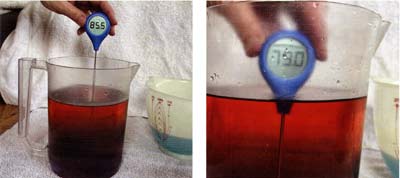
Some pointers: the colder the water, the easier it will be to achieve stratification. A funnel or a turkey baster tube can be used to aim the water down the side of the experimental container towards the bottom. Once the stratified water is in the experimental container, there will be a color boundary between the warm and cold water. That line between the two colors represents the summer thermocline in your pond! If the blue, cool water is at the bottom, and the warm, red water is above it, which water temperature is denser?
There are unlimited experimental variations and questions to be asked and answered using this setup. Some other questions to explore: What happens when salt water is added to fresh water? What happens when warm salt water and cold fresh water are layered? The variations of questions that can be tested are limited only by imagination (and supplies of food coloring, water, and salt!)
Have fun and spend some quality time testing the density properties of water.
Christine Cornwell is a horse trainer who lives in upstate New York with her husband and son. She has worked for the New York State Department of Environmental Conservation and was a high school science teacher. Sharing her love of a healthy, natural world is a daily passion.
Reprinted with permission from Pond Boss Magazine