

It’s the most wonderful time of the year for bass fishing.
When bass feast on baitfish in the fall, they crush anything that buzzes, plops, or pops on the surface. Throwing topwater lures then becomes a favorite way for Missouri guide Denise Dill and her clients to catch bass in the fall. “It is definitely one of the most popular ways to catch bass,” Dill says. The Lake of the Ozarks guide says she has never heard her clients say, “I don't want to see fish explode out of the water, I want to do something else.”
Cooler air and water temperatures throughout the fall cause bass to suspend over deep water and eventually move to the shallows in pursuit of schools of baitfish swimming along the surface. Topwater lures then become effective throughout the fall transition as bass chase their prey on the surface.
Dill describes topwater lures as phenomenal for her fall guide trips. “There are times when I will put on a small (Berkley) Choppo or (Storm Lures) Chug Bug, and that's all we will throw for four hours on a guide trip,” she says.
During the early fall, Dill’s clients catch a greater number of bass than quality fish, but she notices size doesn’t seem to matter to her clients. “It’s more about the explosion and the whole excitement of the topwater bite,” she says. The guide suggests bigger bass start attacking her topwaters later in the fall as the water temperatures continue to drop.
Relying on four types of topwater lures that have different presentations allows Dill to catch bass on the surface throughout the autumn months. “You just have to adjust depending on where the bass are positioned for that particular day,” she says.
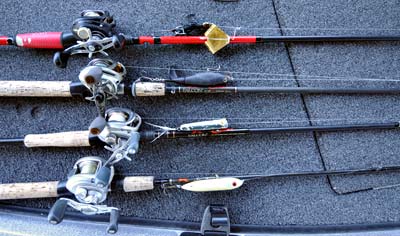
Here are Dill’s four favorite types of topwater lures for catching a fall haul of bass.
Walker
When she’s fishing on cloudy days with a slight chop on the water, Dill favors a bone Heddon Zara Spook to walk along the surface of clear to slightly stained water. She will also employ the Spook on sunny days as long as she can work it along shady banks or the shady sides of docks.
Dill believes the Spook is an effective fall topwater lure because it resembles a wounded shad. The lure's slow side-to-side action as it walks across the surface triggers reaction bites from bass looking for an easy meal.
The Missouri angler throws the Spook on 12-pound monofilament line and retrieves it with the standard steady walk-the-dog presentation. Most of the time she walks the Spook at a moderate speed but will adjust the tempo depending on how bass react to the lure. “If you have a couple of strikes where the bass misses it, you might want to slow it down a little bit, but then again, you might want to speed it up so they are going to chase it, and then for sure they are going to get ahold of it,” she says.
Dill walks the Spook along open rocky banks or around targets such as docks and laydown logs to catch bass in the fall.
Chugger
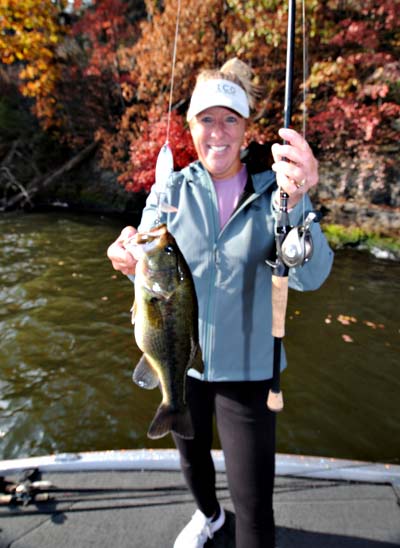
When she wants a finesse topwater presentation in clear to slightly stained water, Dill favors the Storm Lures Rattlin' Chug Bug, which provides a smaller and thinner profile than the Spook. The Chug Bug can handle double duty as a lure that both walks across the surface and spits or chugs with a slower retrieve than the Spook. Dill’s favorite Chug Bug colors are blue-and-chrome or shad.
Tied to 12-pound monofilament, the Chug Bug is an effective topwater for Dill to work around any type of cover, such as docks and laydowns. Her Chug Bug retrieve features less reeling of the lure and more short twitches of the rod to make the lure pop on the surface. "Don't be in a hurry to get it back to the boat,” she says. “You are only doing a little bit of reeling to take up that slack in the line.”
Dill starts out aggressively popping the Chug Bug, but if the retrieve fails to trigger a strike, she will slow down her presentation to tempt finicky bass into biting.
Plopper
The Berkley Choppo, featuring a rear propeller that makes a distinct plopping sound, is Dill's topwater choice for catching bass on breezy days in stained water. She mostly throws the 120-size black Choppo but sets up her clients with the smaller 105 Choppo.
A steady retrieve at a moderate pace creates the plopping sound that triggers explosive reaction strikes. “I really don’t mess around with the speed of it too much,” Dill says of her retrieve. She suggests the lure is ideal for guide trips because all her clients have to do is cast the lure and steadily retrieve it without any rod movements to get bites.
The lure is effective along open banks because it can be presented at a moderate pace to cover water quickly. Dill also likes to throw the Choppo behind dock cables and under catwalks to catch bigger bass in the fall. She ties the lure on 50-pound braid to prevent line breakage when fishing the Choppo around metal cables.
Buzz Bait
A 3/4-ounce Crock-O-Gator Head Knocker Buzz Bait creates enough clacking noise for bass to track the lure even in the muddiest water or heavy waves. Dill prefers this buzz bait because she can adjust the blade, allowing it to strike the buzzer's head harder or softer to create more or less of the clacking sound. She opts for a Headknocker with a gold blade and a black skirt and attaches a 3/0 trailer hook to the leading hook for connecting with short-striking bass.
The Headknocker also features a flat head that allows the buzzer to quickly rise to the surface after hitting the water. Dill favors the quick surfacing buzz bait because she likes to throw it around heavy cover, where the lure needs to buzz on the surface the whole time it is in the bass’ strike zone. She retrieves the lure at a steady moderate pace to keep the buzzer skittering across the surface.
When fishing an open bank, Dill throws the buzz bait on 20-pound monofilament. However, for most of her buzz bait presentations, she ties it on 50-pound braid for throwing the lure around heavy cover, such as dock cables and under catwalks.