

The jig may be bass fishing’s most humble lure. It’s compact, sliding and hopping along the bottom and slipping into thick cover without much commotion. And it offers little flash, most often sporting drab colors. But its lack of fashion is made up by loads of function. No other lure produces in as wide a range of conditions, seasons, depths, or cover and structure.
March means prespawn is in full swing across most of the bass range. Bass are heading toward shallow water, where they’ll spawn once conditions ripen. Getting there from deeper wintering holes usually requires following structure such as points and creek channels. Along the way, they hold in cover, from rock to aquatic grass. There isn’t a day in March when you can’t catch them on a jig.
While a jig’s playing field is wide open, there are specific things that you can do to make it produce better. That starts with understanding how to choose and rig it, what to fish it with, and how to find the best places to use it.
Select A Jig
A jig is defined by the shape and weight of its head. There are football heads, which resemble their namesake. There are flipping heads whose design helps them crash through cover. In summer, when big bass wallow in heavy cover and shallow water, a slender swim jig is what you want. But you can’t beat the casting style for March jig fishing.
Image
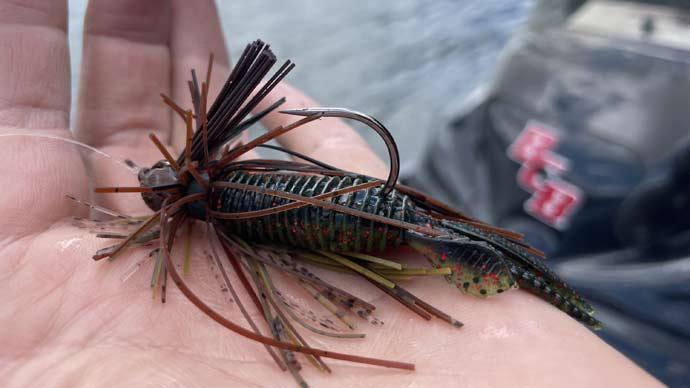
Try matching different trailers with different weights of jigs. For example, a big flat trailer on a 1/4-ounce jig will slow its sink, allowing you to work it like a jerkbait for prespawn bass suspended around docks. Photo by Pete M. Anderson Arkie is the best-known casting jig. It’s somewhat flat, and its weight spreads along its length. Choose one with at least a 3/0 hook made from midgrade wire. Heavy wire hooks require too much force to set when casting, and light-wire hooks are more likely to bend under the weight of heavy springtime bass, costing you in the process.
Bring jigs in at least three weights — ¼, 3/8, and ½ ounce. The 3/8-ounce ones will get the most use; they're easy to cast and pitch accurately, and their rate of sink is easily manipulated with different sizes of soft-plastic trailers. Use your ¼-ounce jigs when bass move shallow, less than 3 feet. Tie on a ½-ounce jig when bass are in deep water or weather changes cause them to bury in cover, and you must go in after them.
A brush weed guard is best. Remove a few of its filaments if the cover you're fishing is relatively sparse. That softens it, allowing it to move out of the way easily during a hookset. And add a rattle to your jigs when the water is dirty or filled with heavy cover. It’ll help bass find your offering.
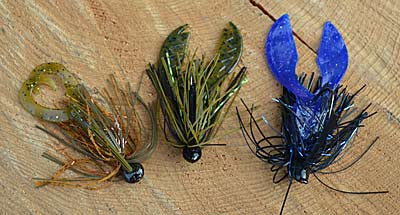
Anglers spend the most time selecting the color of their jig’s skirt. There are times when or locations where a particular one will outfish everything else. But those are more the exception than the rule. So, bring these three patterns during March:
- Natural: Best in clear water, these include combinations of green pumpkin, watermelon, pumpkinseed, and solid black or brown. They should resemble a crawfish.
- Black and blue: This classic combination continues to produce, whether you’re fishing in clear or dirty water. Experiment with different shades of blue, including flash.
- Dark and bright: High in contrast, it shows up in stained or muddy water. One of the best is Texas craw, typically a black skirt with a few strands of chartreuse and pumpkinseed.
Most mass-produced jigs use a collar to hold the skirt strands. It works but isn't as durable as a skirt tied to the jig with wire or thread. Those options also help your jig skip further across the surface, which is essential when reaching the darkest corner under docks or overhanging trees. Collared skirts tend to spin when your jig glances across the water's surface. That rotation catches water, stopping your jig and turning it into the water, prematurely ending your cast.
Add A Trailer
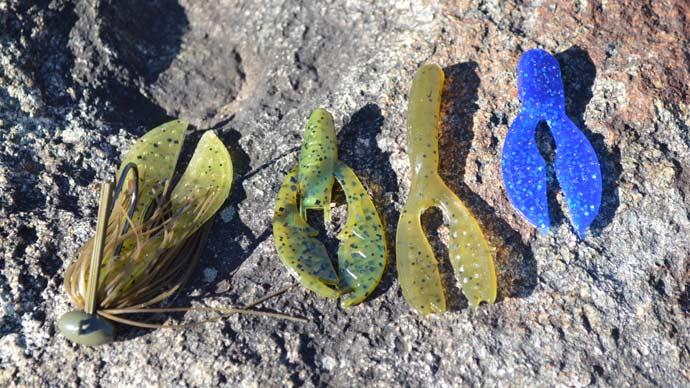
No jig is complete without a trailer. It fills out a lifelike profile, which sometimes matches a baitfish but most times a crawfish. Trailers are available in a host of sizes and shapes, each adding positives to your presentation under certain conditions. Here are four to choose from.
- Natural: Detailed down to antennae, pinchers, and eyes, these trailers are best in clear water, where bass get a good look at your jig. They typically create little action and allow a jig to sink quickly.
- Traditional chunk: Shaped like the original pork chunks, these add more bulk than action. They are best in the coldest water when you want your jig to fall slowly or match an extremely big hatch.
- Flapper: These have large flat appendages like NetBait’s BaitFuel Paca Chunk. They slow a jig's fall by making it glide. The appendages continue to wave while the jig sits still on the bottom.
- Action: The twin-tail grub is the best-known one. It creates action when your jig is sinking or advancing but not when it’s at rest. They're best at March's end when the water is warmest.
While some cuts of natural pork chunks are available, stick with soft-plastic trailers in March. They’re easy to use and available in myriad colors, making it easy to find one that matches your jig’s skirt.
You can rig trailers a couple of ways. Simply running the hook once through its nose is the easiest. It creates action by allowing the trailer to move more, but it’s less durable. One vicious bite or jump by a bass, and that trailer is toast. Instead, try threading yours onto the hook, adding a drop of super glue before snugging it against the head.
Choose Your Combo
Image
Make sure your jig rod has a fast-action and heavy power. You’ll need the former to cast and pitch your jig accurately and the latter to set hooks and steer bass away from cover. Photo by Pete M. Anderson A spinning combo can handle finesse jig applications. But March jig fishing demands the extra power that a baitcasting combo brings. Choose one that’s lightweight and comfortable enough to fish all day, ensuring your last cast is as good as your first. Here’s what else will make yours better.
- Rod: You’ll send jigs to a variety of targets this month, from almost barren rocky banks to thick shoreline bushes. Choose a rod that measures 7 feet or a few inches longer, which makes casting and pitching easy. It should have a heavy power to drive hooks home and steer bass away from cover. Its fast action supports casting accuracy.
- Reel: Working your jig will be handled with your rod's tip. But you'll want to quickly eliminate any slack when it's time to set the hook. A high-speed reel — at least a 7:1 gear ratio — does that. It should have plenty of ball bearings and a profile that fits snuggly in your hand. Don’t worry about a wide spool; a traditionally sized reel carries more line than you’ll need.
- Line: Spool your reel with fluorocarbon or low-stretch monofilament line. Their slightly larger diameter plays better around cover than thinner braided line, which often gets snagged under splinters on dock posts or pieces of bark on laydowns. The pound test should be between 12 and 20, leaning on stronger line as cover increases. Clear or green line will go unnoticed in clear water.
Pick A Spot
Get a jig near any bass during March, and it's almost certain it will bite. Prespawn bass are aggressive and hungry, and their metabolism increases with water temperature. So, they're looking for a big meal.
While there’s no wrong place to fish a jig, some spots are better bets for finding bass in March. There always is an element of hard cover. They’ll be closer to deep water earlier in the month when the water is cold and closer to shallower water if it’s later and warmer. Here are four spots to try.
- Docks: Pick them apart, pitching to each post and concentrating on any associated cover, especially sunken brush. Keep your jig close to dock supports and the bottom when the water is still cold. Key on docks with black floats that absorb sunlight and warm surrounding water. As the water warms, target suspended bass using a large flapper trailer that slows your jig's fall.
- Rocks: The perfect match for a jig, these produce all month, starting at rocky points or piles outside coves. Riprap banks are good, too, especially where they form a point, pass a bridge abutment, or run behind a dock. Look past the rocks at the water’s edge. Ones that tumble into deeper water can hold the biggest bass, which go unnoticed by other anglers. Spend more time dragging than hopping your jig.
- Wood: Laydowns along with sunken or flooded brush are bass magnets during March. Bass will use them, enjoying the warmth they radiate, even when the water temperature seems too cold for them to be so shallow. Concentrate on making repeated casts, each from a different angle, to trigger more strikes. And don’t forget to fish around the tops of laydowns, which may be too deep to be easily seen.
- Aquatic vegetation: Bass use this cover in several ways. They’ll bury inside it when the weather turns, hiding until it stabilizes. And they’ll use the outside edge as a path when traveling to spawning spots. Aim your casts and pitches to points and pockets along the edge and holes within. Exaggerate your hops; they’ll make your jig easier to find amongst all the plants.