

When touring pro Casey Scanlon looks for spawning bass, he searches the shoreline for four types of cover.
Bass use various types of cover for shelter and ambush points throughout the year. During the spawn, bass also seek cover in the shallows as a shield to protect their nests from egg-stealing predators.
“Bass probably don't want to venture very far from where they feed and typically reside, so they are going to use the best piece of cover available to spawn,” Scanlon says. Scanlon usually finds spawning bass building their nests in the thickest, gnarliest cover along the shoreline when competing in tournaments throughout the country.
Here are the four types of cover Scanlon checks along the bank for spawning bass.
Docks
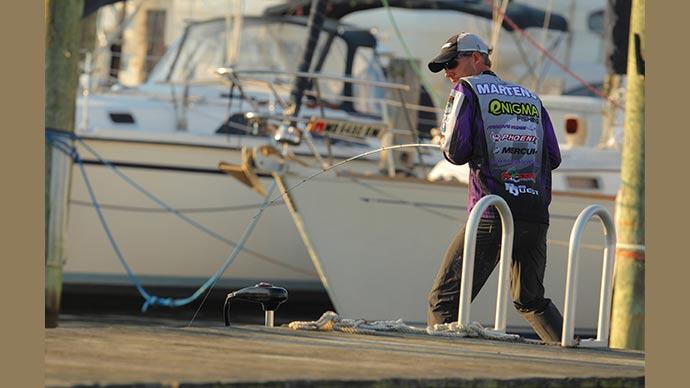
The Missouri angler suggests docks offer spawning bass lots of protection from predators and plenty of shade, and the dock poles are usually set in a hard bottom, which bass prefer for building nests.
Piers anchored with posts and floating docks supported by cables are both ideal cover for spawning bass. When he fishes piers, Scanlon targets all the supporting poles of the dock and the walkway pillars for spawners. His favorite targets for nesting bass along floating docks are the back corners, behind the cables and the walkway supports.
The two-time Bassmaster Classic qualifier finds bass spawning along docks in depths ranging from 0 to 20 feet. "Typically the females will stage out farther on the dock in deeper water until the spawn starts,” he says. “A lot of times, you can see them just suspended underneath the docks, and eventually, during the spawning process, they will make their way to the back side of the docks where they will go to their nests in shallow water that is exposed to sunlight. “
Scanlon’s favorite lure for skipping around docks for spawning bass is a wacky or Texas-rigged green pumpkin or white Bass Pro Shops 5-3/8 inch Stik-O Worm (2/0 Hayabusa Wacky Fluor Guard hook for the wacky rig and a 1/0 or 2/0 Hayabusa 114HD Round Bend Offset hook for the Texas rig). He also pitches around the docks with a green pumpkin or white Bass Pro Shops Magnum Flipping Tube Texas-rigged with a 4/0 Hayabusa 959 Wide Gap Offset Heavy Duty hook and a 1/4- or 5/16-ounce worm weight. A deadsticking or slow crawl presentation works best for Scanlon when bass are nesting around docks.
Weeds
Scanlon notices aquatic vegetation is the ideal cover for spawning bass because it provides nearly 360-degree protection. “They can surround themselves with cover in the form of those weeds and hollow out a nice little spot," he says. His favorite weeds for targeting spawners are eel grass, hydrilla, and lily pads. The best spots along the weeds to find bass during the spawning stages are the outside and inside weedlines or any open spots in the vegetation.
Moving baits that help Scanlon cover water quickly are his go-to lures for the weeds. "A lot of times, the grass beds are very vast, so you can throw a moving bait like a Bass Pro Shops Chatterbomb (bladed jig) so you can cover water and get around those areas where a majority of the bass are bedding.” He also covers water around the weeds with a Texas-rigged 6-or 8-inch swimming worm with a 4/0 or 5/0 Hayabusa 114HD hook or a 3/8-ounce swim jig tipped with a Bass Pro Shops Crawdigy Craw. Once he locates spawning bass, Scanlon slows down and presents a Stik-O, flipping tube or creature bait to the nest.
Wood
Wood in the form of laydown logs, stumps, brush piles, and flooded bushes provides bass with a hard bottom for building nests and plenty of thick cover. Scanlon says bass favor laydowns because they shield the nest from predators and cover both deep and shallow water so they can move up throughout the spawn from staging to nest building and guarding.
“The root systems on stumps are great places for bass to spawn,” Scanlon says. "Usually, the root system is hollowed out from current and wave action, so it gives bass a nice place to hide around or underneath."
Wood cover usually has lots of snags, so Scanlon favors weedless lures such as Texas-rigged soft plastics (Stik-O, Zoom Brush Hog, or flipping tube) with a pegged weight for pitching to the nesting bass.

Scanlon narrows his search for spawning bass when fishing vast areas of flooded bushes by concentrating on isolated bushes or a bush with some open space around it.
Concrete
Manmade objects such as seawalls, boat ramps, and dock pillars provide bass with a hard bottom ideal for nest building.
“Usually, the footing of the seawall has a lot of gravel around it that gets washed out over time from wave action, so it creates a good place for bass to spawn,” Scanlon says. Seawalls can stretch long distances, so Scanlon tries to cover water with topwater lures such as a Bass Pro Shops XPS Buzzer Beater Buzzbait, walking-style topwater bait, or a Rebel Pop-R. If he finds an irregularity, such as a footing or corner of the seawall, the two-time Bassmaster Open winner will pitch a wacky-rigged Stik-O to the spot.
The sides and ends of boat ramps are the targets. Scanlon pitches a jig, Texas-rigged soft plastic bait, or a wacky-rigged Stik-O to spawning bass. Scanlon favors skipping a wacky-rigged Stik-O or a jig under dock cables to reach bass spawning next to concrete dock pillars.