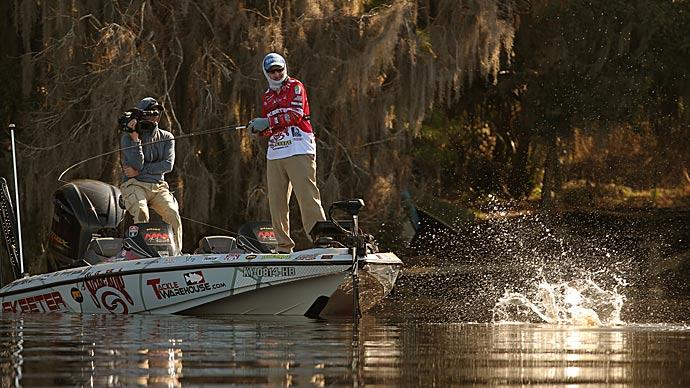


Spinnerbaits are hooked to many of my best bass-fishing memories. There were the giant Great Lakes smallmouth, which charged across flats and through waves to smash one that I couldn’t reel fast enough. Then there was the giant Potomac River largemouth, which rolled around a laydown to engulf mine just after the tide turned toward outgoing. And I won’t forget the submerged beds of aquatic vegetation on New York’s Chautauqua Lake, where football-shaped largemouth would engulf my spinnerbait after a quick flick of my wrist freed it from the grass.
Many bass anglers have similar memories. But plenty have been clouded by vibrating jigs and umbrella rigs, relatively new arrivals on the bass-fishing scene that act and fish like spinnerbaits. That doesn't mean this tackle box staple has stopped producing. Spinnerbaits continue to produce plenty of bass, including big ones, from various situations year-round. It starts with knowing when and where to fish one and improves when you learn how to tweak it to current conditions.
Every spinnerbait falls into one of three categories. Each corresponds to the number of blades they sport.
- Single spins: These spinnerbaits feature one large blade, whose vibrations are easily detected by bass. They’re best for fishing deep water or at night. They also work well for waking — retrieving a spinnerbait quickly so it runs just below the surface, creating a disturbance.
- Tandem spins: The most popular and widely available, the two blades create plenty of lift, making them perfect for fishing shallow water. Fling them around visible targets, such as laydowns and flooded brush, or rip them across a flat to draw reaction strikes.
- Multiple blades: Mostly a niche bait cherished in the Southeast, especially the Carolinas, these spinnerbaits have three, four, and sometimes more tiny blades. They imitate a group of small baitfish and are at their best when bass school in the fall.

Other details can categorize spinnerbaits. They include the line tie — closed loop or open R-bend —weight and style of head. All contribute to the performance of spinnerbaits pulled straight from their package. But there are things you can do to make them better. These adjustments, which can be small, have a significant effect on the number and size of bass that you catch. Here are some ways to make your spinnerbait better.
Change Blades
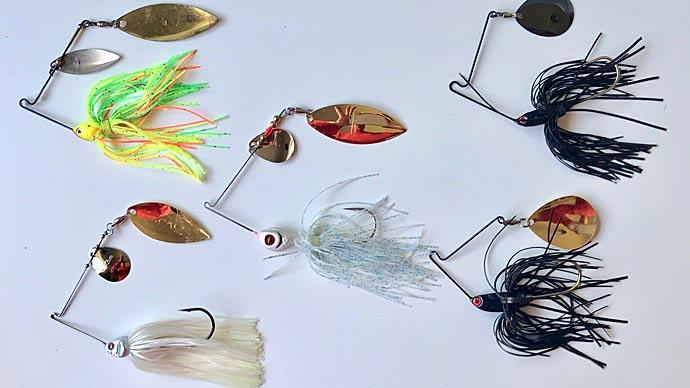
Spinnerbaits are comprised of several parts, but none are more critical than their blades. Spinnerbaits are offered in every blade combination imaginable, and swapping a blade or two is easy, so there's no excuse for not fine-tuning your offering to the current conditions. Deciding which one to use starts with understanding the types and their capabilities.
- Colorado: Round and cupped, this blade style throws off the most bass-attracting vibration, making it perfect for off-colored water and thick cover. It’s best for relatively slow retrieves.
- Willow: Long and narrow, these blades create plenty of flash but not much vibration. Most often used in tandem, they’re best in clear water, where bass rely on their eyes to feed.
- Indiana: Slightly elongated, these split the difference between Colorado and willow blades regarding vibration, speed, and flash. A favorite of river anglers, they’re something bass in other water types rarely see.
- Turtle: This unique shape resembles a squashed willow blade and is good in off-colored water. It produces more vibration than you’d expect for its size.
- Stretched: Stretch an Indiana blade, and you'll have this category's lone member featured on bass fishing legend Rick Clunn’s Trickster spinnerbait. It offers flash like a willow while retaining the vibration of an Indiana. It works well around aquatic vegetation growing in clear water.
Blades are available in two finishes — painted and metallic. Current conditions determine which is best, so you'll want both types on hand. Painted blades seem to glow underwater, so they’re best on overcast days or in muddy water. Chartreuse and white blades are the most popular under the former, and some anglers swear by orange or red blades when fishing the latter. Metallic blades give off plenty of flash, so they're best when the sun shines and the water is clear.
Changing blades is straightforward if you choose that route over purchasing different spinnerbaits. Single spins and the trailing blade on tandem spins are easiest to change. Simply use pliers to open the split ring, working the old blade off and the new blade on. Changing the leading blade on a tandem spinnerbaits take a bit more work. You'll need to open the wire loop holding the swivel and slide off the clevis. Reverse the process when re-attaching the new blade.
Add A Trailer
Image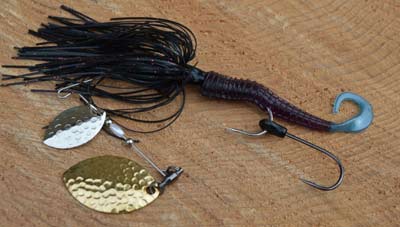
Finetune your spinnerbait. Adding a soft-plastic trailer increases bulk and action. And a trailer hook helps you catch bass that strike short or target your spinnerbait’s blades. Photo by Pete M. Anderson Much of a spinnerbait’s bulk and profile come from its skirt, which flares as your lure moves through the water. Most are made from strands of silicone, though living rubber and bucktail can be used. But sometimes a skirt isn’t enough. You may need a bigger profile to attract heavier bass during a tournament or more water resistance, making retrieving your spinnerbait through shallow cover easier. In those cases, add a soft-plastic trailer.
Spinnerbait trailers, like all soft-plastic lures, come in a variety of sizes and styles. These three versions, in a color that matches or complements your spinnerbait, are the most popular.
- Ringworms: The most subtle trailer, these bring the least amount of bulk and just a faint flicker from their small hooked tail. It should extend just past the skirt, so cut them down by about a third.
- Split tails: Thin like a worm, these are split halfway along their length. Hank Parker made them popular by adding one to the spinnerbait he used to win the 1989 Bassmaster Classic.
- Grub: These simple, sickle-shaped baits make great trailers, bringing plenty of bulk and action. Get more of the latter by rigging it so the tail turns opposite the hook’s bend.
Add A Hook
Spinnerbaits are designed to imitate a small school of baitfish. So, bass often slash at them, attempting to disable some of the baitfish, which it will turn around and eat. But that means sometimes they miss your spinnerbait's hook. Adding a second trailer hook will catch more of them.
Trailer hooks feature a single point and a relatively large eye, which slips over the main hook. A small section of surgical tubing or a plastic disk follows it. Both keep the trailer hook from dislodging. They also let it fall in line behind your spinnerbait and not off to the side, where it can snag cover.
Don’t discount using a treble as a trailer hook. Rig it the same way. While it’s not the best choice when cover is thick, it could make the difference in catching a fast-striking bass in relatively open water.
Add Weight
A spinnerbait’s head harbors most of its weight. Increasing its weight brings four benefits.
- Distance: Heavier lures put more load—flex in your rod. When that energy is released during the cast’s forward movement, the lure is launched further, helping you cover more water in fewer casts.
- Accuracy: Heavy lures are easier to put on target, whether farther from the boat, deeper in cover, or through a headwind.
- Speed: Spinnerbait blades create lift, which increases as their speed increases. Adding weight counteracts that lift, allowing you to increase retrieve speed, an essential trigger to bass in clear water.
- Depth: Stifling blade lift by adding weight makes it easier to fish a spinnerbait in deep water.
There are two ways to adjust a spinnerbait’s weight. The simplest is to tie on one that weighs more. That might mean cutting off a 3/8-ounce one and tying on a ½-ounce one when the wind starts blowing. The second way is more old-school: Disassemble a rubber core sinker, and crimp the lead portion on the spinnerbait hook’s shank. Keeping 1/8-, ¼-, and ½-ounce sinkers on hand makes it easy to create the exact weight of spinnerbait you need.
Control Casts
Cast and crank any spinnerbait, and you’ll catch bass. But you’ll catch more if you master these three casts, choosing the one that best matches what’s currently in front of your boat.
- Pitch: A pendulum-like movement that starts with your rod tip down and finishes with it up. It's best when you need to accurately place your spinnerbait next to cover that’s close to the boat.
- Roll: Move your wrist like you’re turning a doorknob, and you’ll send your spinnerbait to specific targets that are too far to reach with a pitch. It’s best for fishing random targets along a bank, especially under overhanging tree branches.
- Bomb: Let your spinnerbait fly with this powerful overhand cast. It’s best for fan casting cover submerged in deep water or expansive shallow flats.
Each cast offers opportunities to inject more bass-attracting action. So, add a few of these moves to each cast.
- Slow down: If you’re fishing a tapering bottom, slow your spinnerbait as it moves further into deep water, allowing it to continue along the bottom, where bass may lurk.
- Speed up: Keep bass from getting a good look at your lure, so they have to bite to find out what it is. This is an excellent option in clear water and will work in stained water.
- Inject pauses: Well-placed pauses create opportunities for bass to strike. They are best when fishing visible cover. Time them to when your spinnerbait passes or bounces off cover.
- Add pulls: These add bursts of speed to a steady retrieve, forcing bass to bite or lose this meal forever. Bass bite when your spinnerbait appears to be darting away or falling into their face when it slows.