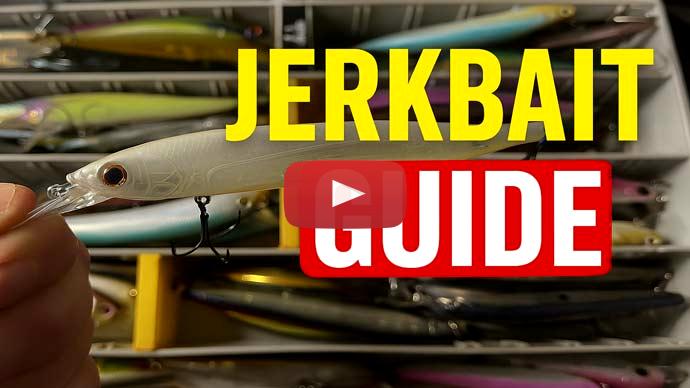
All right, jerkbaits, is what we're talking about today, they work year round, not just in the early spring when it's really cold. They actually work throughout the whole year and for good reason. They imitate bait fish, especially dying bait fish or injured bait fish, which triggers the natural instinct for bass to, you know, predatory instinct, so.
How do you get the most out of them? Because man, there's so many out there, right? So let's, let's make it easy for you. I'm going to break it down a few simple things.
First of all, color choice. There are so many different colors out there, it's ridiculous. And some of these baits have super realistic finishes on them. And of course they're very expensive too. So which ones do you get? Well, the best way to do this is to break it down into basically three main categories.
First of all is the matted finish or the muted finish and these you know the solid type colors here. These work really well in stained water conditions or when it's cloudy. Kind of dark. Those, the solid colors work really well. On the other end of the spectrum when it's sunny out. Then something that's more of a Chrome flashy type finish like these, something that's got a lot of reflection to them, work really well in those sunny conditions.
And then if you've got clear water, then what I like to do is get something that's a little more translucent like these, so you can kind of see through them. You can see a little bit of a light through them, and these work great when it's really clear water. So you don't need every color under the sun. You just need like a few in each of those categories in kind of a bait fish, you know, color something that resembles the forage in your body of water that you're fishing.
You know, you're fishing jerkbait's relatively quick and the bass just have a chance to glance at it really. So you don't need the exact match color, just something that resembles it close enough and it'll work for you. Don't worry about it. So don't. Don't collect. Don't be a jerkbait collector. So.
Another thing to consider is the size of the bait and the diving depth, right? There's a lot of different ones you can get, so the more popular ones are, you know, like what I just showed you. You know, these that have this size, this is like the 110 size. It's got the deep diving lip on it. You know, that's a pretty popular size and for good reason. It's it's like the right size for forage, but you can get in different diving depths.
So for example, like the one I just showed you has that. Has that big lip. Well, here's the same bait. See the difference? It's got a little lip on it as opposed to the long lip. It's the same same size bait. You see that but with a shallower lip on it. It dives a lot shallower. So this will go maybe 5-6 feet deep. This goes to more like 10 to 12 foot deep and so sometimes you just need a bait that gets to the right diving depth.
Other times you want a little bit different size, so this bait is a little bit smaller. Yeah, sometimes the bass, they just want something a little bit different. And a smaller bait, particularly in clear water conditions, or when the bite's a little bit off. A smaller sized bait works really well. Alternatively youou can go to larger ones too. There's some bigger ones out there. This is a good sized one here. You know they they sometimes want a bigger bait.
So having a couple of different sizes and different diving depths that they go to, you can cover pretty much the whole water column and their preference for forage size that time of the year. Sometimes in the season the forage is a little bit bigger than the other times of the rest of the year. And so sizing up or sizing down is the right way to go.
Of the things you need to do at jerkbaits is experiment with your retrieve. Now the standard retrieve is you throw it out there, let it sit for a little bit and then pop, pop and let it sit and pop, pop and let it sit. And you might wait 3 to 5 seconds between popping it and and that's a pretty productive retrieve. But there's a lot of other ways to retrieve it.
Sometimes just pop, pop, pop, pop, pop all the way back to the boat or back to the shoreline can be very, very effective. That darting erratic action depending on the bait you have can be, can trigger bytes. One of the ways that you can tell how much it moves is just, you know, go along the dock or if you're in your boat, kind of pop it right alongside and look at it and see how erratic a movement or how much it dives. And it gives you an idea of how hard to pop it.
Because sometimes a real subtle pop, real subtle jerk is what you need. Maybe just with a suspending jerkbait, you know, get it down to the depth it's at and then let it sit and then nudge it. Just give it a little slight nudge. Slight twitch or maybe a little pop pop, just subtle and let's sit again. And if it's a bait that dives really hard, then that soft twitch actually translates to quite a bit of movement on the other end, so you don't need a hard jerk sometimes. Other times that's what the bass want. They want that thing diving and jerking and going all different directions, really wild or erratic action and that's what triggers it. So you have to experiment with it.
One of the things that some anglers do, instead of pop pop it, they give a pull with a rod and they just (sound) and then they pause it and they reel up and they give it another pull with a rod, reel up and give it another pull and then combining it. With turns of the reel handle. And pulling it. One of the things I like to do is I like to start with turning the reel handle to kind of get the bait moving and then pull with the rod and then pause. So it kind of gets a start running start and then accelerates and it almost looks like a bait fish trying to flee or run away from a bass and then they'll chase it down and trigger it.
That's just some ideas. Don't let that limit your imagination. There's all kinds of ways. Just play around and sometimes you'll you'll figure out what type of cadence or retrieve they want that day. And it might be something that just the other anglers haven't thought of and the bass just are craving it. So don't be afraid to experiment with different retrieves.
One of the critical components to successful jerkbait fishing is the rod and reel and line that you use. The rod, it should be a medium power, moderate action rod. That's a lot. It's very limber rod, about 7 foot one, 7 foot 3 is what you want. That limber rod's going to do two things for you.
First of all, it's a lightweight bait, so it's going to enable you to cast it out far distance. That rod's going to load up more and you're going to use the power of that rod to throw that lure out there further distances. 2nd is because it has a lot of give to it and bend. When you do hook a fish, those little treble hooks, they're going to stay pinned or that rod is going to give like a shock absorber. Every time that fish dives and darts and tries to run away from you, that rod is going to absorb most of that and it's not going to pull the hooks out of its mouth. If you had a stronger rod, you run the risk of yanking those hooks out of the fish's mouth, so a limber rod like that works in your favor.
Another thing is. Is whether you use bait casting or spinning. Most Jerkbait anglers use spinning gear, again because it's a lighter lure to throw. But also you're using lighter line, typically 10 LB line, maybe 12 LB line. And it's easier to cast light line like that on spinning reels. And a quality spinning reel is going to enable you to make those long casts.
So you don't need to invest a ton on the rod because most of the times the rods are actions about the same. But I would invest a little bit more on the reel because you're going to get longer distances with it, plus they have a better drag system. And when you're fishing those little treble hooks, you want a nice smooth drag that's going to give at the right time while you're fighting that fish so you don't end up ripping those hooks out.
The other thing is the line you use. I mentioned 10 to 12 LB line, but you want to use fluorocarbon line. Fluorocarbon sinks enables that bait to get down there and keep it down there. And it's really super sensitive. The thing about using fluorocarbon line though is one brand from another really does, there's a big difference between say each one's being 10 LB line.
You need to look at the line diameter. Many of those less expensive budget fluorocarbon lines have a real thick, relatively speaking, a thick diameter compared to the premium lines. And that's going to be a difference between how deep you can get it and also how are you going to work it and also how far you can cast.
The premium lines like Seaguar, Seaguar most of all of its fluorocarbon lines have a thinner diameter than its competitors. Those you can get it down deeper, have better sensitivity. They have a higher tensile strength. The high end like the R18, that's the high end in the Seaguar lineup, you'll notice a difference with that. You can fish 10 LB, even 8 LB with that using jerkbaits and with fantastic results.
So when you're comparing fluorocarbon lines, make sure beyond line strength, you're comparing line diameter, and that's going to help you pick the right one for your budget and your needs.
So with those tips and tricks lined up, you're going to catch a lot more fish on jerk baits this year. For more tips and tricks like this, visit bassresource.com.