Hey guys,
Matty Wong, Elite Series Pro here and also with BassResource.com. Today I'm gonna talk to you about one of my favorite techniques—Neko rigging, or as some of you might know it as Neeko rigging in America. But it is a finesse technique where you're utilizing any type of finesse worm. Right here, you just got a stick worm, you get a finesse hook—this is a Gamakatsu Antenna hook—and then a nail weight.
The whole secret about this bait is that you're able to get a long cast with a very finesse presentation utilizing a really sensitive Megabass rod and the line and reel setup. But we'll dive all into that as we talk about this technique.
Now in the month of April, it's really important to focus in on little subtle differences. As these fish are coming off of the bed and/or going to the bank, they're in transition points. I like to focus on stumps, little breaks, rock piles—those types of cover where these bass use as staging areas as they start to push to the back of coves or come out of coves from spawning.
And what I got tied up right here—let me just kind of tell you about my setup. This is a Megabass Orochi X10. This is a spinning rod. This is a 6'11", and this is a three-power with a Stinger tip. So this rod—you can cast a really lightweight bait a very far distance and have the sensitivity to stay connected with your bait the entire cast. From the end of a 100-foot cast, you can feel basically everything that you're ticking over at the end, which I think is really important. If you use a rod that's too stiff, you won't have the sensitivity to be able to work your worm over the type of cover that's out there that we're fishing and targeting.
So I got this stick worm on. Some people like to use collars and whatnot—little tubes to keep your soft plastic from tearing—but what I like is I just actually just go straight through the worm. There's a couple different ways you can rig it. You can rig it up wacky like this, and then right here is a 1/16th oz nail weight that I put in at the end.
And so that's one way to rig it. Another way to rig it is—you go in, and this is really important—when you go in towards the head of the worm, always making sure that the hook tip is facing up, not facing down. With the hook tip facing up, it allows—when it's dragging across the bottom—for the worm to stand straight up and the hook tip to stay exposed. With that little nail weight in the nose and the tip of the tail facing straight up, it really helps for the presentation of this deal.
So whether you've got forward-facing sonar or you're just fishing from the bank, you're able to isolate and target cast toward your isolated pieces of cover. Whether you see a stump out there—that’s the thing I really like about this—the Antenna hook has these two monofilament or fluorocarbon kind of weedless little “antennas,” if you will. That helps keep this bait from snagging up, and it also has a little monofilament keeper there.
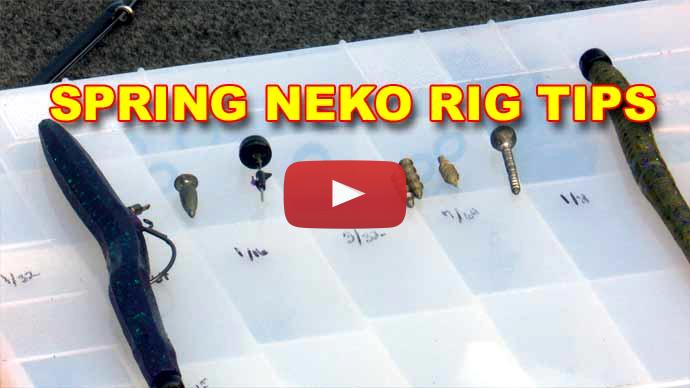
But this is one way to do it. Let’s rig up another one fully. So you get your hook, and I like to utilize this G Box right here. I'm able to keep all of my Neko rig weights all nicely organized. I have them all labeled with a Sharpie up here—everywhere from a 3/8 all the way down to a 1/16. And since we're fishing kind of shallow, I'm going to go with a 1/16.
Then get whatever type of favorite finesse worm that you want to use. The first thing you're gonna do is take that little nail weight and put it in the nose of the worm. So right there at the very tip—you’re going to push it into the nose of the worm.
Next, you're going to take your hook. Now, there are two different ways to do this. You can either, like I said earlier, hook it wacky—or you can just hook it skin-hooked with the point still facing up. With the Antenna hook, you then bend the fluorocarbon weedless guard up—and there you have it, right there. That is a perfectly rigged Neko rig for the spring.
This little guy, especially if you're looking at water clarity—wherever the water's really clean—I like to lean towards natural colors. Whether it's green pumpkin, watermelon red, any type of green pumpkin, any type of bluegill-looking profile or bait—that's kind of a go-to right there.
Now the setup is really, really crucial. What I like to utilize with this whole deal—talked about the rod briefly—is the line, and it’s really important. I like to use Sunline, and I like to utilize Almight. This is a sinking braid. This is a really, really thin diameter braid—and it sinks. So on a long cast, you have more of a direct contact between your bait and your rod tip, giving you more feeling. Versus other types of braided lines that actually float on the surface, you have a lot more scope and a lot more play in that braid. In turn, you're not getting the best bait-to-rod connection. So that's why I like to utilize Almight. Also, it comes in a really bright pink, so it's very easy for you to visually see it. You can help detect bites and even help see where your line is mending on top of the water and as it sinks down to the bait.
Now, another really important element to this thing is your leader material. Some people like to pull off their other type of fluorocarbon that they spool up on their baitcasting reels, but I don’t like to do that. The reason why is because of abrasion resistance. Whenever you’re fishing a Neko rig, you’re fishing it around rock, stumps, brush piles—and that stuff will really tear up your line.
When you're utilizing fluorocarbon, having a more rigid leader material—like this FC Leader right here—it allows for that abrasion resistance, so you don’t lose fish. I can’t tell you how many times I’ve pulled giant bass out of really tricky spots with 12 LB FC Leader.
With a connection knot, I like to utilize the FG knot between the braid and my fluorocarbon. I’ll put about a 6-foot leader, also depending on the clarity of the water. But typically, you don’t need to go any longer than 6 feet when it comes to leader material. It also helps save a couple of dollars because high-quality fluorocarbon isn’t cheap.
And that’s essentially the setup.
Now, we're going to talk about where to look for places to fish this specific rig. As the water starts to warm up into the spring, the bass are pushing into spawning. Now it all depends on where you are in America or across the world—that will pertain to you and your fishery.
So for me personally, once that water temp gets into the 60s, those fish are going up to spawn. Anywhere from that 60 into the 70s—well into—that’s prime spawning conditions. In those high 50s, water temps is a prespawn time. But I would say in April, most of the time, you’re going to find water temps that are in the high 60s to low 70s. So those fish are going to be either pushing in to spawn or they’re coming out.
Staging areas are what I like to target. So if you’re looking at—like right now, we’re in South Carolina on this beautiful man-made impoundment. You have a lot of creeks, a lot of rivers—there’s three rivers that feed into this lake—and then you have these creeks and the main lake. You have points that are off the main lake. Bass like to utilize points as highways as they’re going back into spawning coves. Once these fish come off of beds, they’re going to stop back in on these stopping spots.
So secondary points—meaning if there’s a creek that goes in, you have your main lake out here—and then the first little bump inside the creek or the first point that you see is your secondary point. So targeting stumps, brush piles, isolated rocks—really good places to start when utilizing a Neko rig in the spring.
Depending on if it’s smallmouth, largemouth, or spotted bass, it can all depend on the forage they’re specifically feeding up on. If you’re on a herring lake, sometimes utilizing a shad-colored or more translucent worm is something that I’ll go to. Or if you’re fishing a place that is mainly bluegill or brim, something more natural—like green pumpkin or a tilapia magic color—is a fair and good choice to utilize.
Now how do you work the bait, you might ask? A lot of people will tell you different things. Whether it’s cast it out and leave it, or cast it out and shake it—there’s no wrong answer. You can make a long cast and slowly drag it, let it sit—slowly drag it, let it sit. Or you can just let it sit. I think it has its own effectiveness depending on your fishery and also the time of year.
I think when the water’s a little bit colder, the less you mess with the bait the better. Let those bass be inquisitive and come check out your bait. Because we all know bass are kind of like cats—they’re very temperamental at times, but they’re really curious.
As the water temperatures start to warm up—let’s say into the 70s—giving it a little more action, maybe shaking the worm a little more, might help entice a bass into actually committing to biting. And the equal also applies when coming into the fall—when the bass are starting to push up into the creeks and whatnot—and just utilizing a shaking technique. I’ve found it really helps get a couple more bites.
But there you have it—basically the how-to and the full breakdown on the Neko rig, a technique that’s put a lot of money in my boat, and it’s put a lot of fish in it throughout the years. It’s a technique that I think a lot of people can utilize and benefit from, because it’s something that everyone can do.
Whether you’re a young kid, or if you’re trying to teach kids how to fish, you can utilize something that’s weedless and they’re not snagging up as much—or if you’re a tournament professional, it’s something you can have fun with.
Hopefully you learned a little bit about the new Neko rig and how I like to fish it.