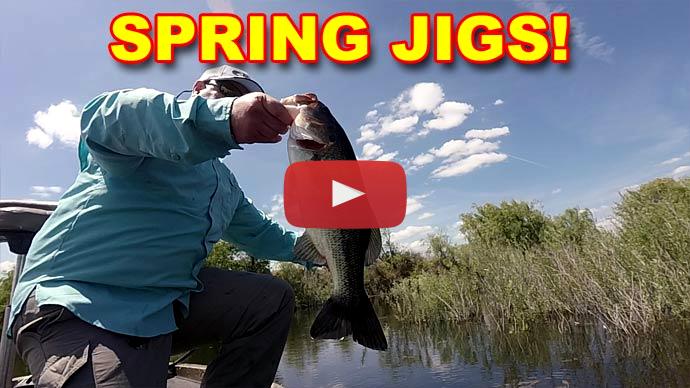
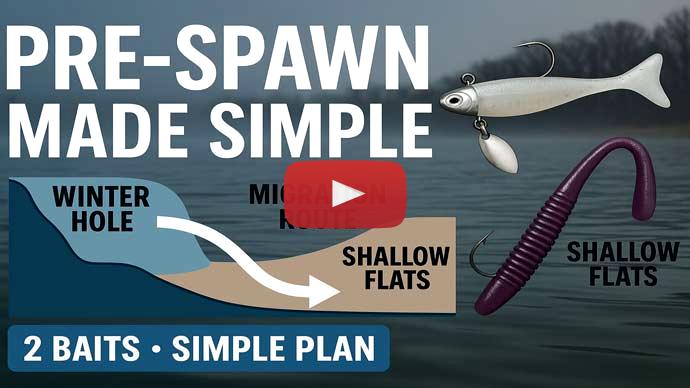
Alright, it's March and pre spawn is pretty much getting into full swing now across the country. Those bass are moving up from their wintering holes to their spawning areas and they're using those transition banks to get there. If you're not sure what I'm talking about with transition banks, there's a video right up here. I go into great detail about that and how the bass use them. Check that one out. But assuming you know, the transition banks are and those migration routes, that's where the bass are right now and there's no really better way to go after them than a jig. I mean. There's a lot of other lures out there that do work, but the jig day in and day out, you can pretty much catch them every day with a jig.
The thing is, there's all kinds of jigs, football jigs and swim jigs and finesse jigs and on and on and on. Let's make it easy for you. The one you want to use right now is the Arkie jig, or sometimes it's called the casting jig, and that's because it's designed to go through a variety of different types of cover.
So just to give you a quick overview of what an Arkie jig is. This might show up best, but it's this kind of style of jig head. OK. It's kind of round has a little bit of a point to it, not much of a point. Kind of a blunted point. You know, the eye of the hook is up in the front, the eye of the jig, that line tie is up in front and. And I'll give you one more. Let's just give you, you know, same. Same type of thing you can see. That's really good. That is perfect. That really shows exactly what the shape is and.
The reason why these work so well is because right now the bass could be in open water in rocky areas or around sunken timber or stumps. Boulders, that sort of thing. Or they could be buried up in the cover and this style of Jake can go through pretty much all of that. So you want to be ready because you don't know where they're going to be and you have to have the right jig tied on.
The sizes you need, basically just quarter oz, 3/8 and half oz is all you're going to need. The 3/8 ounce is the one you're going to use pretty much 80% of the time. And you can control its fall rate by what kind of trailer you put on. We'll talk about trailers in a minute. So you can use that pretty much anywhere, but the bass are still real deep. Go to that half oz and if you find them nice and shallow then. Maybe go to that quarter oz for a little bit slower fall.
The key thing here is you don't want to hook on it. That's super stout. This is why you don't want to flipping jig. The flipping jigs are equipped with a real stout hook. And because these fish are going to be anywhere and can be in open water, you don't need heavy flipping gear with 50 LB braid in open water. That's, you know, that's overkill. And the bass can see the line for example, perhaps. You know, you just don't need that so. That medium kind of hook is again all-purpose that can go in the open water and you can go into, you know, cover as well.
The weeds aren't very thick right now so you don't have to worry about heavy duty gear at the moment. So that's really key and another thing you want to do because the weeds aren't that thick. Is. See the the weed guard here, I got it trimmed down to just get to the hook point. OK, that's going to help you. That's going to help you a lot. It's going to help with hook sets, it's going to help clear that hook out of the way with a hook set, and it's going to allow it to go through that weedy cover a little bit better without getting hung up. Again, the weeds aren't that thick, so you don't need a super long stout weed guard. So keep that in mind. Trim that down a little bit.
As for colors. There's really three main types of colors to use right now. One is natural, and these are for like the clear water. To stained water. But these are like, you know, the Browns. Right, your Browns and your green hues watermelon. Can be black as well, you know, different variances of it, but that's a real staple in that type of water.
Another color is you can use an indie color Water really, but as you're black and blue. Or variances of that in this case. This one has a little bit of purple in it too, but black and blue is like a staple anywhere in any color water. If you were going to have just one jig, Arkie style black and blue jig would be it. But then. But it also helps if the water is turbid or you got some muddy water, you got those fronts that come through and stain the water up quite a bit. You want something with a little bit of flash. So like a blackened chartreuse works really well. And I like this. It's got a little bit of chartreuse on the head too. But you know, there's you can add some flash in here too, some mylar strands, you know, play around with it.
The thing about it though is you notice like. This is a good example. See this the collar on it? Right here, it's rubber. It's a rubber collar. Now. It helps keep the costs down on the jig. The problem with rubber collar is over time they get brittle and they break and also they don't hold super tight. So if you're skipping under docks, this head style, by the way, is really good for skipping under docks. But this skirt can twist and move as you're skipping. It'll catch the water and slow down that skip and you won't get as good as good as a skip out of it. So what I like to get is wire ties.
In this instance. This jig head. This jig head here. Has a wire tie. You can barely see it. It's right there. Let's see if I can't get that. See it? It's right here. It's barely in there but that. A wire tie is what you want. Far more durable, holds the skirt in place. It's going to last you a long, long time, so if you can find jigs with wire ties, my opinion they're better.
So let's talk about trailers here for a minute. There's a variety of different kind of trailers and they each of them serve their purpose. One of them is the natural looking craw trailers like this one. It actually looks like a real crawdad doesn't have a lot of movement to it. But. These kind are great and really clear water where the bass has a chance to get a good look at it. Plus when the water is cold, you don't want a ton of action when the water's really cold and these you know, don't have a whole bunch of action to it. So these are great for that kind of thing and they come in different colors, but I go with the natural colors. So you can see this one's a green pumpkin that is one style.
Now another style is what would be like a chunk, if I can find where I have that trailer, a chunk. Now this one. As you can see, this is just a chunk trailer. And with a little bit of appendages on it, there's a variety of manufacturers. This one's from Missile Baits. It's the Mini D chunk, I think is what it's called and. Again, natural colors, but this really works well again in colder water. It has a little bit of action to it. It's a little bit smaller profile. This is the mini one. They have a larger one too, but those work excellent in water that's got a little bit of stain to it.
Another style, what I would call is a like a flapper style and that is one like this. You can see it's got some cross on it, a little bit small body. It doesn't have a ton of action to it and this is great. Again, when the water is cold or when you've had these fronts come through and it's kind of shut the bite off and the bass aren't super active, something that doesn't have a lot of action to it works really, really well. And it's got that large profile, so this is something I'd pull out. Those post front conditions.
And then finally I would have what's kind of an action style, one that's got some amount of action to it. So one of them would be like this. You got your split tail grubs. You see that it's just a grub. That's all it is. Is this a grub, if I don't drop it, and a little split tail on it. Works, works really well as a trailer or like this. This is the Rage Craw. I really like the rage craw myself because see this, these craws, they got a little edge on them and it catches the water and so they go through the water, they kick. They look real active and lively. This is great when the bass are up somewhat shallow, they're feeding, they're active, they're moving around an awful lot. Or when you've got some stained or muddy water, something's got some, a lot of movement that they can hone in. With their lateral lines, that vibration, that's perfect for those situations.
As for rigging those trailers, what's really important. Is some guys, they just nose hook it and I won't do that because the trailer gets torn up almost all like like on the first fish. It's torn up and useless. So a better way to do it is rig it on like that, right? Just thread it on. To the jig itself. Like that? So the whole thing is on, it's kind of like you would at Texas Rig or something like that, but you're you're threading it onto the hook of the jig and that way it's much more durable. You still got the. The appendages here underneath it's sticking out beyond the skirt. Works great. This is the way I've been doing it for decades and it works really, really well.
Now as for the rod and reel that you want to use, again we have a medium. Power hook, a medium style hook, the flipping gear, we're not using that today, so. A 7 foot one to seven foot 3 medium heavy fast action bait casting rod is what you need. This is all-purpose your Swiss Army knife rod. You should have one anyway because you can throw a variety of of baits with it. So just use this rod. You can fish the jig in any kind of depth and any kind of cover with it with ease as long as you're not throwing a super thick heavy cover. But we don't have to deal with that this time of year.
I would pair with it. 15 LB Seaguar InvizX fluorocarbon line. Why? Because that is fluorocarbon is way more durable and abrasion resistance than braid. Braid is really good around thick vegetation, but we're not dealing with that right now. So you want to use that. And if you're around wood and logs and pilings, I've got splinters and things you can get hung up on. Fluorocarbon holds up to that better, and it holds up better to rocks. So it's all around just a better all-purpose line and I would get the clear color because again, you got if you got clear water, even if you got muddy water, it's not going to show up. So I always use clear.
As far as the reel, the reel I would use a 6.5 to 7.1 gear ratio. That's kind of an all-purpose one. It's 6 1/2 dozen other. You know, the lower the gear ratio, the more torque you have. So you can get him out of cover right now. You don't have to deal with that. So a higher gear ratio like that 7 to 1 is better because once you get that line out there, a lot of times you've got a little bit of slack in it. And if you get that bite, it gives you a chance to reel up that slack a little bit quicker before you set the hook. And also after every cast and pitch you can reel up the line quick. And cast back out there faster.
If you're reading between the lines, a 7.1 gear ratio or higher is not a requirement. If you've got something between 6.5 and 7.1 somewhere in that range, you're good. If you're a little bit lower 6.3 or a little bit higher 7.4, don't fret, it's fine. You're going to be okay. You just don't want something on the extreme super low or super high.
As to where to fish it, well, remember now earlier in the month, the water's cold and it warms up as it goes on. So they'll be deeper earlier in the month and shallower towards the end of the month. Keep that in mind when I mentioned these places. So docks is an area that I would definitely throw to and docks has got that. Wood pilings. The fish will relate to that, especially if you got brush piles underneath there. A lot of owners will do that. Dock owners, they'll sink, sink some brush piles around their docks. If you can find that, that would be really good area to target. Get that cast and put that jig right alongside that dock piling. And that hard bottom is perfect for dragging that jig. You know, let's skip that jig up under the dock, let it flutter all the way down and this drag it along the bottom as it warms up, Look for those floating docks that have like they're made out of that black plastic type material because that black it, it warms up faster than the surrounding areas and that water will warm up faster. So those floating docks with the black pilings or the what do they call those? The flotation devices? That's the thing that I like to target because I tend to catch more active bass there and that's when I start to put those more active trailers on too. As the water warms up, slows down the fall even more, gives you more time for that bass to hit that lure.
So that's our main thing, rocks, Rocky bottoms is another. So those points. And humps and rock piles are the things that you want to target. This is perfect, perfect for jigs because that's a lot of times where you find crawdads and bass are looking for crawdads and jigs look just like it. So I would throw in one of those realistic looking trailers on there or one of those flapper trailers as the water warms up and just drag along the bottom around all those rocks riprap is a good area to target. Will you have gravel that goes up in abutment or a seawall or maybe around bridge pilings? Those would be areas that I target. Sometimes you have them around docks, some gravel around that, so that would be an area to target as well.
Wood is something else. That would be stumps, lay downs, sucking logs, and we already mentioned docks, but the wood a lot of times absorbs the heat and radiates it, not quite as much as the rocks, but the wood still does and so that the bass will gravitate towards that. So you definitely want to fish any of those areas I just mentioned. Lay downs would be really good, particularly earlier in the month and when the water's colder, get out towards the end of the lay downs. Sometimes it's way out deep, you don't even see it, but those are areas. To slowly work the jig around the tops of those lay downs, man, that's an area a lot of bass anglers miss and sometimes some big girls are sitting there. So make sure you fish those lay downs and those stump areas with a jig.
And then finally, aquatic vegetation, again, there's not a whole lot there, but the ones that are there, the fish are using. And what they'll do is during those front conditions and post front, when the bite shuts down, those fish will get up inside of those weeds and they'll kind of bury up in it and wait for conditions to stabilize. And when they do, they'll be on the outside edge of those weeds and using that as migration paths. So you want to target those areas with the jigs. If you've got a post front condition, look for those little pockets and openings. Inside the weeds and when it's stable out, then you want to go for those edges, those little points that come out, those irregularities and anomalies. If you've got an area where it's hard bottom that butts up against where the weeds are, maybe even a log near there or something like that. Now you've got a trifecta. You've got the right kind of cover with the weeds. That's definitely an area I'd work hard with the jig. Usually just dragging on the bottom is best. However, don't hesitate to experiment a little bit with hopping and dropping it sometimes, exaggerating. Lifting it way up and letting it flutter down elicits a strike, even though it doesn't seem like they would be hitting something like that but.
You don't know until you try, so experiment with true trees until you figure out what kind of retrieve they want that day and then replicate that as you go out throughout your day. So I hope those tips help put more tips and tricks like this. Visit bassresource.com.