

Editor's Note: We ran this article ten years ago this month and thought it appropriate to refresh our memories about this valuable book. That, and to keep the memory of our dear friend, the late Dr. Dave Willis, alive.
We are excited! By the time this issue of Pond Boss magazine is printed, we will have a new textbook available on pond management!
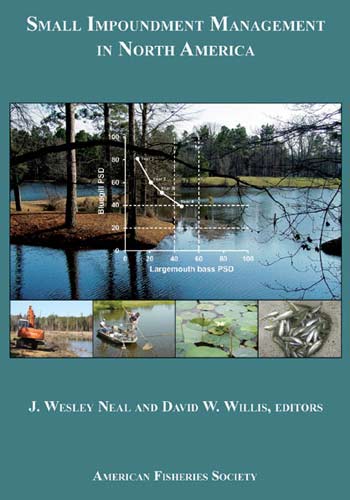
The new book, Small Impoundment Management in North America, is published by the American Fisheries Society (AFS). The book actually is the brainchild of Dr. Wes Neal, who worked with the Small Impoundment Technical Committee of the Southern Division of AFS. After agreeing to serve as editor for this book project, Wes recruited Willis to serve as his coeditor.
Both of us have a passion for ponds, and we recruited chapter authors who shared that passion. Both of us believed that it was important to get a good mix of chapter authors. As a result, we included university professors, state and federal natural resource agency biologists, and private sector biologists. We will highlight many of the authors below, but Pond Boss was well-represented by Bob Lusk and Mike Otto.
This book was conceived as an in-depth treatment of small impoundment management. We solicited experts in the field, and then asked them to write detailed chapters with scientific references. We envision that most uses of this book will be in university pond management classes for advanced undergraduate or graduate students. We know that the book will be used in such classes at our two schools - Mississippi State University and South Dakota State University. We also believe there will be a market for the book among practicing fisheries professionals and among some truly interested pond owners. You know the type ~ folks who read Pond Boss magazine and spend much time on the Pond Boss forum!
Let's run through the chapters and chapter authors to give you a feel for the book. We (Dave and Wes) wrote the introductory chapter. We had to define a pond, which Pond Boss forum regulars know is not easy. We also provided a history of pond management and some of our biggest influences. So, we covered the Homer Swingle years at Auburn University, and all he taught the fisheries profession. We also covered the contributions of Richard 0. Anderson.
Those of you who attended the first Pond Boss Conference and Expo got to hear Dr. Anderson speak to us!
Inquiring minds are probably asking: so, what is a pond or small impoundment? For this book, we defined a pond as a small water body with a surface area of up to about 40 hectares (about 100 acres). Defining a pond or small impoundment is always difficult. In fact, we cannot even universally define a pond as a small impoundment. Some small bodies of water are excavated (e.g., gravel pits, rock quarries), and the colloquial use of the term "pond" in New England refers to small natural lakes. Thus, small water bodies of all types, including impoundments (hill ponds), excavated ponds or pits, pump-storage levee ponds, and bodies of natural origin (e.g., glacial lakes) were included in the term 'pond' for this book. While the choice of a distinct cut-off at 40 hectares might be criticized legitimately, and other authors have chosen different sizes, we believe there is a functional reason for this choice. Larger waters tend to have greater diversity in both habitats and predator-prey relationships. Ponds can be manipulated more effectively by a fishery biologist or pondowner to achieve desired results than larger water bodies. In larger reservoirs and natural lakes, environmental variation can undermine the success of well-intentioned management plans.
Chapter 2 is Considerations for Building Small Impoundments. This chapter was written by our very own Robert Lusk and Michael Otto, with help from Wes Neal. The chapter is packed with practical information, of course. Topics included pond types, planning, construction considerations, and restoring older ponds.
Chapter 3 is Physiochemical Characteristics of Ponds by Claude Boyd and Christopher Boyd. Dr. Claude Boyd has retired from Auburn University. He is undoubtedly the national expert on water quality in fish culture ponds and small recreational fishing ponds. We allowed him to use as many pages as he wanted and encouraged him to reference all his research efforts over the years so that all that information would be in one place. We won't kid you - this is not light reading. However, this chapter is one of the book's true highlights.
Robert Kroger and Craig Tucker wrote Chapter 4, Biological Productivity of Small Impoundments. Both of these authors are from Mississippi State University. They discussed such topics as aquatic food webs, primary and secondary production, and aquatic plant communities in small impoundments.
Chapter 5 is Managing the Pond Environment. The authors were a nice mix: Nathan Stone (University of Arkansas at Pine Bluff), Joe Morris (Iowa State University), and Barry Smith (American Sport Fish). This is the chapter that provides practical information on liming, fertilization, fish feeding, nutrient control, aeration, circulation, de-icing, evaporation control, habitat improvement, and livestock watering.
Stocking Strategies for Recreational Small Impoundments are covered in Chapter 6. Authors were Rusty Wright from Auburn University to cover southern perspectives and Cliff Kraft from Cornell University to cover northern perspectives. They covered largemouth bass-bluegill stocking strategies, species stocked for angling enhancement, species stocked as prey enhancement, other pond stocking options, areas for further research, stocking procedures, and time to first harvest.
Chapter 7 is Assessment and Harvest of Largemouth Bass-Bluegill Ponds. Authors were Hal Schramm from the Mississippi Cooperative Fish and Wildlife Research Unit and me (Willis). We actually worked through Homer Swingle's original fish community assessment tools in quite some detail. Then we did the same thing with Dick Anderson's tools. Again, it was "interesting" to put together southern and northern biologists and let them try to reach a consensus.
We are really proud of Chapter 8, Stunted Fish in Small Impoundments: An Overview and Management. This chapter was authored by Derek Aday at North Carolina State University and by our own Brian Graeb at South Dakota State University. These guys had quite the challenge. Different people within the fisheries profession think quite differently about just what stunting is, or if we should even use this term. So, Derek and Brian used a very broad definition of stunting, but then worked through the different components that might be involved. We really hope this chapter will stimulate a good discussion within our profession.
Chapter 9 on Pond Renovation was written by Jeff Slipke (Midwest Lake Management, Inc.) and Steve Sammons (Auburn University). This is another chapter with much practical information, including draining, chemical renovation with rotenone, and selective and partial renovations.
Graves Lovell (Alabama Department of Conservation and Natural Resources), Joe Morris (Iowa State University), and Richard Clayton (Iowa State University) wrote Chapter 10, "Fish Kills in Recreational Ponds." Topics include low dissolved oxygen, water chemistry, chemical toxicants, parasites and diseases, fire ants, thermal shock, investigating fish kills, and population assessment and recovery.
Chapter 11, Managing Aquatic Vegetation, was written by John Madsen (Mississippi State University), Robert Richardson (North Carolina State University), and Ryan Wersal (Mississippi State University). They covered aquatic plant problems in ponds, planning management activities, and aquatic plant management techniques.
Marley Beem (Oklahoma State University) and Jeff Blaser (Nebraska Game and Parks Commission) wrote Chapter 12 on Other Pond Problems. Topics included pond leaks, clay turbidity, general pond maintenance, and safety and human health.
Michael Masser and Billy Higginbotham from Texas A&M University wrote chapter 13 on Fee-Fishing Opportunities. They discussed intensively managed small ponds, traditional fee-fishing, and recreational pond leasing. Again, the chapter is chock full of practical advice, and no one should consider starting such a business without reading this chapter!
Two of our friends who work as state agency biologists, Richard Eades (Nebraska Game and Parks Commission) and Tom Lang (Kansas Department of Wildlife, Parks and Tourism), wrote Chapter 14 on Community Fishing Ponds. They defined community fishing ponds and then discussed the special opportunities they offer, common community pond issues, and how to optimize them.
Wes Neal and Ben West (University of Tennessee) wrote Chapter 15 on Pond Outreach, Education, and Consulting. Both Wes and Ben have years of experience with Extension and have provided valuable information on public-sector pond outreach, outreach and education principles, private-sector consulting, and liability. Students (and others) who read this chapter will now be exposed to extension work and the private sector of pond management as career options.
Finally, Chapter 16 was included in the book so we could cover Managing Small Impoundments for Wildlife. Authors were Kevin D. Nelms with the Natural Resources Conservation Service, Michael D. Porter with The Samuel Roberts Noble Foundation, and Matthew J. Gray with the University of Tennessee. Their topics included impoundment characteristics and wildlife impacts, impoundment management techniques, and wildlife management related to small impoundments.
The book is available from AFS at https://fisheries.org/bookstore/all-titles/professional-and-trade/55069c/ . The book totals 420 pages, plus an index. List price will be $79.00, and $55.00 for AFS members. Book production is an expensive process these days.
So, if our quick overview is this long, just think how much information this book covers! We hope everyone can see why we are so excited about completing this project!
Dr. Wes Neal is an Associate Extension Professor in the Department of Wildlife, Fisheries, and Aquaculture at Mississippi State University, and the late Dr. Dave Willis was the head of the Department of Natural Resource Management at South Dakota State University. Copies of this book are available through the American Fisheries Society, or you can call Pond Boss to order at (903)564-6144.
Reprinted with permission from Pond Boss Magazine