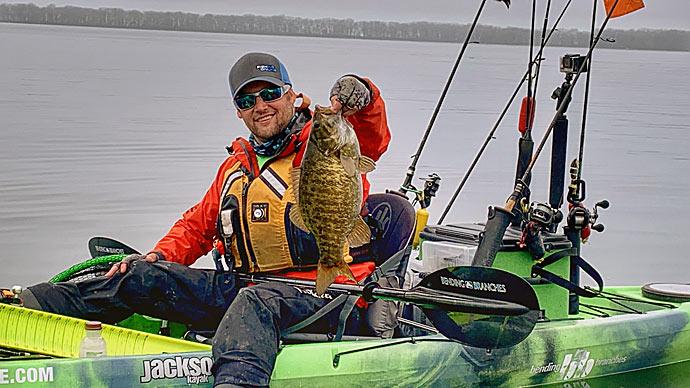


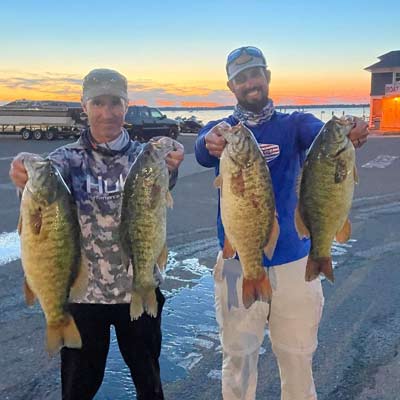
Destin DeMarion remembers a June day well. He and a couple of buddies were fishing in his home waters — Lake Erie — though closer to Buffalo, New York, than where he currently lives, Harborcreek, Pennsylvania. The trio set up shop offshore, and it seemed all the lake’s fabled smallmouth were swimming to them.
Catching those smallmouth, which weighed from 3 to 6 pounds, was straightforward. "We were dragging Ned rigs," said DeMarion, who fished two Bassmaster Elite Series seasons and operates Big Fat Bass Guide Service. "And we were catching multiple fish at a time."
Finding them was more complicated. They weren’t everywhere, and they didn’t stay in one spot long. But DeMarion said that’s to be expected during early summer. It’s a season of transition for smallmouth, and that makes it a season of adjustments for bass anglers. He said the key to catching more of them is understanding where they’re coming from, knowing where they're going, and mapping out how they’ll get there.
Time To Go
DeMarion uses water temperature to determine when early summer smallmouth fishing starts. He watches his electronics, waiting for it to warm to between 70 and 75 degrees. “That’s typically the last week of June or early July for [Lake Erie],” he said. By then, nearly all smallmouth are done spawning. It’s time for them to feed up, and they don’t wait around for their next meal.
DeMarion believes smallmouth have reasons beyond food to leave the shallows. Self-preservation is one. “The bigger females get out quicker,” he said. “A lot of them lay eggs, and there’s no point in sticking around. They don’t want to be exposed. They need a safe zone.” The more water over their heads, the more secure they feel.
Bass and baitfish are also seeking better conditions. As water warms, it holds less dissolved oxygen. So, they swim to deep water, which is often cooler and holds more dissolved oxygen. One exception is moving water, which often runs cooler than main-lake shallows, even if it lacks depth. That will keep smallmouth shallow, as is the case at Lake Erie’s extremes, where the Detroit and Niagara rivers flow.
On The Move
A smallmouth’s journey from shallow to deep isn’t always quick or direct. On reservoirs, they might wander along a creek channel or ledge. They might follow the edge of aquatic vegetation on a shallow natural lake such as New York’s Oneida. And on the Great Lakes, it could be something as subtle as a vein of exposed rock along the bottom or an almost undetectable depth change.
DeMarion believes many of Lake Erie’s smallmouth that spent the spring in and around Presque Isle Bay head straight off the peninsula or east toward New York, both deeper basins. He said bait dictates which direction they go. How far they travel has always been a question. They’re working on an answer in Ohio.
A study funded by Ohio Sea Grant placed transmitters in smallmouth — 60 in 2023 and 150 more the next year — that were released back into Lake Erie. Each transmitter emits a unique signal, which is picked up by any of the more than 400 strategically placed acoustic receivers when a study smallmouth swim by.
Data gathered in 2025 was mixed. While the majority of tagged smallmouth remained near where they were captured in Ohio's portion of Lake Erie, a few covered many miles. One swam to the lake's north shore and back within a week. One smallmouth swam up the Detroit River to Lake St. Clair — twice — covering more than 500 miles during 18 months. Researchers hope to gain further insights before the study concludes in 2027.
However far they go, smallmouth don’t make their entire move in one shot. They stop along the way, spending time on pieces of cover such as a pile of rocks or clump of aquatic vegetation. There, they ambush prey or wait out changing conditions. These are the places where DeMarion intercepts them.
Initially, only a few smallmouth bass vacate the shallow water. But more and more follow as the water continues to warm. DeMarion said they travel in small pods, which can be challenging to locate in large expanses of water. "Sometimes it can be kind of tough fishing, especially right after the spawn," he said. However, as conditions and their location stabilize, the bite improves.
How long these mid-depth spots produce varies. If it’s between summer haunts and a popular smallmouth spawning spot, such as Presque Isle Bay, then it’s likely to be regularly replenished over a more extended period. However, all these spots eventually stop producing as summer progresses.
Reaching Their Destinations
However an individual smallmouth decides to get there, or how far they travel, DeMarion said they usually end up in one of two places. A portion of the population are homebodies, so they settle on some type of structure. It might be chunk rock, a flat, break line, ledge, or hump. They're relatively easy to locate. The ones that take a bit more work to locate are nomadic, chasing baitfish through open water. They tend to relate to the thermocline — a layer of water where the temperature changes dramatically. He said it usually forms on Erie in late July when surface waters are warm enough for the lake to stratify.
DeMarion said the biggest smallmouth, which were the first to leave the shallows, are the first to settle into a summer pattern, regardless of the destination. Competitive anglers need to note that. “You want those fatter fish in tournaments,” he said.
Electronics play an important role whenever you're fishing offshore for bass. The various sonars and imaging systems help you locate schools of bass and identify spots where they congregate. The navigation function ensures you can easily return to them. The addition of forward-facing sonar has made them more helpful. DeMarion uses FFS to locate pods of smallmouth bass as they transition through their early summer period. And when he finds them, it’s time to catch them.
Match Your Tackle
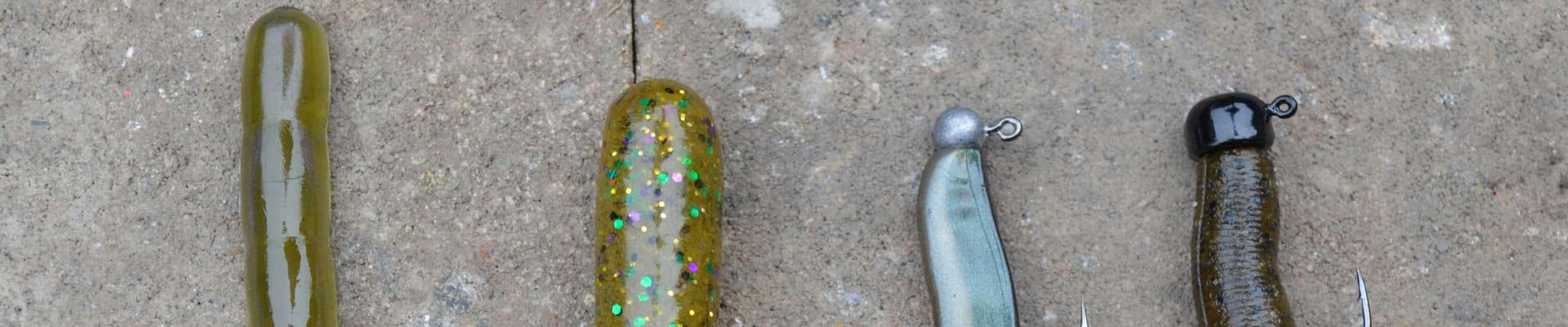
Subtle is the game’s name when choosing lures for early summer smallmouth. “It’s a lot of finesse stuff,” DeMarion said. “They’re in that neutral mood.” So, he often turns to drop shots and Ned rigs. He’ll use a Beast Coast Sniper football jig when he wants to show them a bigger profile.
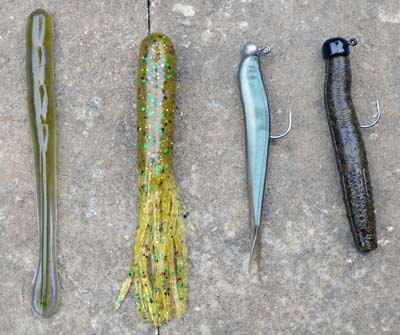
Tube baits were once the No. 1 choice for catching smallmouth, especially on the Great Lakes. DeMarion said while other finesse techniques have taken their place, a tube will still catch its fair share of smallmouth. The time-tested Erie drag — dropping your tube to the bottom, engaging your reel, and letting the wind push your boat and pull your bait along — remains an effective presentation, though he has added a finer point to it. Instead of covering large swaths of the bottom, he uses his electronics to line up shorter and more precise drifts across specific spots.
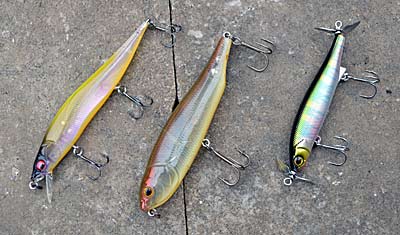
Early summer smallmouth aren't always bottom-oriented. When the barometer is rising, the sun is shining, the wind is calm, and the water is clear, they excel at using their eyes to hunt. “Sometimes you can call them up by fishing above them,” DeMarion said. Spybaits, and jig and minnows both work, he said. But so do light-weight marabou jigs, which are fished on a slow and steady retrieve. Small jerkbaits and topwaters can work, too, especially where the current pushes smallmouth into shallow water.
The point of downsizing to finesse lures is to offer bass something that requires little effort to eat and looks and acts naturally. "They might not eat it if it doesn't look perfect," DeMarion said. So, he ties his to light-weight braided line, usually 6-pound test with a matching fluorocarbon leader, to ensure that it does. “A lot of that has to do with the line being thin and super limp,” he said. It has little water resistance, allowing smaller lures to run deeper with less weight, and its pliability offers freedom of movement, something that’s snuffed out by thicker lines.
DeMarion is particular about his hook, too, whether it has one or three points. It needs to be made from light to medium wire, walking a fine line between thin enough to set easily and thick enough not to bend when a giant smallmouth runs, dives, or jumps. “The main thing is I want to get that hook in the fish,” he said. “If not, it’s going to throw it, especially if it’s something heavier like a tube.”
DeMarion does two more things to ensure solid hookups. First, he snugs down his reel's drag. He wants zero slip when he snaps back his rod. If it's instantly clear that he's tangled with an extra feisty smallmouth, he'll quickly back off his drag a bit, preventing the line from breaking or hook pulling free. "That's not for all anglers,” he said. “But I prefer not to back reel.”
The right rod completes DeMarion’s smallmouth-hooking package. One that measures 7 feet and 6 inches and sports a fast action will generate plenty of casting distance, even with the lightest lure. A medium-light power has just enough backbone to set small hooks while protecting light-weight line. He prefers a medium-power rod when fishing drop shots. Its extra bit of backbone helps him set the hook from further away, a common situation in clear water, where smallmouth are often found year-round.