

We all have our favorite lakes that we fish all the time and know dozens of secret honey holes. Most of these sweet spots took lots of scouting to find, a luxury you don't have on a new lake. Following are my top five spots to help you find bass quickly the next time you're on a new lake trying to find a few fish, or if you're in a tournament and need one or two more keepers to fill your limit.
#5: Channel Banks
A channel bank is where a creek or river channel swings close to the shore in a cove or the main lake. Sheer bluff banks are often visible in these areas, a dead giveaway of channel banks on many lakes. Channel banks aren't as prominent in other situations, but they are easily found by looking at a good topo map. With quick access to deep and shallow water, channel banks are a favorite of bass, especially in the cold months of the year. Many bluffs go on for a long way, so key on the sections where the channel approaches the bank and also where it leaves. These transition zones are often the hot spots, including any pockets or rockslides along the bluff. All manner of baits produce in these areas, from spinnerbaits and jerkbaits to swimming finesse jigs and Rage Bugs. Parallel to the bank, work quickly until you get a bit, and then work the area with multiple baits for additional fish.
#4: Rip Rap
This manmade cover adorns most lakes, and its intricate maze of gaps and holes is a nearly year-round sanctuary for many of the things bass love to eat, including crawfish, bluegill, and baitfish. Riprap is easy to find and easy to fish as well. Medium running crankbaits in crawfish and shad color schemes quickly pick off active fish, while a one-eighth-ounce football jig with a green pumpkin Ragetail Menace rigged shaky style will clean up the more stubborn bass.
#3: Docks
Especially in areas of a lake lacking wood or grass cover, bass hang out around boat docks almost all the time, even spawning near them. Most anglers pick around the edges of docks and make effortless casts, leaving fish in the interior available to the more persistent angler. Skip or pitch a 3/8-ounce finesse jig with a matching Ragetail Baby RageCraw trailer or a tube bait on a 1/8th-ounce tube jig into the hardest-to-reach areas of the dock, making repeated casts to critical areas. Probe the bottom under and around docks for brush piles, as these hidden jewels can produce a quick limit of lunkers. If the fishing is extremely tough, downsize to a spinning rod with 4" green pumpkin Senko rigged on a weedless wacky jighead. The slow flapping fall of the worm entices strikes from inactive fish, and the smaller size entices bites from even the most reluctant bass.
#2: Points
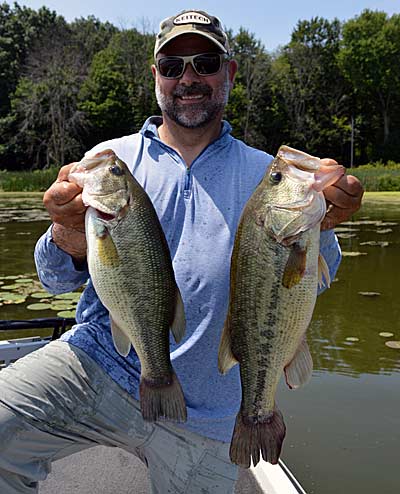
Fishing extended sections of shallow water jutting out into deep water, or "points," is not only one of the most basic bass fishing patterns, but it is often also the most productive pattern on any given day. Of course, not all points are created equal. Points can be barren or have grass, timber, or rock. Some points are located out in the main lake, while others are located at the mouths of coves or in the back of creeks. Figuring out which points are best is always the trick, but running various windy points is a great place to start your search. Try spinnerbaits and lipless crankbaits on shallow portions of points, switching to deep diving cranks and Carolina-rigged Rage Hawg on the end. Once you get bit, find more similar points, and you'll often be able to put a pattern together quickly.
#1: Isolated Cover
Barren stretches of the lake, devoid of cover, might not have a lot of fish in them, but you can bet your bottom dollar that the ones living in the area will all relate to anything there. This so-called "isolated cover" - a lone laydown, a single clump of weeds, a solitary boat dock or rock pile, or even a few pieces of junk in the water like a toilet, washing machine, or old tires - is a proverbial oasis in the desert for bass. I like to quickly fish isolated cover from a distance with a spinnerbait or crankbait to catch the active fish. After that, it is time to settle in and start working the area over with repeated pitches of a Texas-rigged Rage Bug or Senko. Believe it or not, a tiny piece of isolated cover can produce multiple fish, often after the thirtieth, fortieth, or even fiftieth cast to it. Also, don't just fish productive areas once. Come back a little later, and you'll likely find a few more fish using the same cover piece.
The next time you're in a pinch trying to find a few biting bass, give these locations a try.