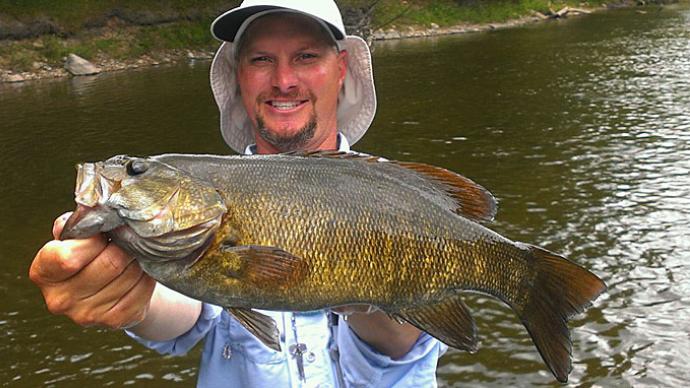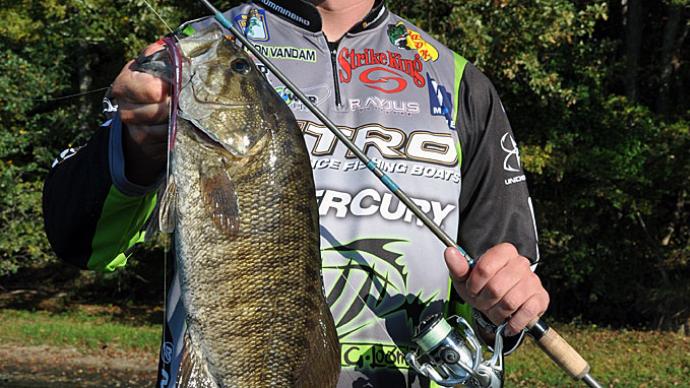


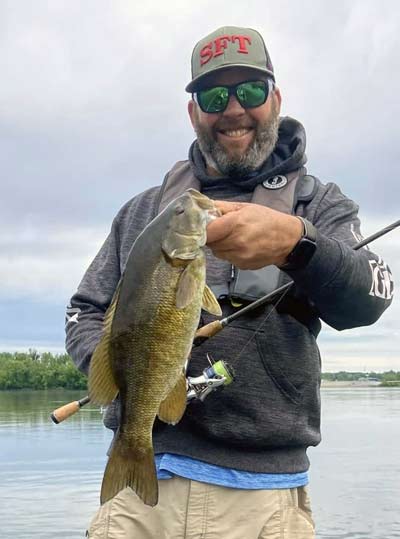
The Susquehanna is the East’s longest river, stretching almost 450 miles from its headwaters, about a deep fly ball from the National Baseball Hall of Fame and Museum in Cooperstown, New York, to its mouth at the Chesapeake Bay near Havre de Grace, Maryland. While muskies, walleye and catfish attract anglers along its length, smallmouth receive the most attention. That includes the Acord family.
For more than 35 years, Mike Acord, along with his brother and father, have operated Susquehanna Fishing Tackle. Bass fishing is their avocation and advocation. Skills learned from their father helped propel the sons to success, including Acord's pair of top-five finishes as a co-angler, which included a win during the early years of the Bassmaster Elite Series, and his brother’s two qualifications for the Bassmaster Classic through the B.A.S.S. Nation. Add plenty of fun fishing, competing in local tournaments, and offering guided trips. All are intimately familiar with the Susquehanna River, which flows not far from their shop in Columbia, Pennsylvania, where you can find the hottest tackle and the latest information on the local smallmouth bite.
Acord said the smallmouth that swim the stretch of the Susquehanna local to him are usually through the post-spawn period by early July. Then some cool stuff starts happening. “It can be really complex, too,” he said.
Some smallmouth spend the summer within eyesight of where they spawned, especially if current and baitfish are nearby. “They roll out in the middle of the river and stay there,” Acord said. Then, there's a traveling population that pursues baitfish. He’s found some that moved several miles. “It’s a lot further than I ever thought,” he said. Either way, he most often finds them in three situations and relies on an equal number of ways to catch them. They’re spots and techniques that can be found and applied anywhere smallmouth swim in moving water.
Focus On The Flats
The Susquehanna offers a variety of fishing situations, but the best options for summer are a small subset. “We fish two kinds of water,” Acord said. The first is shallow flats. These sandbars are from a couple hundred yards to a half-mile long and no more than a couple feet deep. "These big smallmouths love to roam on those flats," he said. "They're something not a lot of people fish."
Smallmouth aren’t everywhere on these flats. Acord lets his jet boat slowly drift across them, aiming his casts at the pieces of cover and structure that he comes across. Eel grass patches are one of the best targets. He said smallmouth run their edges, ambushing any of the resident baitfish or crawfish that slip from their safety. smallmouth hang in ditches, which may be only 6 or 8 inches deeper, too, to escape the current. He also watches for small depressions, which reveal themselves with a water-color change.
Acord said shallow flats usually fish best in the mornings and evenings when boat traffic is lightest. But you can catch on them anytime — even behind other anglers — if you take your time. “If you know an area has a lot of fish in shallow water, Power Pole down and sit there,” he said. “Let the fish calm down and relax.” Once the noises associated with your arrival dissipate and the bass become accustomed to feeling the water displaced by your boat, they’ll feed again. “You don’t have to do it all the time,” he said. “But it’s especially good when fish are pressured, or the river is low and clear.”
Stop On Current Breaks
Summer smallmouth are found in faster-moving water, too. Drive across any bridge that crosses the Susquehanna, especially between Interstate 81 in Harrisburg and Route 30, not far from the Acords’ store, and you’ll see countless ledges. These drops are clean rock, any sediment or gravel washed away by current. And while a change in current reveals each one’s location, Acord said the ones with the deepest water behind them are the best.

Smallmouth hold behind ledges, escaping current, conserving energy, and waiting for food to be delivered to them. They usually don’t stray from them, so boat control is crucial to catching them. Acord holds his boat on top of the ledge and pitches his baits to the side, working them parallel to the structure. He moves back and forth across each ledge, searching for smallmouth.
Any object, from a rock to a bridge abutment, can form a downstream eddy. And most also create what Acord calls a “push.” As current approaches the object, it must flow left, right, or over. That movement creates some slack water upstream of the object. Smallmouth will wait there, getting the first shot at food. “I’ve caught some of my biggest fish on the front side,” he said. "When you get on a really good push pattern, it can be outstanding because this river has a lot of bridges."
‘Follow The Water’
Rivers are dynamic. Events, such as a heavy rain, can affect water conditions miles away. “That’s what I love about river fishing,” Acord said. “It’s never the same.” Therefore, it’s essential to monitor conditions, even during the summer. "You have to follow the water," he said.
Acord said smallmouth become comfortable, spreading out across multiple spots during periods of normal turbidity, level, and current. But as each increases, smallmouth relocate and congregate. Some find protection behind islands. Others head to the bank, where points and other small pieces of structure slow current, causing sediment to participate out and clarity to slightly increase.
Many smallmouth head toward tributaries. While the main river continues to run muddy, Acord said tributary water will clear. Smallmouth will hold in the mouth or along the bank just downstream of the tributary. He said the longer the main river stays muddy, the further up a tributary smallmouth swim.
Acord said smallmouth will remain in these spots until they sense the main river beginning to return to normal. At that point, most of them spread out across different locations. That can make them a challenge to locate.
Fish These Baits
River smallmouth have a varied diet, eating almost anything that the current brings to them. But Acord focuses on two offerings. “Our section of the river is loaded with crawfish,” he said. "But certain times of the year, baitfish become the deal. They just get on a baitfish pattern." That happens in spring before the water warms enough to make crawfish active and in fall when shad are on the move.
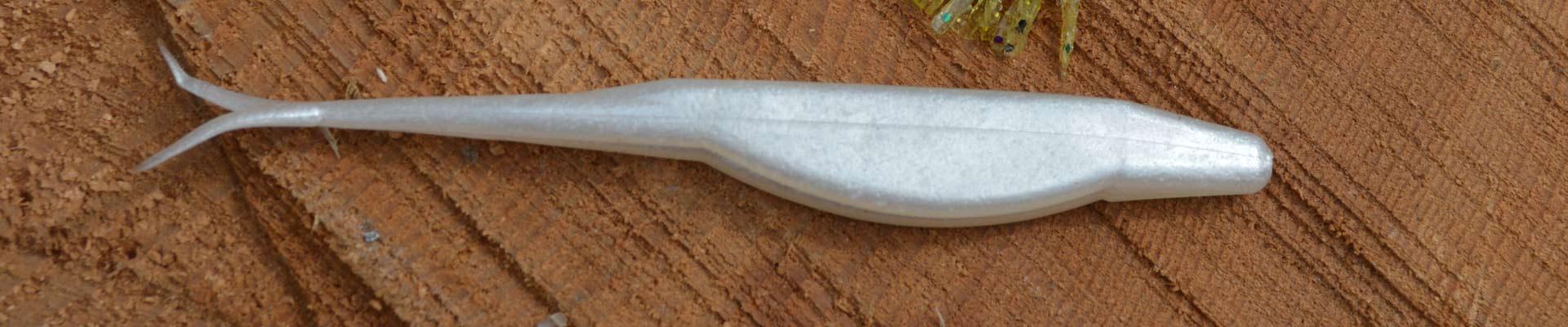
Summer offers river smallmouth a mixed bag of crawfish and baitfish. Acord matches his tackle to both, and his No. 1 choice is a Zoom Super Fluke. “I love that thing,” he said. Measuring 5 ¼ inches long, its forked tail and deep belly create a dipping and diving action, a dead ringer for a baitfish.
Acord uses a White Pearl Super Fluke about 85% of the time, choosing Bubble Gum or a baitfish pattern the remainder of the time. He Texas rigs it, using a 3/0 or 4/0 EWG-style hook by Gamakatsu, BKK, or Hayabusa. He ties it to a 12-foot-long leader of 8-pound test fluorocarbon line, which is attached to his mainline — 10- to 15-pound test braided line — with a Crazy Alberto knot. That, along with a spinning rod, generates long casts.
The extra-long leader is vital for one reason. Fluorocarbon sinks, breaking the water's surface tension and pulling down Acord’s lightweight offering, making it relatively easy to work several feet deep. That means he doesn’t have to add weight to his Super Fluke, whether with nail weights or a weighted hook. And that’s important.
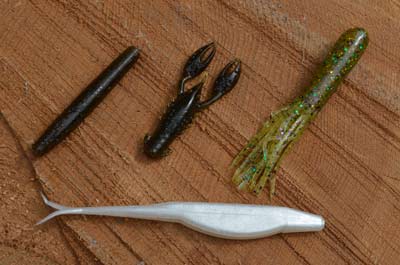
Current isn't unidirectional. Instead, portions are redirected by even the smallest rock or stick. Those random micro-movements bat about baitfish and crawfish as they make their way forward. A weightless Super Fluke is affected in the same way, making it look more realistic. Added weight kills that extra action. “If it looks natural, they’re more likely to eat it,” he said. "That's why I fish my jerkbaits with a lot of slack lines."
Acord’s second choice is a topwater. “We’re huge topwater fans,” he said. “We fish them as soon as we can until it’s too cold for them to work.” He’ll tie on a Don Iovino Splash-It popper or River2Sea Whopper Plopper in the 90 or 110 size. And he always has Reaction Innovations Vixen and Heddon Zara Spook walking baits at the ready.
Acord doesn't spend much time contemplating the color of his topwater. Bone, white, minnow — they all produce. “I don’t think it makes a difference,” he said. “[Smallmouth are] after the profile, action, and sound.” He is particular about his line. He ties 50-pound test braid straight to his bait. Its lack of stretch makes working his lure easier and setting hooks surer. On the rare days when bass are feeling a tremendous amount of fishing pressure, he’ll switch to monofilament line, either 12- or 14-pound test.
When conditions or the smallmouth tell Acord that moving baits aren’t the deal, he fishes the bottom. He starts with a 2.5-inch Right Bite tube in either Green Pumpkin or Green Pumpkin Purple Flake. If the water is stained or muddy, he’ll dye its tails chartreuse. And he always uses an SFT Tackle Big Hook weedless tube jig head, which features a 3/0 hook.
Beyond a tube, Acord fishes Ned rigs outfitted with appropriately sized Z-Man soft-plastic lures. He said their buoyancy helps take advantage of those micro-currents. He will also rig a 4-inch Keitech Swing Impact — Bluegill Flash, Silver Flash, or Green Pumpkin — on an SFTtackle Big Hook ball head and work it along the bottom, too.
Acord’s jig box has 40 or 50 compartments. Each holds a different style or weight of jig. That extensive inventory is vital. It allows him to match his soft-plastic offering to current conditions. When he’s fishing a rocky ledge, for example, his jig needs to fall vertically, directly into its eddy. That can require one that weighs 3/8 ounce to overcome 3 to 5 feet of water swirling with current. Its relatively hefty weight makes it susceptible to snags, so he shortens his casts and adds hops to his retrieve. And while the calmer water of shallow flats requires a lighter jig, the goal remains the same. “You have to be on the bottom,” he said. “But it’s a fine line between being on the bottom and getting hung up all the time.”