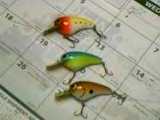
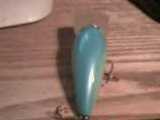
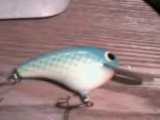
Chris
Members
-
Joined
-
Last visited
Everything posted by Chris
-
The Pond Shiner I made this bait so that the body is curved almost like it is warped and I tapered one side of the head and tail and stuck a place to tie to it on the side. The bait sits in the water like a normal plug but when you pull it the tapered head acts like a crankbait lip and fights against the pull and moves the bait sideways. The idea is that you can make a cast in a farm pond and work the bait all the way around the pond from one spot fishing the edge.
-
I just finished a shad rap looking bait, and now im stumped. How do i get the line tie on the bill? Plan A-You can drill a small hole in the bill and take a wire and bend it in a U shape and put both ends into the hole then twist the wire on the back side of the bill and bend it at a 90 degree then drill a small slot in the center of the bill slot dip it in epoxy then insert the bill and wire into the slot. Plan B-take an eye screw and screw it into the bill and take some epoxy and dab some on the back side to prevent the eye screw from backing out. Plan C- same as A but bend the wire in a U shape put it through the lip and bend both ends of the U wire at a 90 degree so that one wire is overlapping the other and dip the wire and bill in epoxy and push the wire into the bait and the bill into the slot. Plan A is the easiest to do. Also was wondering if I can weight a wooden bait. Yep you can buy a belly weight or make your own or just drill a hole in the body of the bait and stick in a weight and epoxy over it. If your just drilling and sticking a weight in the bait put it in just forward of the front hook and make sure it is center this will set the crankbait slightly nose down. For other lures like topwater or jerkbaits where you put the weight depends on how the bait will sit at rest. how do you get the concave right on the mouth of a popper Drill it, carve the bait body then lay it flat and with a large drill drill the mouth then finish it off with sand paper.
-
Bass are cold blooded and know that when the water temp cools off the metabolism slows down and when the water heats up they need to eat more because their metabolism is high. They know that when it is hot some areas have less oxygen and temps are not to their liking. Bass know that when the food is gone go find them. Bass have a comfort zone that they like and one that they don't. If you have a warm trend and the bass move up thinking that it will be a mild winter it is because the temperature has become more tolerable and the bait has moved up. If you have a long span of warm weather and warm water temp bass will move up early and spawn early.
-
It restricts the forward movement of the bait and kicks up more water. It also looks cool and has a cool sound on the water and it works.
-
-
Here is the other end of that block.
-
I have not fished with it yet but it was tested in a sink, it sits the way I want it to the bait weighs close to a 1/2 oz so it should cast good.
-
With the tail finished off the bait body measures 3 5/8"
-
-
If you scroll down on the site there is a place to order. It is a cool bait the trailer is made out of a foam material. The company has been out for awhile it isn't a well known company but..I knew about it ;D It's good stuff!
-
I catch them on crankbaits all the time. Chartreuse Rapala minnow is a good bait and also a CC shad. In streams and rivers we caught them on Panther Martins, spoons, and Rooster tails.
-
I use excel mono green BPS line 10-14 for most of my cranking. I use fluorocarbon sometimes for deep cranking or if I want to get a foot or two deeper with a bait. I personally don't like to use braid for cranking. I like to use stretch to my advantage if I get hung up. It tends to help get the bait free when you pop it (bow and arrow technique). Sometimes I use the buoyancy of the mono to reduce the depth of a bait. I do use braid for rattletraps around heavy weeds. Favorite rod length would be 6'6" but if I am deep cranking I use a 7' rod. I use three different kinds of rods to do different things. I have a composite that I use for general purpose. I have a glass rod that I use for shallow cranking and short distance casting around objects. I have a graphite rod that I use for deep cranking.
-
Nothing beats this check this one out guys. www.soslo.com/
-
Whats your favorite material made for a crankbait? Balsa,Cedar,jelutong,foam, stainless steel, or other? It depends what I want out of a bait. Cedar is a good material to use if you want a slow riser or suspending crankbaits. The material is great for deep cranking but it has less action in compared to basswood or balsa. The material is less responsive. The stuff that Lee uses (jelutong) is more responsive than cedar it is harder than balsa and is a happy medium. The problem with Lee Sisson's lures or at least my complaint is the hardware he uses. He uses an eye screw that is to large and makes it harder to tune and I feel that it takes away from the action or potential action that it could have. Poplar, and basswood are other good materials to make crankbaits out of. What's your favorite material made for a crankbait? Balsa, poplar would be a close second. I don't own any stainless steel or foam crankbaits.
-
I also change hooks to add weight to a bait for casting distance or if I want the bait to suspend more or slowly rise.
-
Color selection for crankbaits? For this up coming spring crawfish color will produce, is there any unusual color that might work for a highly pressured area. Early in the year I use crawfish-looks like a crawfish or bluegill, khaki-looks like off colored shad or albino, splatterback black-looks like a crappie, olive back chartreuse belly-shows up well in off colored water. Does the a snap or swivel work better then a split ring when tying your fishing line to the crankbait? Does the rapala knot work better then tying your line to a split ring? I use an oval split ring any tips on Modifying crankbaits? increase in hook size, or change in color,ect? I use sharpie markers, spike-it dye, to add color or just repaint them. I change hooks to round bend in open water or when the fish are just slapping at the bait and triple grip hooks for cover. I increase the back hook if I need more weight to cast a light bait or to change the vibration or signature of the bait. I change to larger hooks if the hooks stink on a bait or they don't cover the bait like I want. I also change hooks if the hook gaps are small that come with the bait. I change the front hook sometimes to short shank hooks if the front hook tends to hang on stuff.
-
I plan to make the most out of my crankbaits Learn the personality of each bait. Figure out what action it has and what depth. Figure out how long or how long of a cast it takes for the bait to reach a known depth. Figure out which baits are better in cover than others and how each bill reacts to cover. This is how you make the most out of a crankbait. anyone have a special technique or method? I'll give you four straight retrieve in cold water, stained to muddy water and around cover. CS 4x4 by JM-Woodcraft would be a good choice for this application. That particular bait has a body and bill design that will get through cover clean. Erratic retrieve in open water, clear water, hot water. It is like a stop and go but in high gear. It works best with wood baits. reel reel reel pause for a split second reel reel pause reel pause reel reel reel pause and so on. You hesitate the bait for just a second and with a 5 to 1 reel your not burning the bait that fast. Speed reel with a 6 to 1 reel works in spring, summer in clear water. Slow roll this works best with a balsa bait in cold water or when the bass are sluggish. Because balsa is light and floats well it doesn't take much movement or speed to give it a lot of action. Most baits if you slow down way down loose action balsa doesn't work that way. *The erratic, speed, and slow roll retrieve I would suggest the tapered tail version of the CS 4x4. The bait is named after me "Chris's Special" myself and Whittler put a lot of time into that series over a year in development. Check out the tacklemaking section it shows the bait.
-
Looks kinda like a surf board ;D An old plug maker made me a lure like this over 20 years ago and covered it with a real frog skin. The bait was made out of ceder just like I made this one. I caught a ton of fish on it till I lost it to a big fish and I didn't have the heart to tell the guy that I lost the lure because I knew the time he put in to make it for me. Whatcha think?
-
The bait has a curved up nose and will have a prop and dressed treble hook with feathers on the tail.
-
It is modeled after a Heddon S.O.S. plug. Hand carved with a pocket knife and sand paper bait measures 3" long.
-
How old? Who made the lure? What are they made of? wood, plastic? What condition are they in? The older the lure the more value. Some companies made only a hand full of lures. Wood baits have more value than plastic but some plastic lures because they where unique or only a few where made can hold value. The condition of plastic lures and wood depends on how much the lure is worth. You can find a list of books online. *On average most lures can range between $10-$50 a unique lure can be up there in price. If the lure is in bad condition it will be less than 10 bucks. Collectable lures like frogs, Jim Pfeffer, wood crazycrawler, and wood jitterbug can be worth quite a bit if in good condition. Vintage lures that where made in 70's and 80's it just depends on the lure and how much someone wants it.
-
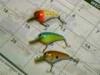
The clown is a 4x4 round the other two are tapered tails.
-
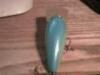
If you notice the tapered tail style is not quite fat and not quite thin. The lure is just fat enough to still give good coverage of the hook while the flat side pushes a lot of water. Notice how the lip is the same width at the base as the body...it helps cover the hook better. This style pictured has two kick out points on the edge of the lip and a simi rounded front of the lip. It helps the bait work its way around objects. The bait will strike a kick out point and shoot the bait away from the object. The pull point has an oval split ring that helps keep the bait tracking straight and not get hung up on the split part. The hooks are spaced apart enough so that they don't get tangled into each other. The belly hook is set so that when the lure is running at the running angle the hook is covered by the bill and body of the bait. The 4x4 is more round and can be fished in the places that most use a spinnerbait without worry of loosing it. (It is very hard to hang up) The round bait has the same action just a little different body style.
-
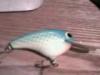
Here is the other style that is also great for light to moderate cover. Same bait with a tapered tail. With a lot of crankbaits the lip is not wide enough to cover the hook or have enough deflective qualities to keep it from hanging up this bait fixes that problem. This bait is weighted so that you can make a very accurate cast next to an object. This bait will not catch air and flap in the breeze. Most balsa baits are hard to cast in moderate wind this bait isn't. If you use 10-14 line this bait will cast a mile. The bait has great vibration and it tends to shift like a struggling shad in a heavy current. This is important because it mimics a shad or other live bait. The lure also searches which gives you a bait that has random movement right and left. The bait is very responsive reacts to cover extremely well. If there was ever a bait that was designed to catch fish like mad and perform beyond most baits this is it. There is no other bait I have ever owned that has the action of this bait period it is Pro quality in every aspect.
-
A guy who was a scientist, came up with the material and sent it in to the patent office and found out that it was already patented. He then asked the person who owned the patent if he could use the material for a different application. After they agreed he sold his idea for the application to two companies strike king and terminator. The original application for the material was for kids toys that you get in a gum ball machine. One of the toys was a hand with an arm that when you swing it the arm whipped out and the hand would stick to things. They also had a spider that you could stick to a mirror and it would climb down the surface.