Mswen
Members
-
Joined
-
Last visited
Everything posted by Mswen
-
Thanks, that was really helpful. A couple pages back is a link to a Japanese company, Rosso Corsa, that makes a lure called the Vodka, where the lip can be popped out and turned around. One side is flat, the other is slightly rounded. It's an interesting concept, but the lure is $20, and I need some reassurance that the lip won't fall out after 3 fish.
-
What about modifying a bait to make it either wake, or wake better? You know how people will scrape part of the lip off on poppers to make them skitter more? I was wondering if it would be possible to cut or file down the lip on a wake bait or shallow diver to change the action, and make it run shallower? But before I go and ruin a crankbait, even a cheap one, I wanted to see if anyone else has tried anything like this, and what the results were? I have a crankbait that I'm willing to sacrifice that has one of the "L" or "stair-step style" lips (if anyone knows a better name, let me know) like on the shallow shad rap, and the super shad rap. I was thinking that might work better than a regular straight lip, if I just filed off the horizontal part, and then shaped it until I got the correct action. Thoughts? Also, this may be smaller than you want, but Rebel makes a Teeny Wake-R that is 1 1/2" and 5/32 oz. I haven't used it, but I've caught a lot of fish on the Teeny Crank, including some pretty nice bass, especially in the brown and white color.
-
The jitterbug is still a great lure. But I consider that a topwater. From what I understand, a true "wake bait" should run just under the surface, causing a bulge and leaving a V, or wake. For my purposes, a super shallow crankbait will do, because I often fish very shallow flats that are thick with moss. If you go too deep, you get moss. Plastics may work, or they may gather moss, cover less water, and get pecked apart by bluegills. I use a jitterbug a lot in these situations, but if the fish aren't willing to hit topwater, options are limited.
-
Where can I get one of those? If you click around, there is also also a micro version (8.5g- 45 mm), and some of their other lures look pretty cool too. A word of warning though, they have this cheesy R&B song -"Hate How Much I Love You" as the soundtrack to most of the videos.
-
I just got on here to ask this same question. I need a few wake baits. Has anyone tried a Bass Pro crank called 'The Egg?' It's a fat, strange looking bait that seems like it might just work. Out of 92 customer reviews, only 2 gave it less than 4 stars (out of 5). There are two sizes, the smaller might fit the 'small' category at 2", but a bit heavy at 7/16 oz., while the 2 1/2", 3/4 oz. version probably doesn't. One of the appeals for me is that it seems large enough to keep panfish away. I don't mind crappies or large bluegills, but at some of the lakes I fish, the smaller bream pecking can be a constant irritation.
-
Try Bog Baits. They make just what you're looking for. Lifelike, full-bodied snakes and frogs in floating and slow sinking versions in a range of colors and styles. You can choose silent or "rattle-" snakes and from a variety of tail styles like straight, sickle, paddle, ribbon, etc. I'm not sure if they have a 20" snake, but I know they have several over a foot, including a 16" & a 17.5". eBay or BogBaits.com
-
I actually had a similar problem. But it was almost the opposite. When I was really young the only things I used were live bait and crankbaits. I tried jigs, spoons, and spinners, but I was fishing from shore and as soon as they got snagged, they were gone. I couldn't even keep sinking crankbaits very long. I've improved on all fronts, though on some (jigs) I still need work. Like others have pointed out, soft plastics is a good category to have mastered. As for others, only taking the baits you want to learn to use is a good suggestion. Here are a few suggestions that I tried. Let me know if they are helpful Think about the similarities between what you know (soft plastics) and what you're trying to learn. If you have success with soft jerkbaits, try a hard jerkbait in the same situation. Use squarebills or spinnerbaits to explore the same brush where you might use a texas rig. Mid or Deep diving crankbaits are good for exploring deep structure where you might also use a Carolina rig. It helps to build some confidence in your lures and tactics. When I want to try something new, I got to a farm pond or to one lake in particular that is overflowing with 16" bass. If a lure won't catch fish there, then it's probably not worth keeping it in my tackle box. Just knowing that a lure has caught fish can make a difference when you're out on the lake. Some of my "go to" confidence baits are Bandit 100 & 200s (300s to a lesser extent), and Berkley Flicker Shads, mainly because these two lures seem to catch just about anything that swims. You can also add soft plastic trailers to spinnerbaits, buzzbaits, jigs, and chatterbaits if that helps. Think about what you may be doing differently because you are used to fishing with plastics. For instance, part of my problem with jigs and spoons is that I forget to pay attention to things like sink rate and to watch my line, and often by the time I am aware of a strike, the fish has spit the lure out, or I miss it altogether. With hard baits you should change direction, add pauses and change speed. A sudden sweep of the rod, a few fast cranks, or a series of twitches, followed by a pause, can often trigger a strike. Remember that you don't want the fish to inspect the lure, you want them to grab it while they can.
-
I read somewhere that fish can hear a popper from as far as 30 feet away. So it's no surprise that topwaters work in open water. And right around dusk, fish come up to feed on insects. When I decide to take a few fish home, I always open the stomachs to see what they've been eating. At certain times of the year I've seen bass as big as 18" (about the largest I keep) that are full of nothing but dragonflies. These fish were always caught on topwaters. If the bass aren't there for the insects themselves, then they come to feed on smaller fish that are after insects or zooplankton. I wonder if they think the popper sounds like feeding baitfish? And if it turns out to be an "injured minnow", even better (until they feel the hook!). That would be ironic, you cast toward what you think is a bass, bass comes for what sounds like a shiner or bluegill feeding on insects, the bass gets caught, and the carp just keeps on jumping.
-
The Hula Popper is one of my favorite topwaters. But the first thing you have to do is break out of the "cast, let the ripples subside, twitch, let the ripples subside, twitch, let the ripples subside..." and "slow down if you don't catch anything" mentality. Vary the speed and force of the twitches. And I would recommend twitching it as soon as it hits the water. Like most predators, bass expect prey to try and escape when they see a predator approach. I suspect this is why they are bumping it, they are investigating (or it could be bluegills pecking, but they seem to bother HPs less than other topwaters). A few quick twitches might turn that into a strike. When I'm using a topwater, I usually give it about 4-6 light twitches as soon as it hits the water, and then a long pause, like some prey trying desperately to get away, but having a hard time, or a little disoriented. About 80% of my strikes come on that first pause. If nothing hits, or if you get a strike that doesn't hook up, continue this pattern all the way back, varying the length of pauses, and the number, speed, and the force of twitches. You can do everything from light taps that barely cause ripples to hard jerks that spray water and pull the lure under. A typical twitch, though, should spit just a little bit of water and rock the lure forward without it going under. Basically, just keep trying things until you find something that works. The old philosophy was that you didn't want to spook the fish. But if that was a problem, why do people catch so many fish on buzzbaits, Super Spooks, rattlebaits, etc. It's like your dog. When a cat doesn't react to their presence, they show little interest (ok, some dogs). When a cat stands his ground and hisses, they might bark, but they usually lose interest soon. But when it runs? They chase. If you fish the HP too slow, the fish lose interest. You might try some shorter, targeted casts, that way you can watch the action more and get a better idea of how it works. I've caught a lot of fish by tossing it under overhanging trees and close to shorelines, basically anywhere you find frogs, insects, or other prey landing in the water. I've even flipped/pitched them to weed pockets and brush piles or under trees where I didn't want to risk a cast. A couple of twitches in hard to reach spots can produce some nice fish. And you can toss it above dense brush without worrying that it will drop into a snag like you do with a jig. As for changing the hooks, it can't hurt, but I've caught plenty of fish on the factory hooks. One thing you should know however, because of their compact size, Hula Poppers are one of the easier lures for bass to throw. Keep that in mind when you finally do hook one. I've rambled on quite a bit, and even came back to add more, but Hula Poppers are a great lure and surprisingly versatile if you're willing to try a few things. I've found that shorter, compact topwaters, like the HP, Jitterbug, and Frog-R seem to draw fewer swipes and pecks, and more actual hookups, at least for me. The main things to take away are to vary your tactics, observe the lure so you know how it works, and think about how a fish perceives it.
-
First of all, I fixed the problem. The blades hadn't been bent far enough back, which I solved with 2 pairs of pliers. I used them yesterday, and while i didn't catch anything, I could feel the difference immediately. It didn't take so much effort just to pull them through the water, and I could vary the speed of the retrieve more. Second, These are musky sized chatterbaits, I came here because I couldn't find much about this type of lure on musky sites. I'm using 50 lb braid, 60 lb leader, and rod/reel to match, so gear is definitely not the problem. I would love to catch the few bass that could completely inhale these, with a 7/0 hook and 5 1/2- 6 in. swimbait trailer, but for most of the ones that do hit, that's a bit much. I'm targeting muskies, but end up catching bass too, hopefully some of the bigger ones, but a 12" largemouth will hit just about anything, apparently. I was mainly wondering about modifications to the blade, without downsizing it. Now that they're working right, I may drill one just to see if it makes any difference, or I may move on to other projects.
-
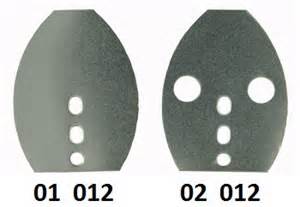
Actually, If I could get a good hookset, I'm ok with the blade size. I'm wondering about bubble style blades and whether they would make much of a difference. like the one on the right here.
-
I have 5 large, 3/4 oz. custom chatterbait style jigs that I use on a local lake which is known for large bass and also stocked with musky. Unfortunately they they have a large blade which makes getting good hooksets difficult. I have seen bubble style blades, and I was wondering if I were to drill a couple of holes in the blades, would it allow for better hooksets? How else might it affect it? Would it allow for faster retrieves?